30-Minute Workout at Home: Full-Body Plan for Busy Days (2026)
A no-equipment 30-minute workout at home: warm-up, 20-minute full-body circuit and cool-down, with three levels, a weekly plan, progression and safety tips.


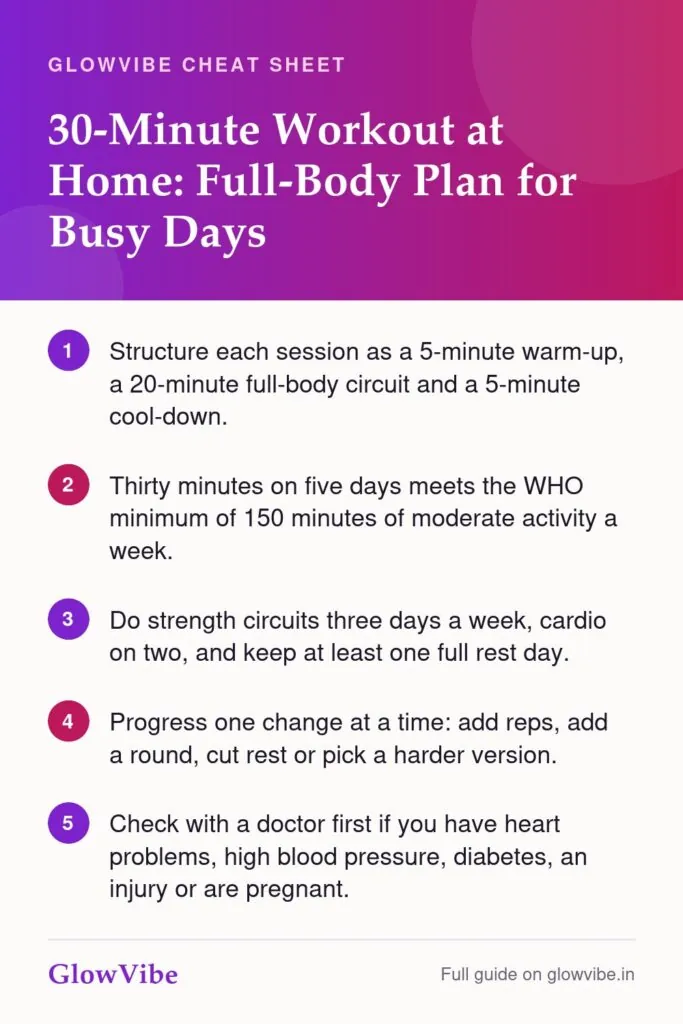
A 30-minute workout at home is enough to build real fitness if you do it most days and mix strength work with cardio. Use a simple structure of 5 minutes warm-up, 20 minutes of a full-body circuit and 5 minutes cool-down, and you need no equipment, no gym membership and very little floor space.
This guide gives you three ready-made circuits (beginner, intermediate and low-impact), a weekly plan, a way to progress, and practical tips for fitting exercise around Indian work hours, heat and meal times. Pick the circuit that matches your level and start this week.
Why a 30-Minute Workout Is Enough
The World Health Organization (WHO) recommends that adults get 150 to 300 minutes of moderate-intensity activity a week (or 75 to 150 minutes of vigorous activity), plus muscle-strengthening activity on at least 2 days a week. Thirty minutes, five days a week, gets you to 150 minutes. That is the whole point: you do not need hour-long sessions to meet the guideline.
Short sessions also have a practical advantage. A plan you can finish before the office cab arrives is a plan you will actually follow. Consistency over months matters far more than one heroic Sunday workout.
What 30 minutes can realistically do for you:
- Improve stamina, so stairs and long walks feel easier
- Build strength in your legs, core, back and arms using your body weight
- Support better sleep, mood and energy through the day
- Help with weight management when paired with sensible eating
Results depend on your starting point, sleep, diet, age and health, so nobody can promise a fixed number of kilos or inches. What you can count on is steady improvement if you keep showing up. For more on the bigger picture, read our post on the benefits of exercise in India.
The 30-Minute Workout Structure
Every session in this guide follows the same three parts. Once the structure is a habit, you only need to swap the circuit.
| Part | Time | What you do | Why it matters |
|---|---|---|---|
| Warm-up | 5 minutes | March or jog on the spot, arm circles, hip circles, bodyweight squats, leg swings | Raises heart rate and body temperature, prepares joints |
| Main circuit | 20 minutes | 4 to 6 exercises done back to back, repeated for 3 to 4 rounds | Builds strength and stamina together |
| Cool-down | 5 minutes | Slow walk, deep breathing, stretches for hamstrings, hips, chest and shoulders | Brings heart rate down gently, eases stiffness |
How to run the circuit: do each exercise for the reps or time listed, rest briefly, move to the next one. After the last exercise, rest 60 to 90 seconds and start the next round. Use a phone timer so you do not have to watch the clock.
Full Body Workout at Home: Three No-Equipment Circuits
All three circuits need only a mat or a towel and a sturdy chair or wall. Choose the one that matches you today, not the one you wish you could do.

Circuit 1: Beginner (3 rounds)
Good for you if you are new to exercise or returning after a long break. Focus on slow, controlled movement.
| Exercise | Reps or time | Rest after |
|---|---|---|
| Chair squat (sit down and stand up) | 10 reps | 30 seconds |
| Wall or knee push-up | 8 reps | 30 seconds |
| Glute bridge | 12 reps | 30 seconds |
| Marching on the spot (brisk) | 45 seconds | 30 seconds |
| Bird dog | 6 reps per side | 30 seconds |
| Forearm plank on knees | 20 seconds | 90 seconds, then next round |
Circuit 2: Intermediate (4 rounds)
Good for you if you can already do 10 full squats and a 30-second plank with good form.
| Exercise | Reps or time | Rest after |
|---|---|---|
| Bodyweight squat | 15 reps | 20 seconds |
| Push-up (full or incline on a table) | 10 reps | 20 seconds |
| Reverse lunge | 10 reps per leg | 20 seconds |
| Mountain climber | 30 seconds | 20 seconds |
| Single-leg glute bridge | 10 reps per leg | 20 seconds |
| Jumping jacks or squat jacks | 40 seconds | 20 seconds |
| Forearm plank | 40 seconds | 60 seconds, then next round |
Circuit 3: Low-Impact (for joints, small flats or neighbours below)
No jumping, so it is kinder on knees and quiet enough for an apartment. It still raises your heart rate if you keep the pace steady.
| Exercise | Reps or time | Rest after |
|---|---|---|
| Step-back lunge holding a chair | 8 reps per leg | 30 seconds |
| Standing knee raise with arm press overhead | 40 seconds | 30 seconds |
| Incline push-up on a counter or wall | 10 reps | 30 seconds |
| Side-lying leg raise | 12 reps per side | 30 seconds |
| Fast step touch side to side | 45 seconds | 30 seconds |
| Dead bug | 8 reps per side | 90 seconds, then next round |
If you want to add more abdominal work on your strength days, our core exercise routine at home slots in well after the main circuit.
Weekly Plan: Mixing Strength, Cardio and Rest
Strength circuits on three days cover the WHO’s two-day minimum with room to spare. Cardio days can be a brisk walk, cycling, dancing, skipping or a yoga flow. Keep at least one full rest day.
| Day | Session (30 minutes) | Notes |
|---|---|---|
| Monday | Strength circuit (your level) | Warm-up and cool-down included |
| Tuesday | Cardio: brisk walk, cycling or dance | Aim to be slightly breathless but able to talk |
| Wednesday | Strength circuit | Try one extra rep per exercise |
| Thursday | Active recovery: yoga or long stretching | Light effort, focus on mobility |
| Friday | Strength circuit | Keep form strict when tired |
| Saturday | Cardio: intervals or a longer walk | 1 minute fast, 2 minutes easy, repeat |
| Sunday | Rest | A relaxed walk with family is fine |
If you prefer the gym, see our 7-day gym workout schedule for women or the 6-day gym workout schedule once you are ready for longer sessions.
How to Progress Without Getting Hurt
Your body adapts in a few weeks, so the same workout gets easier. Change only one thing at a time and give each change a week or two.
- Add reps. Add 2 reps per exercise once the current number feels comfortable for all rounds.
- Add a round. Move from 3 rounds to 4.
- Cut rest. Trim rest by 5 to 10 seconds between exercises.
- Pick a harder version. Knee push-up to full push-up, chair squat to free squat, two-leg bridge to single-leg bridge.
- Slow the tempo. Take 3 seconds to lower into a squat or push-up. This makes easy moves much harder.
- Move up a circuit. After 4 to 6 weeks of Circuit 1, try Circuit 2.
Keep a simple log in your phone notes: date, circuit, rounds and how you felt. Seeing progress on paper is one of the best ways to stay motivated. For a structured cardio progression, try our interval training plan for beginners.
Workout for Busy People: Fitting It Into an Indian Routine
The best time to exercise is the time you can stick to. A few things make it easier in Indian homes and weather.

- Morning before work. Early morning is cooler and usually quieter. Lay out your mat and clothes the night before so there is nothing to decide.
- Avoid the heat. In summer, skip outdoor sessions between roughly 11 am and 4 pm. Exercise indoors with a fan, or go out after sunset.
- Watch air quality. On high-pollution days, common in north Indian winters, do your cardio indoors rather than walking along busy roads.
- Time it around meals. Wait about 2 to 3 hours after a heavy meal like rice, dal and sabzi, and around an hour after a light snack. If you train first thing, a banana or a few soaked almonds beforehand is plenty for most people.
- Hydrate. Drink water before and after, more in humid or hot months. Nimbu pani or a pinch of salt in water helps if you sweat heavily.
- Split it if needed. Two 15-minute blocks (one morning, one evening) still count towards your weekly minutes.
Eating enough protein through the day helps your muscles recover. Dal, paneer, eggs, curd, chana and sprouts are easy Indian options.
Safety: Form, Knees and Back
Good form protects you and makes each rep count. A few rules cover most problems.
- Knees: in squats and lunges, keep knees in line with your toes and push through your heels. Do not let them cave inwards.
- Back: brace your stomach lightly in planks and push-ups so your lower back does not sag. In bridges, lift with your glutes, not by arching your back.
- Pain is a stop sign. Muscle burn and mild next-day soreness are normal. Sharp, pinching or joint pain is not; stop that exercise and swap it for a gentler version.
- Surface and shoes: use a non-slip mat on tiles or marble floors, and wear supportive shoes for jumping moves.
Check with a doctor first if you have a heart condition, high blood pressure, diabetes, a recent injury or surgery, joint problems, or if you are pregnant or recently delivered. Stop immediately and seek medical help if you feel chest pain, severe breathlessness, dizziness or an irregular heartbeat during exercise.
Common Mistakes to Avoid
- Skipping the warm-up to save time. Five minutes now saves weeks lost to a strain.
- Doing too much in week one. Daily intense sessions lead to soreness, then quitting. Follow the weekly plan.
- Rushing reps. Fast, sloppy reps work less muscle and stress joints more.
- Only doing cardio. Strength work on 2 or more days is part of the guideline, not an optional extra.
- Never changing the workout. If it feels easy for two weeks, progress it.
- Ignoring sleep and food. Training without recovery stalls progress.
- Judging by the scale alone. Track stamina, strength and how your clothes fit too.
Frequently Asked Questions
It can help, especially when combined with a sensible diet, good sleep and daily walking. Thirty minutes on five days meets the WHO’s minimum activity guideline, and strength work helps you keep muscle. How fast weight changes varies a lot between people, so focus on habits rather than a deadline.
Yes, especially as a beginner or intermediate. Bodyweight moves like squats, lunges, push-ups and bridges build strength when you progress them with more reps, slower tempo and harder variations. Later, resistance bands or dumbbells can add more challenge.
Five days is a good target: three strength circuits and two cardio sessions, as in the weekly plan above. Beginners can start with three days and add more after a few weeks. Keep at least one rest day.
Either works; pick the slot you can keep. Mornings are cooler in Indian summers and less likely to be disrupted by work. Evenings suit people who feel stiff early in the day, as long as you finish a couple of hours before bed.
Not the strength circuit. Muscles need roughly a day to recover between hard sessions, so alternate strength days with cardio, yoga or rest. Light activity like walking is fine daily.
Do a 3-minute warm-up, two rounds of your circuit and a 2-minute stretch. A short session keeps the habit alive and still adds to your weekly total.
Start Today
Pick your circuit, block 30 minutes in your calendar and do the first session today, even if it feels easy. Follow the weekly plan, add a little every week or two, and check with your doctor if you have any health conditions. Small, steady sessions add up to real fitness. If weight loss is your main goal, our 4-week workout plan for weight loss for females builds on the same ideas.