HIIT Workouts at Home: Tabata, EMOM and 4 Sample Sessions (2026)
How HIIT works, the main formats like Tabata and EMOM, four no-equipment home workouts, how often to train, and safety tips for heat and humidity.


HIIT workouts (high-intensity interval training) alternate short bursts of hard effort with brief recovery, so you can get a solid cardio and strength session done in 15–25 minutes, often at home with no equipment. Below you’ll find how HIIT works, the main formats (Tabata, EMOM, 30:30, 40:20), four ready-to-use sample workouts, and the safety rules that keep it effective rather than exhausting.
HIIT suits busy schedules, small flats and anyone who gets bored on a treadmill. It is also demanding, so the aim here is to help you do it well: the right intensity, the right amount per week, and smart choices for Indian heat and humidity.
What is HIIT, and how is it different from other interval training?
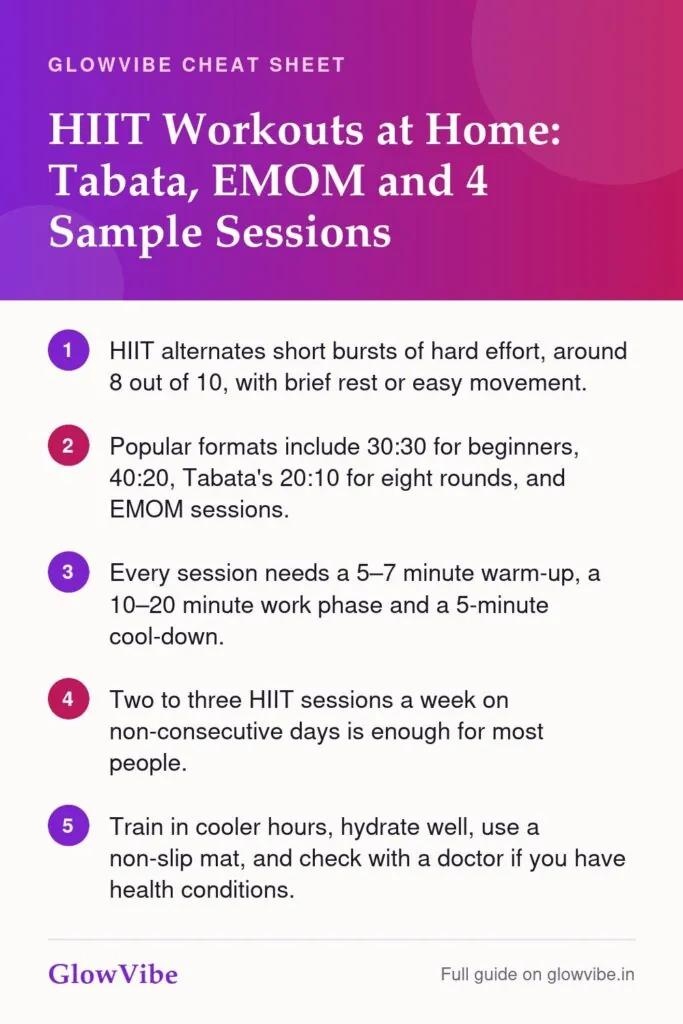
All HIIT is interval training, but not all interval training is HIIT. In HIIT, the “work” intervals are genuinely hard, around 8 out of 10 on a perceived effort scale, where talking is difficult and you are glad when the timer beeps. Recovery is short and either complete rest or very easy movement.
Gentler interval styles keep the hard parts moderate. If you are new to exercise or returning after a long break, a walk-jog approach like our 6-week interval training plan for beginners is a better starting point. Runners chasing a race goal need structured track and tempo intervals instead, covered in interval training for a marathon. This guide focuses on bodyweight and home HIIT sessions.
Benefits of HIIT workouts
Research on HIIT generally shows it improves cardiovascular fitness about as well as longer steady cardio, in less time. Here is what you can realistically expect with consistent training:
- Time efficiency: a complete session, including warm-up and cool-down, fits into 20–30 minutes.
- Better stamina: stairs, sports and running for a bus feel easier within a few weeks.
- Support for fat loss: HIIT burns a good number of calories for its length and helps preserve muscle, though your diet still drives most of the result.
- Muscular endurance: squats, lunges, push-ups and planks under fatigue build strength-endurance in the legs, core and upper body.
- Metabolic health: regular vigorous exercise is linked to better insulin sensitivity, which matters given how common diabetes is in India.
- Mood and focus: many people find a short, hard session clears their head better than a long one.
One honest caveat: the “afterburn” effect (extra calories burned after exercise) is real but small. Don’t count on it to undo a heavy dinner.
Popular HIIT formats: Tabata, EMOM and more
The work-to-rest ratio is what defines a HIIT format. Shorter rest makes a session harder; longer rest lets you work at higher quality. Pick a format based on your fitness level and goal.
| Format | Structure | Best for | Level |
|---|---|---|---|
| 30:30 | 30 sec work, 30 sec rest | Learning HIIT, keeping form clean | Beginner |
| 40:20 | 40 sec work, 20 sec rest | General fitness and fat loss | Intermediate |
| Tabata | 20 sec work, 10 sec rest, 8 rounds (4 min) | Short, very intense finishers | Intermediate to advanced |
| EMOM | Set reps at the start of every minute, rest for the remainder | Pacing, strength-endurance | All levels (scale the reps) |
| Circuit (AMRAP) | As many rounds as possible of a circuit in a set time | Variety, full-body conditioning | Intermediate |
Tabata
A Tabata block is 20 seconds of all-out effort followed by 10 seconds of rest, repeated eight times for four minutes. The original research used a cycle ergometer at very high intensity, so a true Tabata is brutal. With bodyweight moves, choose simple exercises like squat jumps, high knees or mountain climbers, and do one or two blocks with a full minute of rest between them.
EMOM (every minute on the minute)
At the start of each minute you do a fixed number of reps, such as 12 squats, and rest for whatever time is left. If you finish in 25 seconds, you get 35 seconds of rest. EMOMs are great for beginners because you control the difficulty through the rep count, and they teach you to pace yourself.
The three stages of a HIIT workout
Every good session has a warm-up, a work phase and a cool-down. Skipping the first or last stage is one of the main reasons people get sore knees or feel dizzy after HIIT.
- Warm-up (5–7 minutes): march or jog on the spot, arm circles, hip circles, bodyweight squats, walking lunges and a few easy jumping jacks. Build gradually until you feel warm and slightly out of breath.
- Work phase (10–20 minutes): your chosen format, with hard but controlled efforts and strict form.
- Cool-down (5 minutes): slow walking until your breathing settles, then gentle stretches for calves, hamstrings, quads, hip flexors and chest.
During the work phase, “hard” should still mean controlled. If your squats turn into half-reps or your back sags in a plank, slow down or take an extra few seconds of rest. Quality reps beat frantic ones.

A simple check: during work intervals you should be able to say only a few words at a time. If you can chat comfortably, push a little harder; if you feel faint or nauseous, back off immediately.
Sample HIIT workouts you can do at home
All four sessions need only a mat and a timer app. Warm up first and cool down after each one. Low-impact swaps are given so you can train in a flat without disturbing the neighbours downstairs.

Workout 1: Beginner 30:30 bodyweight HIIT (about 15 minutes)
Do each move for 30 seconds, rest 30 seconds, and complete the circuit 3 times. Rest 1 minute between rounds.
- Bodyweight squats
- Step-back jacks (low-impact jumping jacks)
- Incline push-ups on a sofa arm or sturdy table
- Fast marching with high knees
Workout 2: 20-minute 40:20 full-body HIIT (intermediate)
Do each move for 40 seconds, rest 20 seconds, and complete the circuit 4 times. Rest 1 minute between rounds.
- Squat jumps (swap: fast squats with a calf raise)
- Push-ups (knees down if needed)
- Alternating reverse lunges
- Mountain climbers
- Skipping rope or skater hops
Workout 3: Double Tabata (about 12 minutes including rest)
Block A: alternate high knees and squat jumps, 20 seconds on and 10 seconds off, for 8 rounds. Rest 2 minutes. Block B: alternate mountain climbers and burpees (or step-out burpees) for another 8 rounds. Keep it to two blocks; more Tabata rarely means better results.
Workout 4: 12-minute EMOM
Rotate through these three minutes four times. Lower the reps if you have fewer than 15 seconds of rest each minute.
- Minute 1: 15 squats
- Minute 2: 10 push-ups
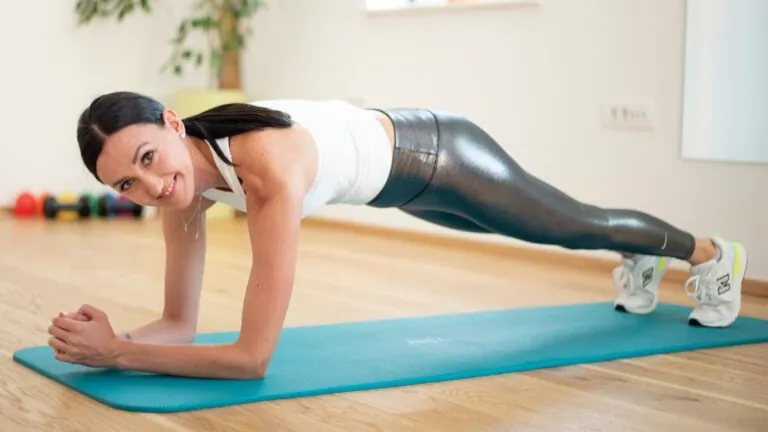
- Minute 3: 20 mountain climbers (count each leg) plus a plank hold for the rest of the minute
Want more core work alongside these? Pair one HIIT day with a session from our core exercise routine at home.
How often should you do HIIT?
For most people, 2–3 HIIT sessions a week on non-consecutive days is plenty. Because each session is intense, your body needs 48 hours or so to recover. Fill the other days with strength training, brisk walking, yoga or rest.
A balanced week might look like this: HIIT on Monday and Thursday, strength training on Tuesday and Saturday, a long walk on Wednesday or Sunday, and one full rest day. If you want a complete weekly structure, our free workout plans include home and busy-day options that slot HIIT in sensibly.
Progress slowly. Add a round, shorten rest by 5 seconds, or swap in a harder move, but change only one thing every week or two.
HIIT safety tips for Indian weather and homes
- Beat the heat: in summer and humid monsoon months, train early morning or after sunset, use a fan, and cut the number of rounds on very hot days.
- Hydrate: drink water through the day, not just during the workout. After heavy sweating, nimbu pani with a pinch of salt or coconut water helps replace fluids.
- Mind your floor: tiles and marble get slippery with sweat. Use a non-slip mat and wear supportive trainers for jumping moves rather than training barefoot.
- Don’t train on a full stomach: leave 2–3 hours after a big meal, or have a light snack like a banana an hour before.
- Know when to stop: chest pain, dizziness, unusual breathlessness or palpitations mean stop at once and seek medical advice.
Check with a doctor first if you have heart disease, high blood pressure, diabetes, joint problems, are pregnant or postpartum, or have been inactive for a long time. In those cases, a lower-intensity interval plan is usually a safer first step.
Common HIIT mistakes to avoid
- Doing HIIT every day: this leads to fatigue, poor sleep and niggling injuries rather than faster results.
- Going too long: if your “HIIT” lasts 45 minutes, the intensity has almost certainly dropped. Short and hard is the point.
- Sacrificing form for speed: knees caving in on squats and hips sagging on push-ups add stress to joints.
- Starting with jumps: build a base with low-impact versions for two to three weeks before adding jumping moves.
- Ignoring food and sleep: HIIT won’t compensate for low protein or five hours of sleep. Our guide to protein-rich Indian foods is a good place to start.
If weight loss is your main goal, HIIT works best as one part of a mix. See the best exercises for weight loss for how it compares with walking, strength training and cycling.
Frequently Asked Questions
Yes, for most people 20 minutes of genuine HIIT, plus a warm-up and cool-down, is an effective session. Done two or three times a week alongside some strength work and daily walking, it covers a large part of your weekly vigorous activity needs.
Beginners can, but they should start with low-impact moves, a 30:30 or EMOM format and only two sessions a week. If you are completely new to exercise, spend a few weeks on walking or a walk-jog plan first to build a base.
HIIT burns more calories per minute, but walking is easier to do daily and recover from. The best approach for most people is both: a couple of HIIT sessions plus regular walking, with diet doing the heavy lifting for fat loss.
Tabata is one specific type of HIIT: 20 seconds of maximum effort and 10 seconds of rest for eight rounds. HIIT is the broader category and includes many other ratios, such as 30:30, 40:20 and EMOM.
Absolutely. Fast squats, step-back lunges, step-out burpees, mountain climbers, fast marching and boxing combinations can all raise your heart rate without impact. This is a good option for heavier bodies, sensitive knees or upstairs flats.
A light snack 45–60 minutes before, such as a banana, a few dates or a small bowl of poha, helps most people. Avoid heavy, oily meals within two to three hours of training, as they can cause cramps or nausea.
It isn’t recommended. Two to three sessions a week with rest or easier activity in between gives your muscles and nervous system time to recover, which is when you actually get fitter.
Start your first HIIT session this week
HIIT gives you a lot of fitness for very little time, as long as you respect the intensity. Start with the beginner 30:30 workout twice this week, warm up and cool down every time, and add rounds or harder moves only when your form stays solid.
Train smart around the heat, eat and sleep well, and listen to your body. A few weeks of consistent sessions is usually enough to notice that everyday activities feel easier.