Interval Training Plan for Beginners: 6-Week Walk-Jog Plan (2026)
A safe, simple six-week interval training plan for beginners, with effort levels, walk-jog timings, non-running alternatives and tips for training in Indian heat.


The best interval training plan for beginners is simple: two or three short sessions a week where you alternate easy walking with brief bursts of brisk walking or light jogging, then slowly make the hard parts longer and the rest parts shorter. Follow the six-week plan below and most healthy beginners can go from walking breaks to jogging comfortably for one to two minutes at a time, without needing a gym or any special equipment.
This guide explains what interval training is, how hard you should push, exactly what to do each week, and how to adapt the plan for cycling, skipping or a home workout if running is not your thing. It also covers the Indian realities that most plans ignore: hot mornings, humid evenings and busy schedules.
What is interval training?
Interval training means switching between a harder effort (the work interval) and an easier effort (the recovery interval) within one workout. Instead of walking or jogging at one steady pace for 30 minutes, you might jog for 1 minute, walk for 2 minutes, and repeat that several times.
For beginners, “hard” is relative. If you are new to exercise, a brisk walk uphill can be your work interval and a slow stroll your recovery. You do not need to sprint. What matters is the contrast between the two efforts, not how fast you look doing it.
Interval training is the beginner-friendly cousin of HIIT. HIIT pushes the work intervals close to all-out effort, which is better saved for later. If you want to understand where you are heading, read our guide to the power of HIIT workouts once you have finished this plan.
Why interval training works for beginners
The recovery breaks are the secret. They let you spend more total time at a challenging effort than you could manage in one continuous stretch, so your heart, lungs and legs adapt faster. And because each hard piece is short, the workout feels more manageable mentally.
- Builds stamina step by step: you improve your aerobic fitness without having to run non-stop from day one.
- Time-efficient: a 20–30 minute session gives you a solid workout, which suits early-morning or after-office slots.
- Burns more energy than an easy stroll: the harder pieces raise the total effort of the session, which helps if fat loss is one of your goals (alongside diet).
- Less boring: counting down short intervals makes the time pass quickly.
- Flexible: the same structure works for walking, jogging, cycling, swimming, skipping or bodyweight moves.
How hard should the intervals feel?
The easiest way to judge effort without a heart-rate monitor is the rate of perceived exertion (RPE), a 1–10 scale where 1 is sitting on the sofa and 10 is an all-out sprint you cannot hold for more than a few seconds. Pair it with the talk test and you have everything you need.
| Effort level | RPE (1–10) | Talk test | Used for |
|---|---|---|---|
| Easy | 3–4 | You can chat in full sentences | Warm-up, recovery intervals, cool-down |
| Moderate | 5–6 | Short sentences, slightly breathless | Weeks 1–2 work intervals |
| Hard but controlled | 7–8 | Only a few words at a time | Weeks 3–6 work intervals |
| All-out | 9–10 | Cannot speak | Not needed in this beginner plan |
Aim for “hard but sustainable”. By the last work interval you should feel challenged, but your form should still look the same as in the first one. If you are gasping, stumbling or feel dizzy, slow down.
Before you start
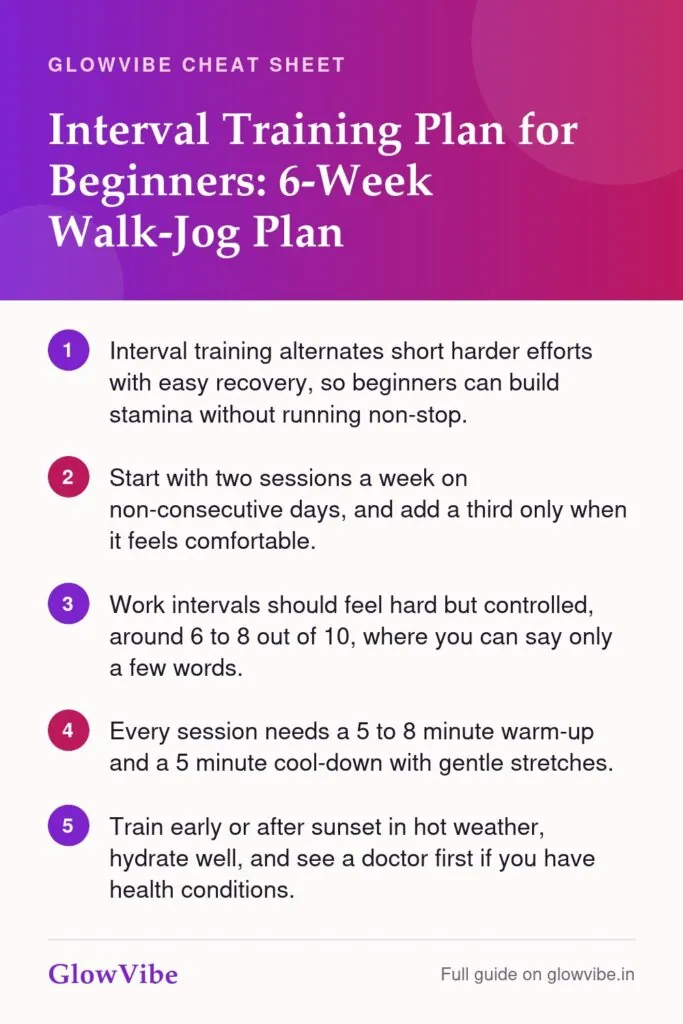
Start with two sessions a week, on non-consecutive days such as Tuesday and Saturday. Once that feels comfortable, add a third. On the other days, easy walking, yoga or light strength work keeps you moving without tiring your legs out.

- Check with your doctor first if you have a heart condition, high blood pressure, diabetes, asthma, joint problems, are pregnant, are over 40 and have been inactive, or have ever felt chest pain or fainted during exercise.
- Wear proper shoes: a comfortable pair of running or walking shoes with cushioning matters more than any gadget.
- Use a timer: your phone’s stopwatch or any free interval-timer app is enough.
- Pick a flat, safe route: a park track, a quiet colony lane or a treadmill. Avoid broken footpaths for the faster parts.
How to structure every session
Every workout in this plan follows the same three-part shape. Do not skip the first and last parts; they make the middle safer and more comfortable.
- Warm-up (5–8 minutes): easy walking that gets gradually brisker, then a few leg swings, ankle circles, arm circles and 10 bodyweight squats.
- Main set (12–20 minutes): the work and recovery intervals for that week.
- Cool-down (5 minutes): slow walking until your breathing settles, followed by gentle calf, hamstring, quad and hip stretches, holding each for about 20–30 seconds.
The 6-week interval training plan for beginners
This walk-jog plan is written for running, but the timings work for any activity. “Work” means a brisk walk or light jog at the effort shown; “rest” means easy walking. Do each week’s session two or three times before moving on.

| Week | Work interval | Recovery | Rounds | Main set time | Target effort |
|---|---|---|---|---|---|
| 1 | 30 sec brisk walk or slow jog | 90 sec easy walk | 6 | 12 min | RPE 5–6 |
| 2 | 45 sec | 90 sec | 6 | 13.5 min | RPE 6 |
| 3 | 60 sec | 90 sec | 6 | 15 min | RPE 6–7 |
| 4 | 60 sec | 60 sec | 8 | 16 min | RPE 7 |
| 5 | 90 sec | 60 sec | 7 | 17.5 min | RPE 7 |
| 6 | 2 min | 60 sec | 6 | 18 min | RPE 7–8 |
Weeks 1–2: Step it up
The goal here is simply to get used to changing gears. Keep the work intervals at a moderate effort; you should finish feeling you could have done a couple more rounds. If even a slow jog is too much, make every work interval a fast walk, and that is perfectly fine.
Weeks 3–4: Ramp it up
The work intervals reach a full minute, and in week 4 the recovery shrinks to match. This is the week most beginners find hardest, so repeat week 3 if you need to. Focus on relaxed shoulders, short quick steps and landing under your hips rather than reaching forward.
Weeks 5–6: Build endurance
Longer work pieces start building the stamina for continuous jogging. By the end of week 6 you will be covering 12 minutes of harder effort in one session. From here you can lengthen the work intervals to 3–5 minutes, try a 20-minute continuous easy jog, or move on to proper HIIT.
Interval training without running
Running is not compulsory. If your knees complain, you are carrying extra weight, or you simply prefer something else, use the same timings with one of these options. Our round-up of cardio exercise equipment can help if you are thinking of buying something for home.
- Brisk walking or incline walking: the gentlest option. Use a slope, a flyover ramp or a treadmill incline for the work intervals.
- Cycling or a stationary bike: raise the pace or resistance for work intervals. Very kind on the knees.
- Skipping rope: skip for the work interval, march on the spot to recover. Start with 20–30 seconds; it is harder than it looks.
- Stair climbing: climb steadily for the work interval and walk down slowly to recover. Hold the railing.
- Bodyweight circuit at home: alternate 30 seconds of marching high knees, step-back lunges, squats or step-ups with 60–90 seconds of easy marching. Pair it with our core exercise routine at home on alternate days.
- Swimming: one length at a stronger pace, then rest at the wall or swim an easy length.
Training in Indian heat and humidity
Heat and humidity make the same pace feel noticeably harder because your body works overtime to cool down. Go by effort, not speed, and expect to be a little slower in May than in December.
- Train early in the morning or after sunset in summer; avoid roughly 11 am to 4 pm.
- Drink water through the day, not just before the session. On long, very sweaty days, an ORS sachet or nimbu pani with a pinch of salt helps replace what you lose.
- Wear light, breathable clothing that dries quickly, plus a cap if the sun is up.
- On high-pollution days, especially in north Indian winters, move the session indoors to a treadmill, bike or home circuit.
- During monsoon, avoid slippery roads for the faster parts and switch to a covered space if needed.
What to eat around your sessions
Interval sessions in this plan are short, so you do not need special sports food. If you train 1–2 hours after a meal, a normal light meal is enough. If you train first thing in the morning, a small, easy-to-digest snack 30–60 minutes before, such as a banana, a couple of dates or a slice of toast, works for most people.
Afterwards, have a balanced meal with carbohydrates and protein, for example poha with peanuts and curd, eggs with roti, or dal, rice and sabzi. For more ideas, see our list of protein-rich foods for weight loss.
Common mistakes to avoid
- Going too hard in the first round: if your last interval is much slower than your first, you started too fast.
- Training every day: your body adapts during rest. Keep at least one easy day between interval sessions.
- Skipping the warm-up: cold calves and hamstrings are the most common source of beginner strains.
- Jumping ahead too quickly: repeating a week is not failure. Move on only when the current week feels controlled.
- Ignoring pain: muscle tiredness is normal; sharp pain, joint pain or pain that changes how you move is not. Stop and rest.
- Only doing cardio: two short strength sessions a week protect your joints and make you a stronger runner. Our free workout plans are a good place to start.
A sample week
Here is one way to fit the plan into a normal working week. Swap days around to suit your schedule; just keep a rest or easy day between the interval sessions.
- Monday: rest or a gentle 20-minute walk
- Tuesday: interval session
- Wednesday: 20–30 minutes of strength or core work
- Thursday: interval session (from week 3, or when ready)
- Friday: rest or yoga
- Saturday: interval session
- Sunday: long easy walk, cycling or a fun activity such as a sport with friends
If weight loss is your main goal, interval training works best combined with a sensible diet and daily movement. Our 4-week workout plan for weight loss shows how to put cardio and strength together.
Frequently Asked Questions
Two sessions a week is the right starting point for most beginners, with at least one easy day in between. Once those feel comfortable, usually after two or three weeks, you can add a third. More than three interval days a week rarely helps at this stage and raises the risk of overuse injuries.
About 25–30 minutes in total is plenty: a 5–8 minute warm-up, 12–20 minutes of intervals and a 5-minute cool-down. Longer is not better when you are starting out. Consistency over several weeks matters far more than one long, exhausting session.
For most healthy adults, yes, provided you start with moderate work intervals and generous recovery, as in this plan. If you have a heart condition, high blood pressure, diabetes, joint problems, are pregnant or have been inactive for a long time, speak to your doctor first. Stop immediately and seek medical help if you feel chest pain, severe breathlessness, dizziness or an irregular heartbeat.
Absolutely. The same work-and-recovery timings work for brisk walking, cycling, swimming, stair climbing, skipping or a bodyweight circuit at home. Choose the activity you enjoy and can do safely, and judge effort with the 1–10 scale rather than speed.
It can help, because it lets you do a more demanding workout in a short time, but exercise alone rarely drives weight loss. Results come from combining regular activity with a balanced diet, enough protein, good sleep and strength training. Speak to a doctor or registered dietitian if you have a lot of weight to lose or a medical condition.
Interval training is the broad idea of alternating harder and easier efforts, at any intensity. HIIT (high-intensity interval training) is a specific type where the work intervals are very hard, close to maximum effort. Beginners are better off building a base with moderate intervals first, as in this plan, before trying true HIIT.
Use the talk test. During work intervals you should only manage a few words at a time, which is around 6–8 out of 10 on the effort scale. If you can chat easily, push a little more; if you cannot speak at all or your form falls apart, ease off.
Ready to start?
You do not need to be fit to start interval training; it is how you get fit. Begin with week 1, keep the hard parts honest but controlled, rest between sessions and repeat weeks whenever you need to. Six weeks from now, the jog that feels impossible today will feel far more manageable.