Free Workout Plans (2026): 4 Home, Gym, Walking and Busy-Day Plans
Four free workout plans with weekly tables: beginner full-body at home, a 3-day gym plan, an 8-week walking plan and a 20-minute plan for busy days.

The best free workout plan is the one that matches your goal, your equipment and the time you can honestly give it every week. Below are four complete plans you can start today, with no app or subscription: a beginner full-body home plan, a 3-day gym plan, a walking plan and a 20-minute plan for busy weeks.
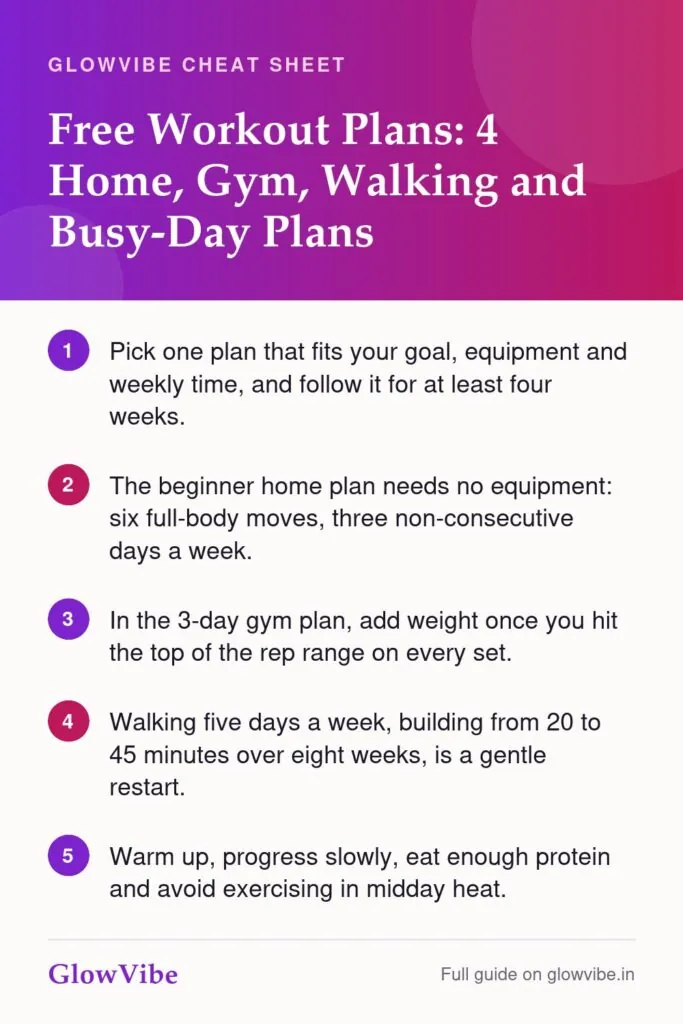
Each plan comes with a weekly schedule, exercises, sets and reps, and a simple way to progress. Pick one, follow it for four to eight weeks, and only then think about switching.
Which free workout plan should you pick?
- New to exercise and training at home: Plan 1, the beginner full-body home plan (3 days a week, no equipment).
- You have a gym membership: Plan 2, the 3-day full-body gym plan.
- Coming back after a long break, or want low-impact cardio: Plan 3, the 8-week walking plan.
- Long office hours, travel or small kids at home: Plan 4, the 20-minute busy-schedule plan.
You can also combine them. Walking pairs well with either strength plan, and the busy-schedule plan is a good fallback for the weeks when life gets in the way.
Free workout plans compared
| Plan | Best for | Days per week | Time per session | Equipment |
|---|---|---|---|---|
| 1. Beginner full-body home plan | Complete beginners, general fitness | 3 | 30–35 min | None (a mat and a chair help) |
| 2. 3-day gym plan | Building strength and muscle | 3 | 50–60 min | Basic gym: dumbbells, barbell, cable or machines |
| 3. Walking plan | Restarting, heart health, low impact | 5 | 20–45 min | Comfortable shoes |
| 4. Busy-schedule plan | Desk jobs, travel, tight days | 4 | 20 min | None |
Before you start: how to read these plans
“3 × 10” means three sets of ten reps. Rest 60–90 seconds between sets of strength moves and about 30 seconds between circuit exercises. Choose a difficulty where the last two reps of each set feel hard but your form still looks clean.
Start every session with a five-minute warm-up: march on the spot, arm circles, hip circles, bodyweight squats and a few lunges. Finish with five minutes of easy stretching for your hips, hamstrings, chest and shoulders.
If you have a heart condition, high blood pressure, diabetes, joint pain, are pregnant or have recently had surgery, check with your doctor before starting any new plan. Stop if you feel chest pain, dizziness or sharp joint pain.
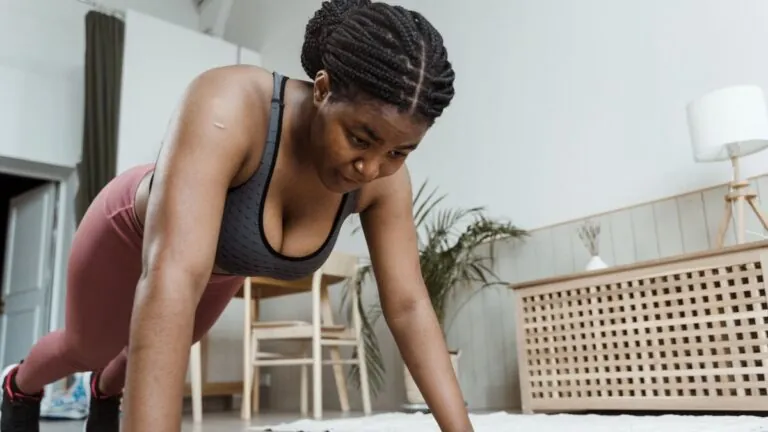
Plan 1: Beginner full-body workout plan at home (4 weeks)
This is a no-equipment plan you can do in a bedroom or on a terrace. Train on three non-consecutive days, such as Monday, Wednesday and Friday, and walk or rest on the other days.

| Exercise | Sets × reps | Easier option | Harder option |
|---|---|---|---|
| Bodyweight squat | 3 × 10–15 | Sit-to-stand from a chair | Pause 2 seconds at the bottom |
| Push-up | 3 × 6–12 | Hands on a wall or kitchen counter | Full push-up from the floor |
| Glute bridge | 3 × 12–15 | Smaller range | Single-leg bridge |
| Reverse lunge | 3 × 8 each leg | Hold a chair for balance | Slow 3-second lowering |
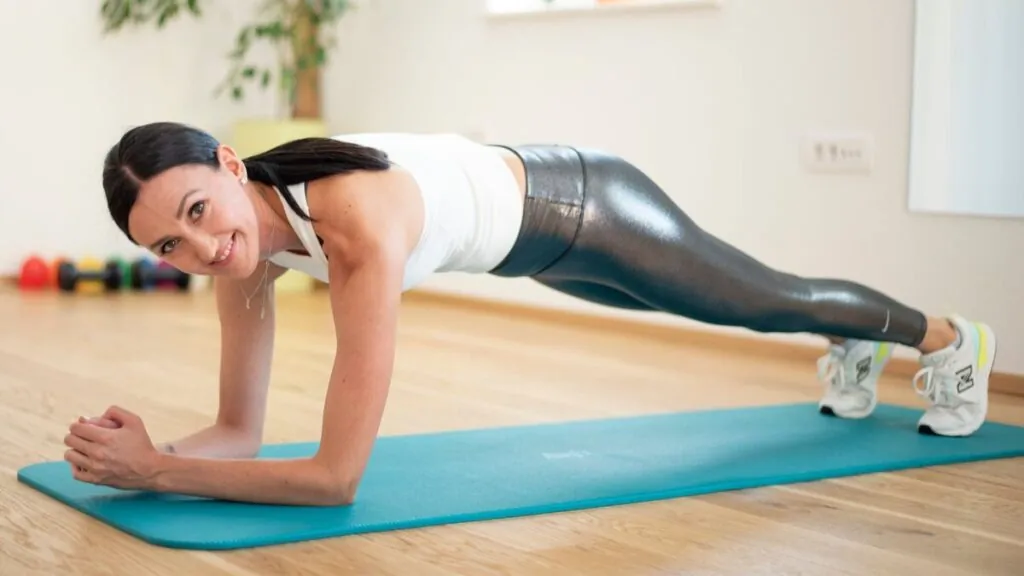
| Plank | 3 × 20–40 sec | Knees down | Add shoulder taps |
| Bird dog | 2 × 8 each side | Move arm or leg only | Hold 3 seconds at the top |
Progress week by week rather than all at once. The goal is steady improvement, not exhaustion.
| Week | What to do |
|---|---|
| Week 1 | 2 sets of each exercise at the low end of the rep range; learn the form |
| Week 2 | 3 sets of each exercise |
| Week 3 | Add 2–3 reps per set, or 10 seconds to the plank |
| Week 4 | Move one or two exercises to the harder option |
Want more core work? Swap the bird dog for moves from our core exercise routine at home. If your main goal is fat loss, our 4-week workout plan for weight loss for females builds on this same structure with more cardio.
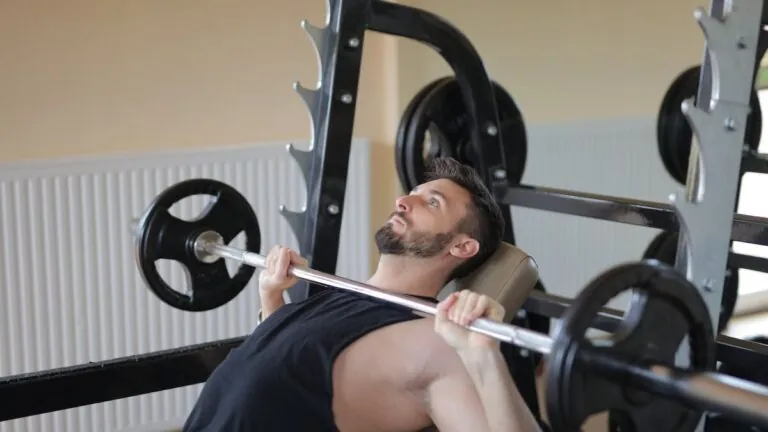
Plan 2: 3-day gym workout plan for beginners
Three full-body sessions a week is enough for most beginners to get noticeably stronger. You alternate between Workout A and Workout B, so week one is A-B-A and week two is B-A-B.
| Workout A | Sets × reps | Workout B | Sets × reps |
|---|---|---|---|
| Goblet squat or barbell squat | 3 × 8–10 | Romanian deadlift (dumbbell or barbell) | 3 × 8–10 |
| Dumbbell bench press | 3 × 8–12 | Seated dumbbell shoulder press | 3 × 8–12 |
| Lat pulldown | 3 × 10–12 | Seated cable row | 3 × 10–12 |
| Leg press | 2 × 12 | Walking lunge | 2 × 10 each leg |
| Plank | 3 × 30–45 sec | Dead bug | 3 × 8 each side |
| Bike or incline walk (optional) | 10 min easy | Bike or incline walk (optional) | 10 min easy |
Use double progression: once you can do the top of the rep range on every set with good form, increase the weight slightly next session and drop back to the bottom of the range. Keep a simple log on your phone so you know what you lifted last time.
For better rowing and pulldown technique, see our guide to back exercises at the gym for beginners. After three to six months, when full-body sessions start to feel too long, a push pull legs workout routine is a natural next step.
Plan 3: 8-week walking plan
Walking is the easiest free workout to stick with, and it is gentle on the joints. “Brisk” means you can talk in short sentences but would struggle to sing. Walk five days a week and keep two days for rest or light stretching.
| Weeks | Brisk walking per session | Days | Add this |
|---|---|---|---|
| 1–2 | 20 minutes | 5 | 3 minutes easy pace before and after |
| 3–4 | 25–30 minutes | 5 | One slightly hilly route or stairs once a week |
| 5–6 | 30–35 minutes | 5 | Twice a week: 1 minute fast, 2 minutes normal, repeated 5 times |
| 7–8 | 40–45 minutes | 5 | One longer weekend walk of 50–60 minutes |
In Indian summers, walk before 8 am or after sunset, carry water and slow down on very humid days. During the monsoon, walk indoors in a mall, a building corridor or on a society terrace, or march on the spot at home for the same time. Ready for more? Our 6-week walk-jog interval training plan picks up where this one ends.
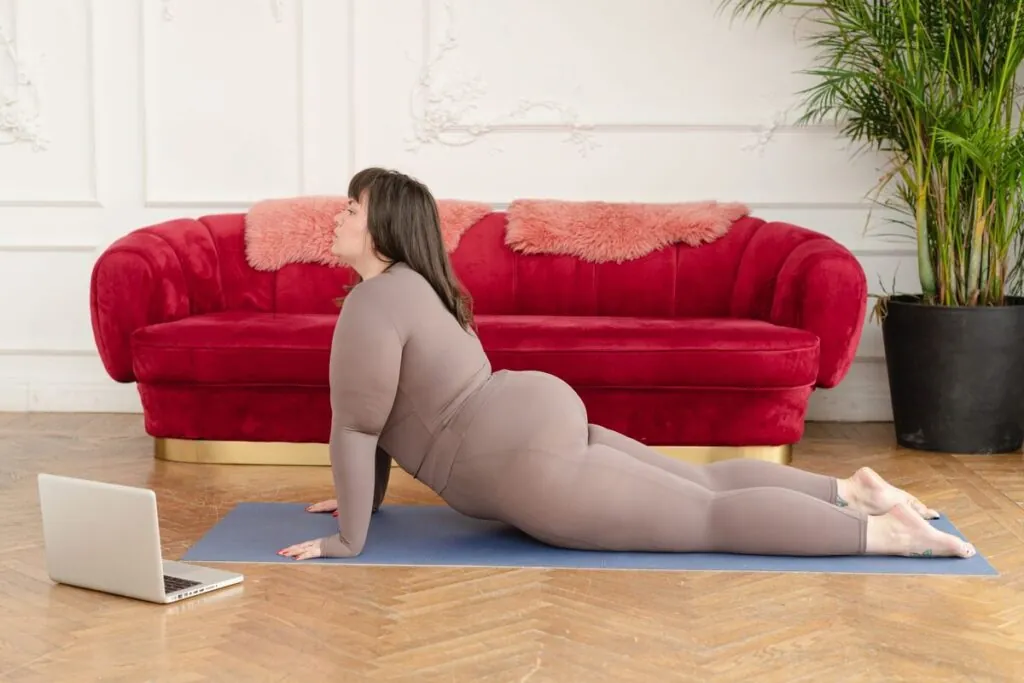
Plan 4: 20-minute workout plan for a busy schedule
This plan is for weeks when an hour at the gym is not realistic. Four 20-minute sessions add up to 80 minutes of focused training, which is far better than nothing. Do it before work, at lunch or while dinner is cooking.
| Day | Session (after a 3-minute warm-up) | Format |
|---|---|---|
| Monday: Lower body | Squats, reverse lunges, glute bridges, calf raises | 40 sec work, 20 sec rest; 4 rounds |
| Tuesday: Upper body and core | Push-ups, chair dips, plank, superman hold | 40 sec work, 20 sec rest; 4 rounds |
| Thursday: Cardio intervals | Jumping jacks or step jacks, high knees, mountain climbers, skaters | 30 sec work, 30 sec rest; 4–5 rounds |
| Saturday: Full body | Squat to press (water bottles), push-ups, lunges, plank | As many rounds as possible in 15 minutes |
| Other days | Walk 15–30 minutes, take the stairs, stretch for 10 minutes | Easy movement |
If you sit at a desk all day, add a two-minute break every hour: stand up, roll your shoulders, do ten squats and stretch your hip flexors. Low-impact swaps like step jacks instead of jumping jacks keep things quiet for flats with neighbours below.
How to choose the right plan for your goal
- Weight loss: combine Plan 1 or Plan 2 with Plan 3. Strength training helps you keep muscle while walking adds daily activity; food choices still matter most.
- Muscle and strength: Plan 2, with enough protein and sleep.
- General health and energy: Plan 1 plus two or three walks a week.
- Restarting after illness, injury or a long gap: Plan 3 first, then add Plan 1 after a month (with your doctor’s okay if needed).
- Little time: Plan 4, and upgrade to Plan 1 or 2 when your schedule frees up.
Be honest about time. A plan you can do three days a week for six months will beat a six-day plan you abandon after two weeks.
Sample week: combining strength and walking
| Day | Home version | Gym version |
|---|---|---|
| Monday | Plan 1 workout | Plan 2 Workout A |
| Tuesday | 30-minute brisk walk | 30-minute brisk walk |
| Wednesday | Plan 1 workout | Plan 2 Workout B |
| Thursday | 30-minute walk or 10 minutes of stretching | 30-minute walk or 10 minutes of stretching |
| Friday | Plan 1 workout | Plan 2 Workout A |
| Saturday | Long walk, cycling, a sport or dance | Long walk, cycling, a sport or dance |
| Sunday | Rest | Rest |
Simple rules that make any plan work
- Schedule it. Put workouts in your calendar like meetings, at a time you can protect.
- Progress slowly. Add a few reps, a little weight or a few minutes each week, not all three at once.
- Track something. Reps, weights, steps or walk minutes. Seeing numbers improve keeps you going.
- Eat enough protein. Include dal, paneer, curd, eggs, chicken, fish, soya or sprouts at most meals. Our list of protein-rich Indian foods has easy options.
- Sleep and hydrate. Aim for seven to nine hours of sleep, and drink more water in hot, humid weather.
- Review every four weeks. If you are progressing, keep going. If you are stuck or bored, change one or two exercises, not the whole plan.
Common mistakes with free workout plans
- Plan-hopping: switching every week means you never get the benefit of progression.
- Doing too much too soon: severe soreness after week one usually means you started too hard. Cut the sets and build up.
- Skipping the warm-up: five minutes makes the workout feel easier and reduces the chance of strains.
- Chasing reps over form: a slow, controlled squat beats twenty rushed half-squats.
- Training through pain: muscle tiredness is normal; sharp or joint pain is a signal to stop and get it checked.
- Ignoring heat: exercising at midday in May or June without water raises the risk of heat exhaustion. Move workouts to cooler hours.
Frequently Asked Questions
For most beginners, yes. Results come from training regularly, progressing gradually and recovering well, and a well-built free plan covers all of that. Paid coaching is worth it mainly if you want personal form checks, have an injury or are training for a specific event.
Three strength days plus two or three walking days is a good starting point. Common guidance for adults is at least 150 minutes of moderate activity a week plus muscle-strengthening work on two or more days. You can build up to that over a few weeks.
Light movement like walking or stretching every day is fine and helpful. Hard strength sessions for the same muscles need around 48 hours of recovery, so avoid training them heavily on back-to-back days. Keep at least one full rest day a week.
Rest days can be fully restful or include easy movement such as a relaxed walk, gentle yoga or ten minutes of stretching. Focus on good sleep, enough protein and staying hydrated. These days are when your body adapts to the training.
Most people feel more energetic and find workouts easier within two to four weeks. Visible changes in strength and body shape usually take eight to twelve weeks of consistent training and sensible eating. Measuring reps, weights and waist size shows progress before the mirror does.
Yes, a home plan combined with daily walking and a modest calorie deficit can support steady weight loss. Exercise alone burns fewer calories than most people expect, so portion control and protein-rich meals matter just as much. If you have a medical condition or want to lose a lot of weight, speak to a doctor or registered dietitian.
Start with one plan this week
You do not need an expensive app or a perfect routine to get fitter. Pick the plan that fits your goal and schedule, put the first three sessions in your calendar and follow it for at least four weeks. Small, steady progress is what turns a free workout plan into lasting results.