Bodyweight Exercise Mistakes and How to Fix Your Form (2026)
Knees caving in squats, sagging push-ups, breath-holding planks: fix the 10 most common bodyweight exercise mistakes with easy form cues, regressions and a beginner routine.


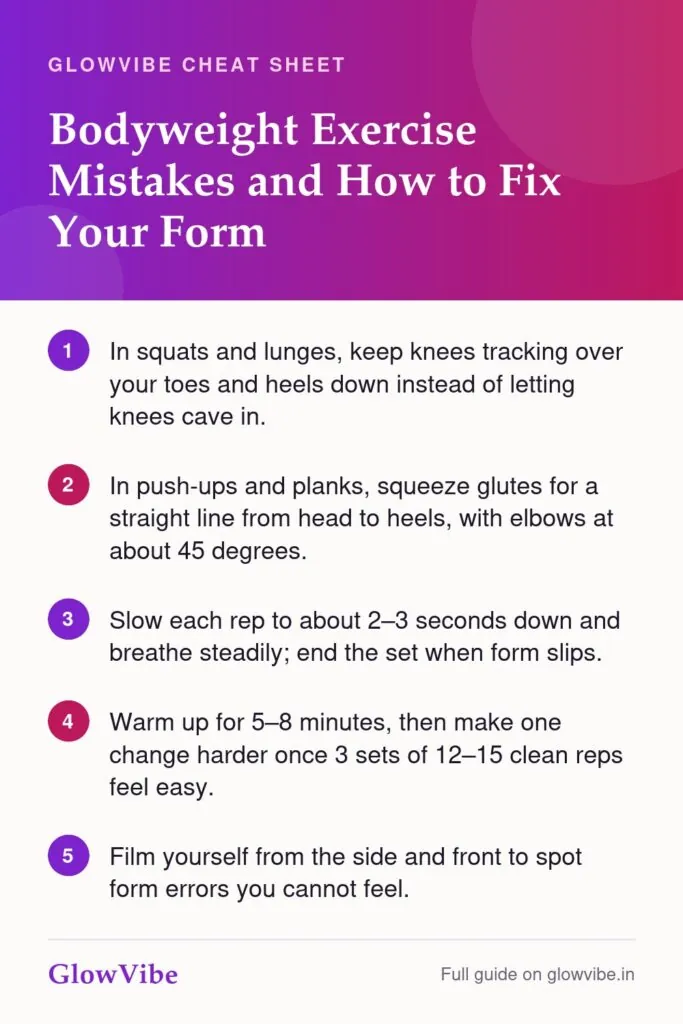
The most common bodyweight exercise mistakes are knees caving in during squats, sagging hips in push-ups and planks, holding your breath, rushing reps and never making the moves harder. Fix your form first, slow each rep down, and progress step by step, and simple bodyweight exercises will build real strength without hurting your knees, back or shoulders.
Bodyweight training needs no gym, no equipment and very little space, which is why it is so popular in Indian homes, hostels and terraces. But “no equipment” does not mean “no technique”. Below are the 10 mistakes we see most often, why each one matters, and exactly how to fix it, with an easier and a harder version so you can train at the right level.
Common bodyweight exercise mistakes: quick-fix table
| Exercise | Common mistake | Quick fix | Easier version |
|---|---|---|---|
| Squat | Knees cave in, heels lift | Push knees out over toes, weight in mid-foot | Box (chair) squat |
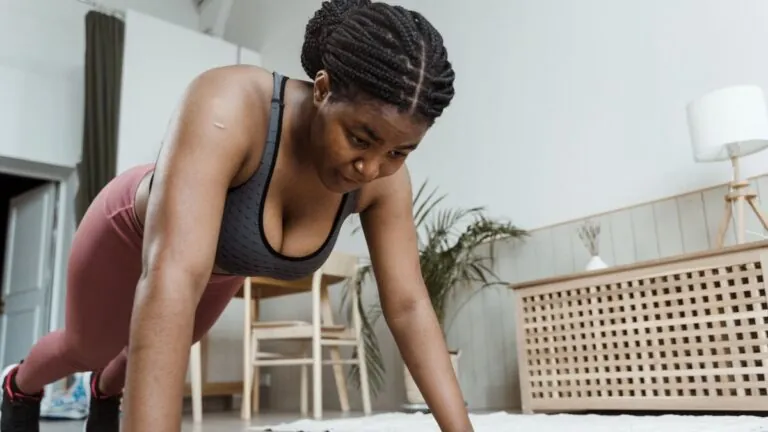
| Push-up | Hips sag, elbows flare | Squeeze glutes, elbows at about 45° | Incline push-up on a wall or table |
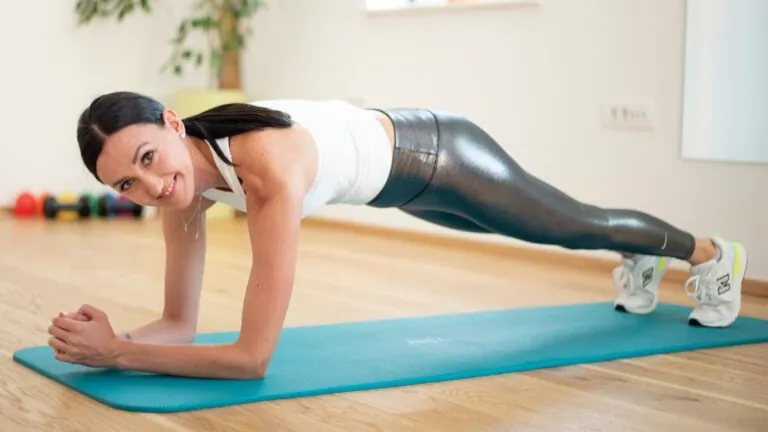
| Plank | Hips too high or low, breath held | Straight line head to heels, breathe slowly | Knee plank |
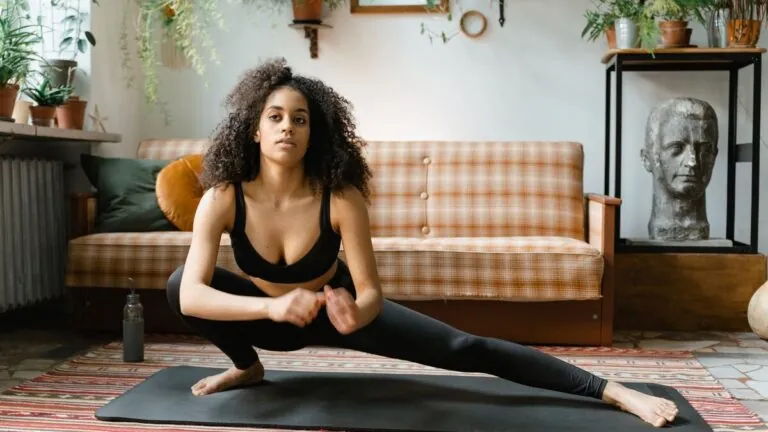
| Lunge | Front knee drifts inward | Knee tracks over second and third toe | Split squat holding a wall |
| Burpee | Heavy, flat-footed landings | Land softly, knees bent, step instead of jump | Step-back burpee, no jump |
| Mountain climber | Hips bounce, shoulders behind hands | Shoulders over wrists, hips level | Slow alternating knee drives |
| Crunch | Yanking the neck | Fingertips light, chin off the chest | Dead bug |
10 bodyweight exercise mistakes and how to fix your form
1. Squat form: knees caving in and heels lifting
What goes wrong: as you sit down, your knees collapse toward each other, or your heels peel off the floor and you tip onto your toes. Often the chest also drops forward and the lower back rounds at the bottom.
Why it matters: knees caving in puts uneven stress on the inside of the knee, and rising onto your toes shifts load away from your glutes and onto the front of the knee. You get less strength from each rep and more aches.
The fix: stand with feet roughly shoulder-width apart, toes turned out slightly. Keep your weight spread over the whole foot, think “spread the floor” with your feet, and let your knees travel in line with your toes. Sit back and down as if reaching for a chair, chest proud, and only go as deep as you can while keeping your heels down. Tight ankles? Add wall ankle rocks to your warm-up.
- Regression: box squat to a chair, or hold a door frame for balance.
- Progression: pause squats (3 seconds at the bottom), then split squats and jump squats.
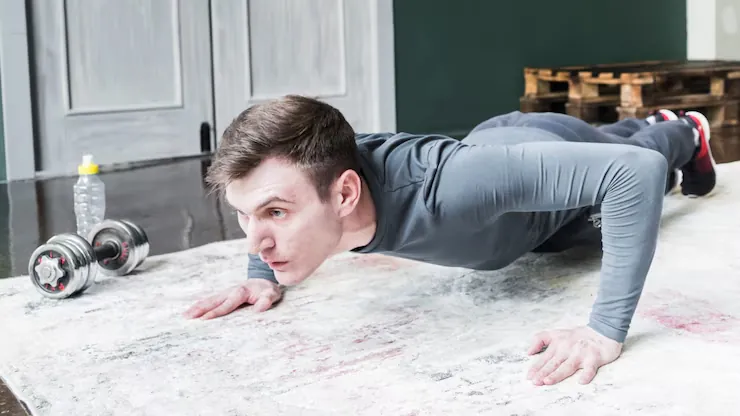
2. Push-up mistakes: sagging hips and flared elbows
What goes wrong: the hips sink toward the floor so your body forms a banana shape, and the elbows shoot straight out to the sides like a “T”.
Why it matters: sagging hips load your lower back instead of your core. Elbows flared at 90° put the front of the shoulder in a cramped position, a common reason push-ups start to hurt.
The fix: place hands slightly wider than shoulders, squeeze your glutes and brace your stomach as if someone is about to poke it. Your body should be one straight plank from head to heels. Tuck your elbows to roughly 45° from your body (an arrow shape, not a T) and lower until your chest is a fist’s height from the floor.
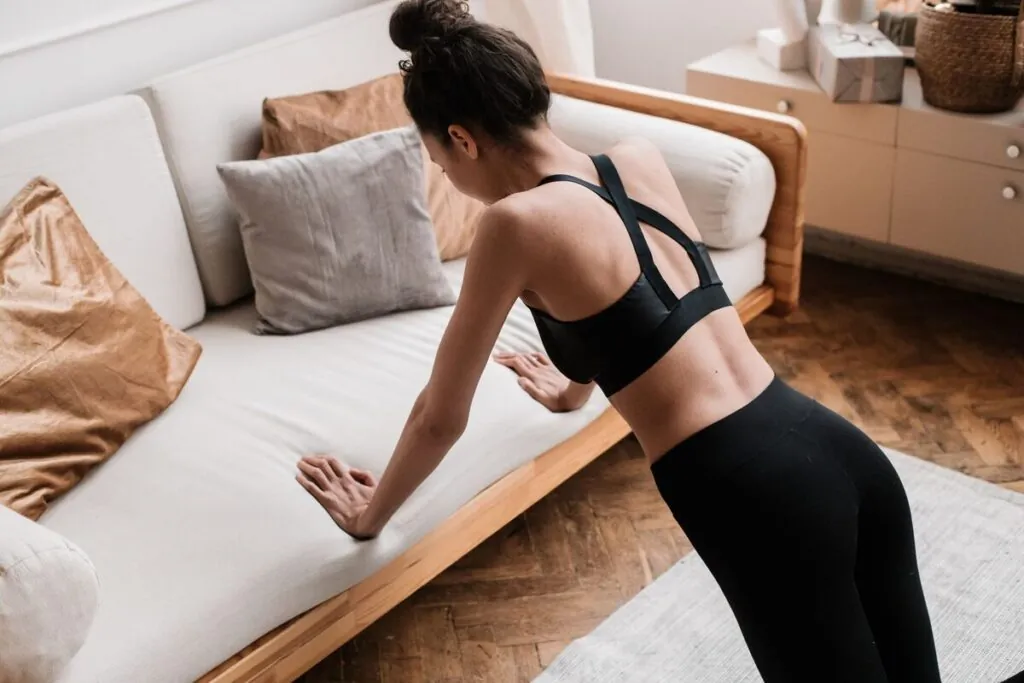
- Regression: wall push-ups, then incline push-ups on a table or the kitchen counter. These keep the straight-body position, which knee push-ups often lose.
- Progression: slow 3-second lowering, then decline push-ups with feet on a step or bed.
3. Plank mistakes: hips too high or too low, and holding your breath
What goes wrong: the hips either pike up toward the ceiling (easier, but it takes the core out of the exercise) or droop toward the floor. Many people also hold their breath and go red in the face chasing a longer time.
Why it matters: a drooping plank strains the lower back, while a piked one barely trains your abs. Holding your breath raises tension and makes you fatigue faster.
The fix: elbows under shoulders, gently tuck your tailbone, squeeze glutes and thighs, and keep a straight line from head to heels. Breathe slowly through your nose and out through your mouth. A solid 20–30 seconds beats a shaky two minutes.
- Regression: knee plank, or an incline plank with forearms on a bench.
- Progression: plank shoulder taps, side planks, then long-lever planks with elbows slightly ahead of the shoulders.
4. Lunges: poor knee alignment
What goes wrong: the front knee wobbles inward, or your stance is so narrow (like walking on a tightrope) that you lose balance.
Why it matters: a collapsing front knee is the same problem as in squats, but on one leg it is harder to control.
The fix: keep your feet hip-width apart, like standing on railway tracks rather than a single line. Lower straight down, keeping the front knee pointing over your second and third toes and your torso tall. The knee may move a little past the toes if your heel stays down and it feels fine; what matters is control.
- Regression: static split squat with one hand on a wall.
- Progression: reverse lunges, walking lunges, then Bulgarian split squats with the back foot on a bed or chair.
5. Burpees: sloppy landings
What goes wrong: you throw your feet back and crash into a sagging plank, then land from the jump stiff-legged and flat-footed with a loud thud.
Why it matters: burpees are usually done fast and tired. Repeated heavy landings load your knees and lower back.
The fix: land quietly on the balls of your feet with knees bent, letting your legs absorb the impact. Hit a proper plank position when your feet go back. If your landings get noisy, slow down or switch to the easier version. Wear supportive shoes and use a mat if you train on tiles or marble.
- Regression: step-back burpee with no jump, or hands on a raised surface.
- Progression: add the push-up, then a tuck jump at the top.
6. Mountain climbers: bouncing hips and drifting shoulders
What goes wrong: the hips bob up and down with every knee drive, the shoulders shift back behind the hands, and the feet barely move a few centimetres.
Why it matters: mountain climbers are a moving plank. If the hips bounce, your core is not doing the work and the speed is wasted effort.
The fix: stack your shoulders over your wrists, keep hips level with your shoulders, and drive each knee toward your chest with control. Go slow enough that your hips stay still, then speed up.
- Regression: hands on a sofa or bench, slow alternating knee drives.
- Progression: faster tempo, or cross-body climbers (knee toward the opposite elbow).
7. Crunches: pulling on your neck
What goes wrong: hands are locked behind the head and you yank yourself up, chin jammed into the chest.
Why it matters: the neck takes the strain while the abs do little. That is why many people feel crunches in the neck rather than the stomach.
The fix: rest fingertips lightly beside your ears or cross arms over your chest. Keep a fist-sized gap between chin and chest, breathe out as you curl your ribs toward your hips, and lift only your shoulder blades. Small, slow movement is enough.
- Regression: dead bugs or heel taps, which train the core with no neck strain at all.
- Progression: reverse crunches, then hollow-body holds.
For a full set of safe ab moves, try our core exercise routine at home.
8. Rushing your reps
What goes wrong: you chase a number, 50 squats or 30 push-ups, and the reps get shorter and faster as you go.
Why it matters: momentum does the work instead of your muscles, and form breaks down exactly when you are most tired.
The fix: use a tempo of about 2–3 seconds down, a brief pause, and 1 second up. Count only the reps that meet your standard. When form slips, end the set.
- Regression: fewer reps per set, more sets.
- Progression: slow the lowering phase to 4–5 seconds; it makes easy moves surprisingly hard.
9. Skipping the warm-up
What goes wrong: you roll out of bed and go straight into jump squats and burpees.
Why it matters: cold, stiff joints move less freely, so your form suffers and the first few sets feel harder than they should.
The fix: spend 5–8 minutes on a dynamic warm-up: marching or light jogging on the spot, arm circles, leg swings, hip circles, cat-cow and 10 slow bodyweight squats. Save long static stretches for after the workout.
- Regression: if short on time, do one easy set of each exercise before your working sets.
- Progression: add jumping jacks, inchworms and world’s greatest stretch before intense sessions.
10. No progressive overload
What goes wrong: you do the same 3 sets of 10 for months and wonder why nothing changes. The opposite mistake is jumping to advanced moves too soon.
Why it matters: muscles adapt to what you ask of them. Without a gradually harder challenge, progress stalls; with too big a jump, form collapses.
The fix: write down your sets and reps. Once you can do 3 sets of 12–15 clean reps, make it harder by changing one thing: more reps, a slower tempo, shorter rest, or a harder variation. For example: wall push-up → incline push-up → floor push-up → decline push-up.
- Regression: step back one variation for a week if form breaks down.
- Progression: single-leg and explosive moves, or a backpack loaded with books for squats and lunges. This is the core idea of calisthenics for beginners: earn each level before moving up.
How to check your form at home
You often cannot feel form errors, but you can see them.
- Film yourself: prop your phone at hip height. Record from the side for push-ups, planks and squat depth, and from the front for knee alignment in squats and lunges. Watch one set in slow motion and look for one problem at a time.
- Use a mirror: a wardrobe or bathroom mirror gives instant feedback on knees caving and hip height.
- Quick self-checks: lay a broom along your back in a plank (it should touch head, upper back and hips), and squat facing a wall to stop your chest diving forward.
Beginner bodyweight routine (3 days a week)
Do this on non-consecutive days, such as Monday, Wednesday and Friday. Warm up first, then do 2–3 rounds, resting 60–90 seconds between exercises. Pick the easier version of any move you cannot do with clean form.
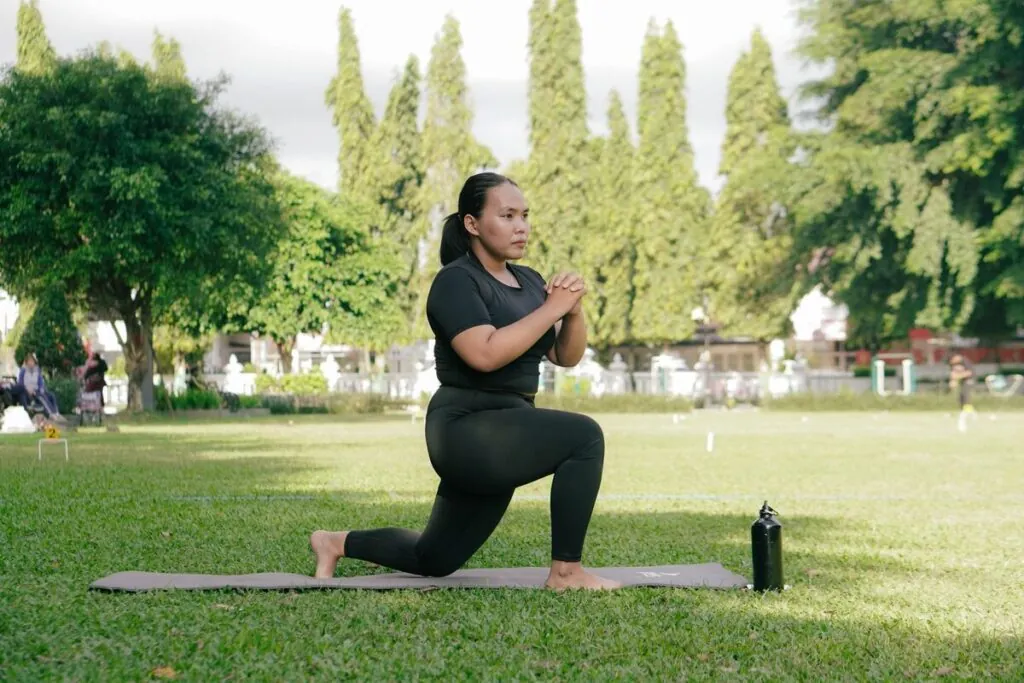
- Squats (or box squats): 10–12 reps.
- Incline push-ups: 8–10 reps.
- Reverse lunges: 8 reps each leg.
- Glute bridges: 12–15 reps.
- Plank: 20–30 seconds, breathing steadily.
- Dead bugs: 8 reps each side.
- Slow mountain climbers: 20 seconds.
Finish with 5 minutes of gentle stretching. After 3–4 weeks, add reps or move to the next variation. When you want a longer session, try our 30-minute workout at home. For older parents or complete beginners, our guide to easy home exercises for all ages has gentler options. If you later join a gym, a structured 6-day gym workout schedule builds nicely on this base.
Safety notes
- Mild muscle soreness for a day or two is normal. Sharp, stabbing or joint pain is not; stop that exercise.
- If you have a knee, back or shoulder injury, high blood pressure, a heart condition, are pregnant or recently postpartum, check with a doctor or physiotherapist before starting.
- In hot, humid weather, train in the cooler morning or evening, keep water nearby and stop if you feel dizzy or unwell.
- Use a non-slip mat on tiled or marble floors, and keep the area clear of furniture.
- Take at least one or two rest days a week and get enough sleep; recovery is when you actually get stronger.
Frequently Asked Questions
Yes, especially as a beginner. The key is progressive overload: harder variations, slower tempo and more reps over time. Eat enough protein and sleep well to support the work.
Three full-body sessions a week on non-consecutive days is a great start. Add light walking or yoga on other days if you like.
Both work, but incline push-ups on a wall or table are easier to do with a straight body, which teaches the full push-up position. Lower the surface gradually until you reach the floor.
Usually your hips are sagging. Tuck your tailbone slightly, squeeze your glutes and shorten the hold. If it still hurts, switch to a knee plank and get any persistent back pain checked.
As deep as you can while keeping your heels down, knees tracking over your toes and back neutral. For most people that is thighs parallel to the floor or a little lower; depth usually improves with ankle and hip mobility.
Do dynamic moves like leg swings and arm circles before, and slower static stretches after. Long static holds right before jumping or explosive work are best avoided.
Train slower, train smarter
Most bodyweight exercise mistakes come from rushing: rushing the warm-up, rushing the reps and rushing to advanced moves. Pick the right level, film a set now and then, and make one small step harder every few weeks.
Clean squats, solid push-ups and a steady plank are the foundation for everything else, whether you stay at home or move on to the gym. Get those right and the results follow.