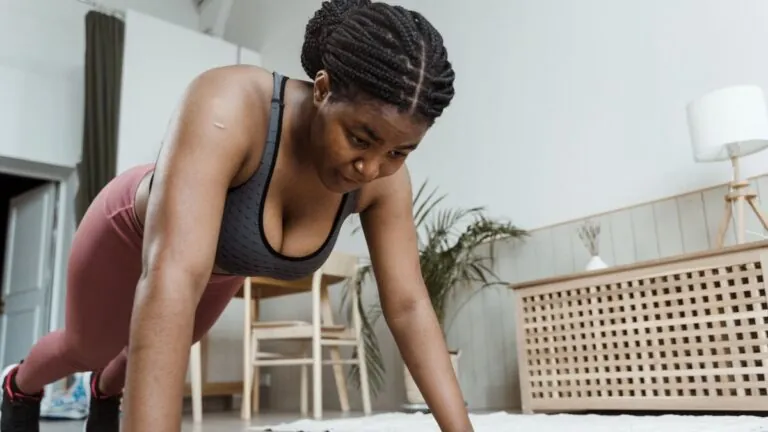
Core Exercise Routine at Home: 10 Moves with Form Cues (2026)
Ten core exercises you can do at home, each with form cues, regressions and progressions, plus beginner, intermediate and advanced routines.

A good core exercise routine at home needs just a mat, about 15–20 minutes and eight to ten well-chosen moves: planks, dead bugs, bird dogs, glute bridges, side planks and a few crunch variations. Do them two to four times a week with slow, controlled form, and most people notice a steadier back and better posture within a few weeks.
This guide is the exercise-by-exercise manual. For each move you get form cues, the mistake to watch for, an easier version (regression) and a harder version (progression), plus three ready-made routines for beginner, intermediate and advanced levels.
What your core actually is (and why it matters)
Your core is much more than the “six-pack” muscle. It includes the rectus abdominis at the front, the obliques on the sides, the deep transverse abdominis that wraps around like a belt, the muscles along your spine, your glutes, the diaphragm above and the pelvic floor below. Together they keep your trunk stable while your arms and legs move.
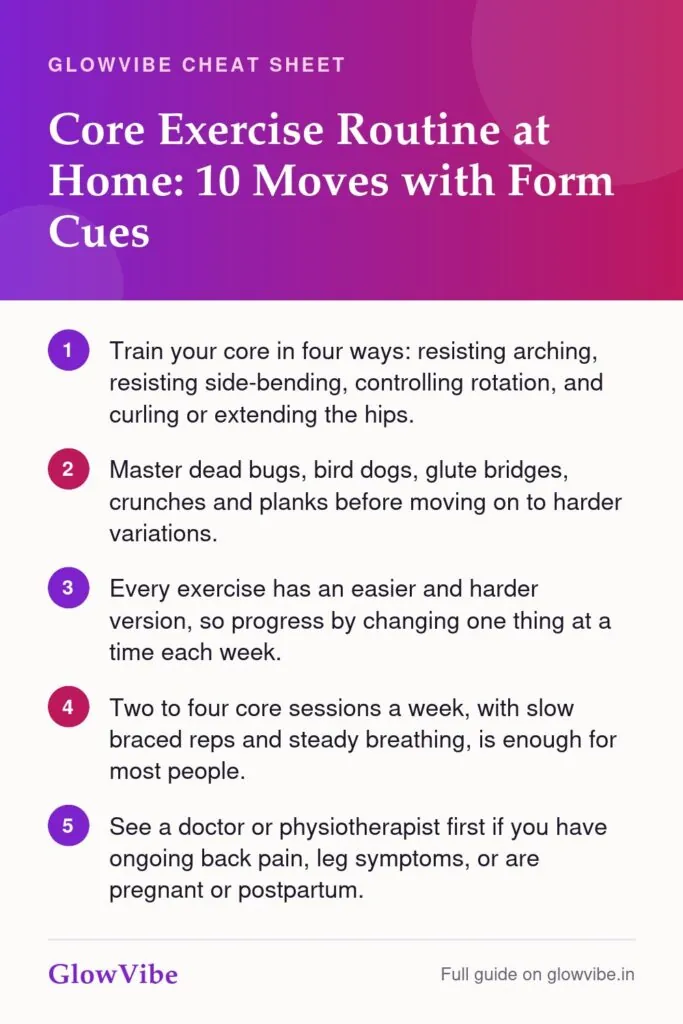
That is why a balanced routine trains the core in four ways, not just by crunching:
- Anti-extension – stopping your lower back from arching (planks, dead bugs, hollow holds).
- Anti-lateral flexion – stopping you from tipping sideways (side planks).
- Anti-rotation and controlled rotation – resisting or controlling twisting (bird dogs, shoulder taps, bicycle crunches).
- Flexion and hip extension – curling the trunk and driving the hips (crunches, reverse crunches, glute bridges).
A strong core helps you carry a heavy grocery bag up the stairs, sit through a long workday with less slouching and lift more safely in the gym. It will not, on its own, burn belly fat; that comes from overall activity and diet, which we cover in our guide to the best exercises for weight loss.
Core exercises at a glance
| Exercise | Main job | Level | Easier version | Harder version |
|---|---|---|---|---|
| Dead bug | Anti-extension | Beginner | Move legs only | Straight legs, slower tempo |
| Bird dog | Anti-rotation, back | Beginner | Arm or leg only | Elbow-to-knee crunch, hold 5 s |
| Glute bridge | Hip extension | Beginner | Shorter range | Single-leg bridge |
| Crunch | Flexion | Beginner | Hands on thighs, small lift | Pause at top, slow lower |
| Forearm plank | Anti-extension | Beginner–Intermediate | Knees down or incline | Shoulder taps, longer lever |
| Side plank | Anti-lateral flexion | Intermediate | Bottom knee down | Top leg lifted, hip dips |
| Reverse crunch | Lower-ab flexion | Intermediate | Bent knees, small range | Straight-leg raise |
| Bicycle crunch | Rotation | Intermediate | Feet on floor, slow twist | Slower tempo, pause each side |
| Hollow hold / V-sit | Anti-extension | Advanced | Tuck hollow | Full V-sit |
| Push-up to row | Anti-rotation, upper body | Advanced | Plank shoulder taps | Heavier dumbbells or water bottles |
Foundation moves: start here
These five exercises teach you to brace, breathe and keep your spine still. Master them before you chase longer planks or fast crunches. The bracing cue for all of them: take a normal breath in, then gently tighten your stomach as if someone is about to poke it, without sucking it in or holding your breath.
1. Dead bug
Lie on your back with arms pointing to the ceiling and knees bent at 90 degrees over your hips. Press your lower back lightly into the mat, then slowly lower your right arm and left leg towards the floor while breathing out. Return and switch sides.
- Form cue: your lower back should not peel off the mat. Only go as low as you can keep it there.
- Regression: keep arms still and lower one heel at a time to tap the floor.
- Progression: extend the legs straighter, or take three seconds to lower and three to return.
2. Bird dog
Start on all fours, hands under shoulders and knees under hips. Reach your right arm forward and left leg back until both are in line with your body, hold for two seconds, then return. It is one of the kindest exercises for the lower back.
- Form cue: imagine a cup of chai balanced on your lower back. Do not let your hips twist or your back sag.
- Regression: lift only the arm, or only the leg.
- Progression: hold each rep for five seconds, or bring elbow to knee under your body between reps.
3. Glute bridge
Lie on your back, knees bent, feet flat and hip-width apart. Push through your heels and squeeze your glutes to lift your hips until your body forms a line from shoulders to knees. Pause, then lower slowly.
- Form cue: finish the movement with your glutes, not by arching your lower back. Ribs stay down.
- Regression: lift only halfway and build up.
- Progression: single-leg bridge, or a three-second hold at the top.
4. Crunch
Lie on your back with knees bent and fingertips lightly behind your ears. Breathe out and curl your head, shoulders and upper back off the mat, as if bringing your ribs towards your hips. Lower with control.
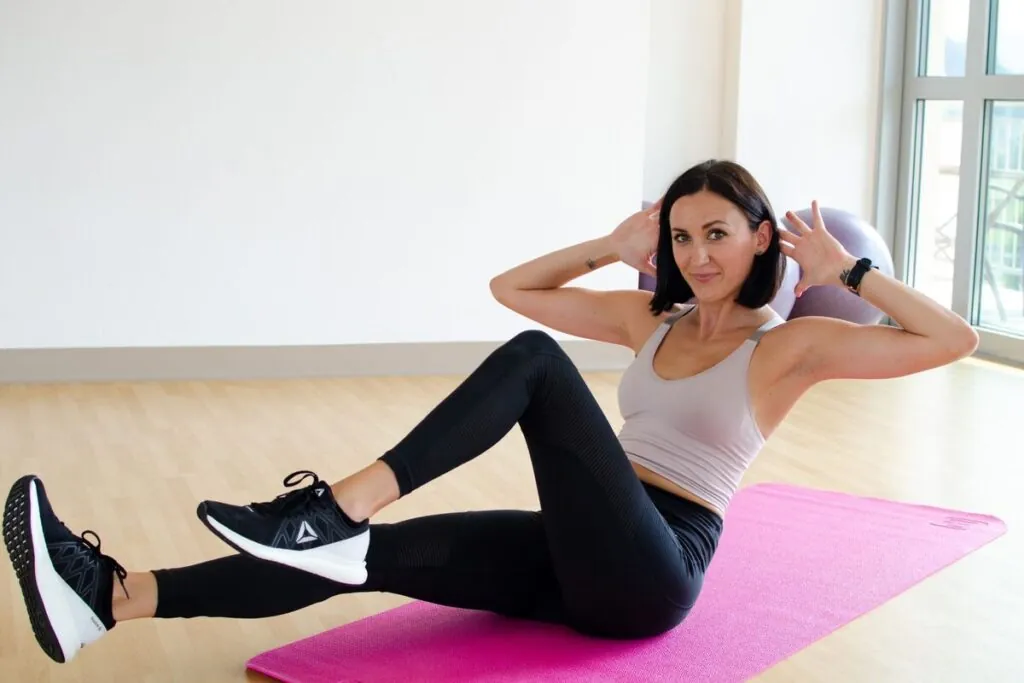
- Form cue: keep a fist-sized gap between chin and chest and never pull on your neck. The lift is small; your lower back stays down.
- Regression: slide your hands up your thighs towards your knees.
- Progression: pause for two seconds at the top and take three seconds to lower.
5. Forearm plank
Place your elbows under your shoulders, step your feet back and lift your body into one straight line from head to heels. Brace, breathe steadily and hold. Quality beats duration: a solid 20 seconds is worth more than a sagging minute.
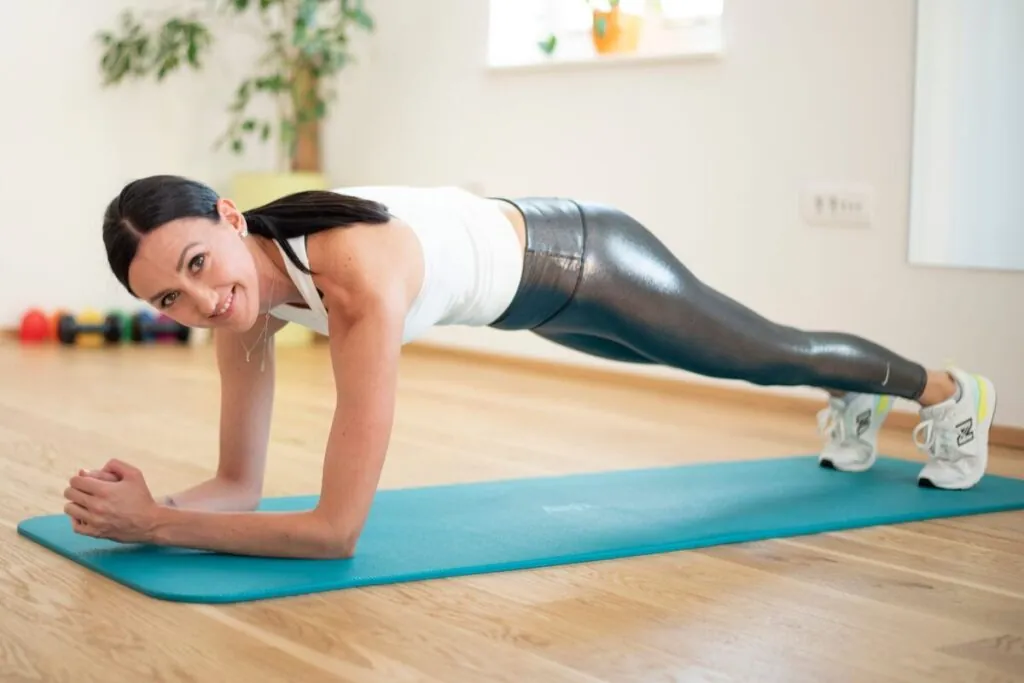
- Form cue: squeeze your glutes and tuck your tailbone slightly. Hips neither sag nor pike up.
- Regression: knees on the mat, or hands on a sofa or bed edge for an incline plank.
- Progression: high plank with alternating shoulder taps, or walk your elbows slightly further forward.
Intermediate core exercises
Move on to these once you can hold a clean 30-second plank and do 10 slow dead bugs per side without your back lifting.
6. Side plank
Lie on your side with your elbow under your shoulder and legs stacked. Lift your hips so your body is straight from head to feet, and hold. This targets the obliques and the deep muscles that stop you leaning sideways.
- Form cue: push the floor away with your forearm so your shoulder does not sink, and keep hips stacked rather than rolling back.
- Regression: bend the bottom knee and keep it on the mat.
- Progression: lift the top leg, or do slow hip dips and lifts.
7. Reverse crunch and leg raise
Lie on your back, hands by your sides, knees bent and lifted. Breathe out and curl your hips slightly off the mat, bringing knees towards your chest, then lower slowly. The straight-leg raise is the harder cousin of this move.
- Form cue: the movement comes from curling the pelvis, not from swinging the legs.
- Regression: keep knees bent and make the hip lift tiny.
- Progression: straight-leg raises, lowering only as far as your lower back stays pressed down.
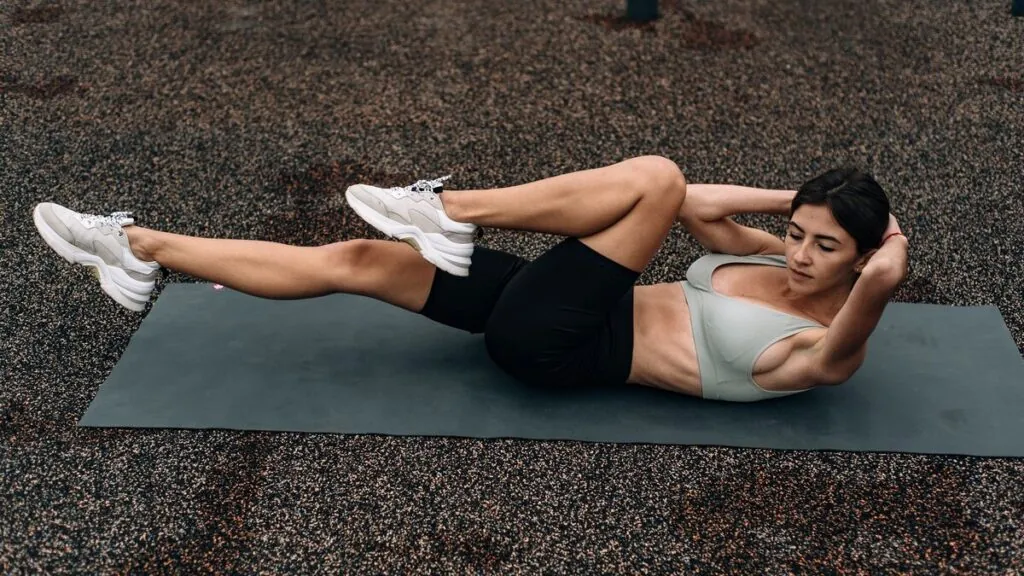
8. Bicycle crunch
From the crunch position, lift your feet and bring your right elbow towards your left knee as the right leg extends, then switch. Think “rotate the ribcage”, not “touch elbow to knee”.
- Form cue: go slowly. Fast, flapping bicycles mostly train your neck and hip flexors.
- Regression: keep both feet on the floor and twist the upper body only.
- Progression: pause for two seconds on each side.
Advanced core exercises
These demand more control and strength. Add them only after the intermediate moves feel steady.
9. Hollow hold and V-sit
Lie on your back, press your lower back into the mat, and lift your shoulders and legs so your body forms a shallow banana shape. Hold. The V-sit takes this further: you balance on your sitting bones with legs and torso raised into a V.
- Form cue: if your lower back arches off the floor, you have gone too far. Raise your legs higher.
- Regression: tuck hollow, with knees bent towards your chest.
- Progression: arms overhead in the hollow, or a full V-sit with straight legs.
10. Push-up to row
Get into a high plank holding a pair of light dumbbells (or two filled water bottles). Do a push-up, then row one weight up to your ribs while the rest of your body stays still. Repeat on the other side.
- Form cue: widen your feet for balance and fight the urge to rotate your hips as you row.
- Regression: skip the push-up and do plank shoulder taps or rows from the knees.
- Progression: bring your feet closer together or use heavier weights.
Three ready-made core routines
Warm up for three to five minutes first: marching on the spot, cat-cow stretches and a few slow bodyweight squats. Rest 20–30 seconds between exercises and 60–90 seconds between rounds.
Beginner: 15-minute no-equipment routine (2–3 rounds)
- Dead bug – 6–8 per side
- Glute bridge – 10–12
- Bird dog – 6 per side
- Crunch – 10
- Knee or forearm plank – 15–20 seconds
Intermediate: 20-minute routine (3 rounds)
- Forearm plank – 30–40 seconds
- Side plank – 20–30 seconds per side
- Reverse crunch – 10–12
- Bicycle crunch – 10 per side, slow
- Single-leg glute bridge – 8 per side
- Dead bug with straighter legs – 8 per side
Advanced: 25-minute routine (3–4 rounds)
- Push-up to row – 6 per side
- Hollow hold – 20–30 seconds
- Side plank with top leg lifted – 20 seconds per side
- Straight-leg raise – 8–10
- Plank shoulder taps – 10 per side
- V-sit hold – 10–20 seconds
To progress, add one rep or five seconds each week, and change only one thing at a time. When you want more structure, browse our free workout plans to fit core work around full-body training.
Choosing moves for your goal
- Desk job or stiff back: prioritise bird dogs, dead bugs, glute bridges and side planks, and limit crunches.
- Runners and walkers: side planks, single-leg bridges and bird dogs build the hip and trunk stability that running demands.
- Gym lifters: planks, dead bugs and push-up to rows carry over well to squats and deadlifts. Pair them with our back exercises for beginners for a balanced trunk.
- Short on time: add a five-minute core finisher after a HIIT workout instead of a separate session.
In hot, humid months, train in the cooler early morning or evening, keep water nearby and use a towel on the mat so your hands and forearms do not slip during planks.
Common mistakes to avoid
- Holding your breath: breathe out on the effort and keep breathing in holds.
- Chasing time over form: stop the plank the moment your hips sag.
- Pulling on your neck: fingertips only behind the ears in crunches.
- Only doing crunches: include anti-extension, side and rotation work every week.
- Arching the lower back in leg raises: shorten the range until you are stronger.
- Training through pain: mild muscle burn is fine; sharp or radiating pain is a signal to stop.
Frequently Asked Questions
Two to four sessions a week is plenty for most people. Gentle moves like bird dogs and dead bugs can be done more often, but give harder routines a rest day in between so your muscles recover.
You can do a short, easy stability routine daily, but intense sessions every day tend to backfire. Alternate harder days with lighter ones, and listen to any lingering soreness.
No. Nine of the ten exercises here need only a mat. A pair of light dumbbells or water bottles helps for the push-up to row, but plank shoulder taps work as a no-equipment swap.
Many people feel steadier and find planks easier within three to four weeks of consistent training. Visible abs depend mainly on body fat, so diet and overall activity matter more than extra crunches.
Gentle moves like bird dogs, dead bugs and glute bridges are often well tolerated, but back pain has many causes. If you have ongoing pain, pain that spreads down your leg, numbness or a recent injury, see a doctor or physiotherapist before starting.
Core training can be helpful, but the right moves change during pregnancy and after delivery, especially if you have abdominal separation. Get clearance and guidance from your doctor or a women’s health physiotherapist first.
Whenever you can be consistent. Some people like a quick morning session; others prefer evenings. Just avoid heavy core work right after a large meal.
Build your core one clean rep at a time
Pick the routine that matches your level, focus on slow, braced reps and progress a little each week. Use the regressions without guilt, since they are how you build towards the harder versions. For more reasons to stay active, read about the benefits of exercise, then roll out your mat today.