Easy Home Exercises for All Ages: Safe Moves for Beginners & Seniors
Ten gentle, low impact home exercises with steps, reps and easier or harder versions, plus a plan by age, a weekly schedule, morning routine and safety tips.

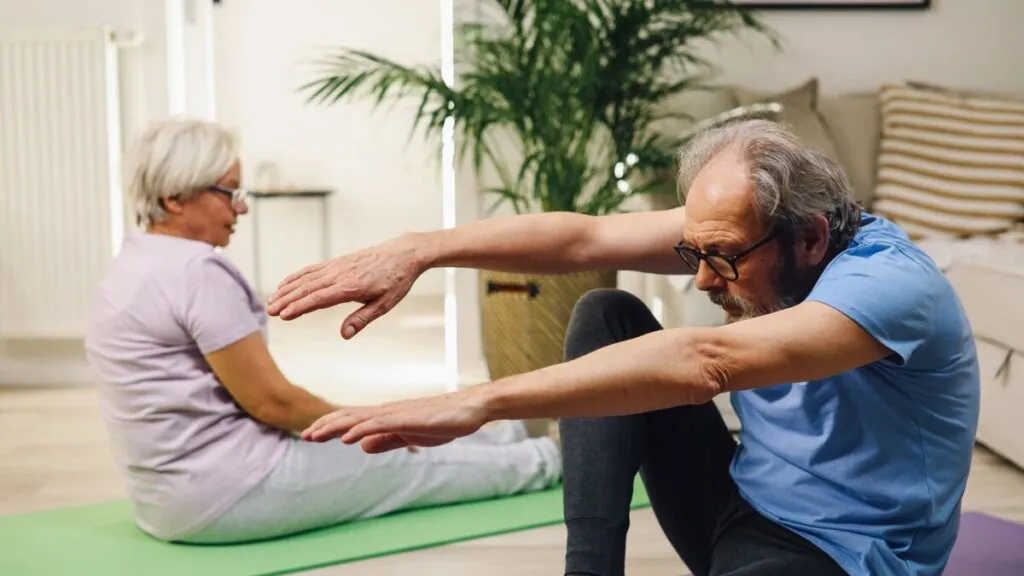
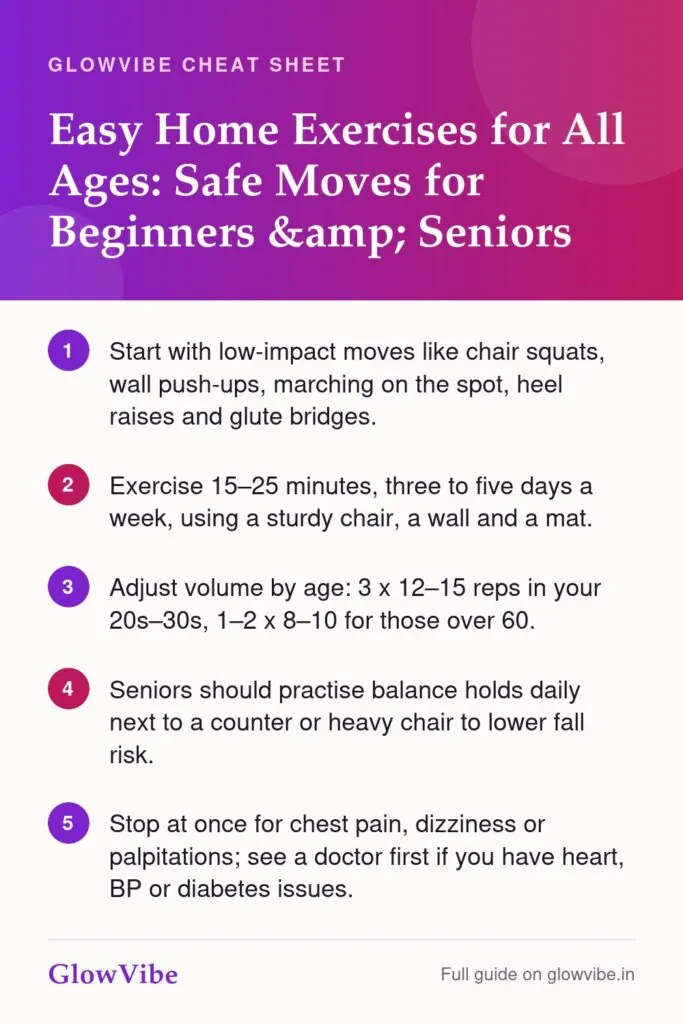
The best easy exercises at home are simple, low-impact moves like chair squats, wall push-ups, marching on the spot, heel raises and glute bridges, which build strength and balance without jumping or equipment. Do 15–25 minutes, three to five days a week, and you will notice that stairs, getting up from the floor and carrying shopping bags all start to feel easier.
This guide gives you 10 gentle moves with steps, reps and an easier or harder version of each, so the same routine works for a college student, a busy mother in her 40s and a grandparent in their 70s. You will also find a plan by age group, a weekly schedule, knee- and back-friendly swaps and the safety rules that matter most.
Quick answer: the 10 best low impact exercises for home
- Chair squats – thighs and hips; makes standing up easier.
- Wall push-ups – chest, shoulders and arms without floor work.
- Marching on the spot – gentle cardio and warm-up.
- Heel raises – calves, ankles and walking balance.
- Glute bridges – hips and lower back support.
- Bird-dog – core control and spine stability.
- Standing side leg raises – outer hip muscles that keep you steady.
- Seated knee extensions – front-thigh strength that supports the knee.
- Cat-cow – mobility for a stiff back and neck.
- Balance holds – single-leg stability to lower fall risk.
All you need is a sturdy chair without wheels, a wall, a mat or folded durrie, and a bottle of water. Wear shoes with grip or go barefoot on a non-slippery floor; socks on tiles or marble are a common cause of slips.
Easy home exercises by age group
The moves stay the same across ages; what changes is the volume, the support you use and how hard you push. Use this table as a starting point, then adjust to how your body feels.
| Age group | Sessions per week | Sets x reps | Focus | Best progression |
|---|---|---|---|---|
| 20s–30s | 4–5 (20–30 min) | 3 x 12–15 | Strength, stamina, posture from desk work | Harder versions, slower reps, add a backpack with books |
| 40s–50s | 3–5 (20–25 min) | 2–3 x 10–12 | Muscle and bone strength, joint care, belly fat | Increase reps first, then slow the lowering phase |
| 60+ | 3–4 (15–20 min) | 1–2 x 8–10 | Balance, leg strength, getting up from a chair or floor | Use less hand support over weeks; add balance holds daily |
10 gentle exercises for beginners at home (with steps)
Move slowly, breathe out on the effort and stop each set while you can still do one or two more with good form. Next-day soreness is normal; sharp pain is not.
1. Chair squats
Stand in front of a chair, feet hip-width apart. Push your hips back and lower until you lightly touch the seat, then press through your heels to stand. Keep your chest up and knees pointing in the same direction as your toes. Reps: 8–15.
- Easier: sit down fully and use your hands on your thighs to stand.
- Harder: hover just above the seat for 2 seconds, or remove the chair.
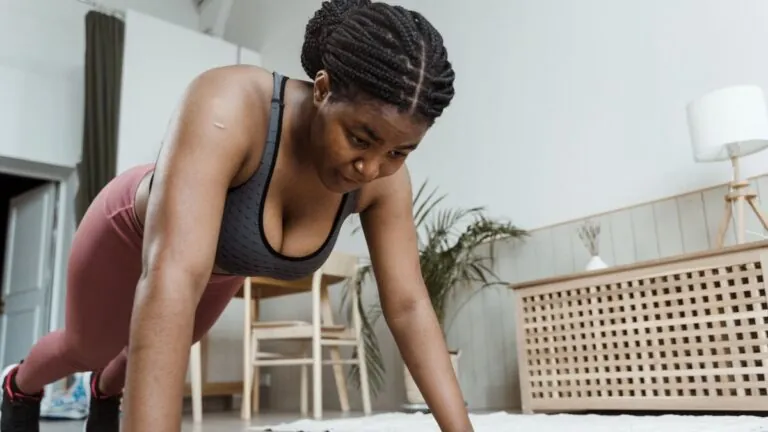
2. Wall push-ups
Stand an arm’s length from a wall and place your palms on it at shoulder height. Bend your elbows to bring your chest towards the wall, keeping your body in one straight line, then push back. Reps: 8–15.
- Easier: stand closer to the wall.
- Harder: use a kitchen counter or sturdy table, then progress to knee push-ups on the floor.
3. Marching on the spot
Stand tall and lift one knee towards hip height, then the other, swinging your arms naturally. This is a low-impact swap for jumping jacks and doubles as your warm-up. Time: 1–3 minutes.
- Easier: march while seated, or hold a chair back.
- Harder: march faster, lift knees higher or add overhead arm reaches.
4. Heel raises
Hold a chair back, feet hip-width apart. Rise slowly onto the balls of your feet, pause for a second, then lower with control. Reps: 10–15.
- Easier: do them seated, lifting only your heels.
- Harder: one foot at a time, or on the edge of a step.
5. Glute bridges
Lie on your back with knees bent and feet flat. Squeeze your buttocks and lift your hips until your body forms a line from shoulders to knees, hold for 2–3 seconds, then lower. Avoid arching your lower back at the top. Reps: 10–15.
- Easier: lift only a few centimetres, or do a standing hip squeeze against a wall.
- Harder: hold for 5 seconds, or lift one foot slightly off the floor.
6. Bird-dog
Start on hands and knees, hands under shoulders, knees under hips. Slowly reach your right arm forward and left leg back, keeping your hips level, hold for 3 seconds, then switch. Reps: 6–10 per side.
- Easier: move only the arm or only the leg.
- Harder: hold for 5–8 seconds or draw a small square with the hand and foot.
7. Standing side leg raises
Hold a chair or wall and stand tall. Lift one straight leg out to the side about 20–30 cm without leaning your body, then lower slowly. Reps: 8–12 per side.
- Easier: smaller lift, or lie on your side and do it on the floor.
- Harder: lightly touch the chair with one finger only, or pause at the top.
8. Seated knee extensions
Sit tall on a chair with feet flat. Straighten one knee until the leg is level, tighten the front of your thigh for 2–3 seconds, then lower slowly. This is one of the kindest exercises for knee pain at home because there is no load on the joint. Reps: 10–12 per side.
- Easier: straighten only partly, in a pain-free range.
- Harder: hold for 5 seconds, or loop a light cloth bag with a water bottle over the ankle.
9. Cat-cow
On hands and knees, breathe in as you let your belly drop and lift your chest (cow). Breathe out as you round your back and tuck your chin (cat). Move slowly, within a comfortable range. Reps: 6–10 slow rounds.
- Easier: do it seated on a chair, hands on your knees.
- Harder: add a gentle side-to-side hip sway between rounds.
If you enjoy this kind of breath-led movement, our post on why yoga matters for students explains how short yoga sessions help with focus and stress at any age.
10. Balance holds
Stand next to a kitchen counter with one hand resting on it. Lift one foot slightly off the floor and hold, keeping your standing knee soft and eyes on a fixed point. Time: 10–30 seconds per side, 2–3 times.
- Easier: stand with one foot slightly in front of the other (semi-tandem).
- Harder: heel-to-toe stance, then try with hands off the counter, then slowly turn your head.
A simple weekly plan
Pick 5–6 moves per session and do them as a circuit, resting 30–60 seconds between moves. Start every session with 3–5 minutes of marching and arm circles, and end with cat-cow and slow breathing.
| Day | Session | Moves |
|---|---|---|
| Monday | Strength A | Chair squats, wall push-ups, glute bridges, bird-dog, heel raises |
| Tuesday | Walk + balance | 20–30 min brisk walk, balance holds |
| Wednesday | Strength B | Side leg raises, seated knee extensions, wall push-ups, glute bridges, cat-cow |
| Thursday | Rest or gentle mobility | Cat-cow, marching, light stretching |
| Friday | Strength A | Repeat Monday, add one rep per set if it felt easy |
| Saturday | Active day | Walk, yoga, dancing, gardening or playing with kids |
| Sunday | Rest | Balance holds while brushing your teeth |
Once this feels comfortable for four to six weeks, you can move on to our 30-minute full-body workout at home or add a dedicated core exercise routine at home.
A 10-minute morning exercise routine
Mornings are often the only quiet time in an Indian household, and in summer it is also the coolest part of the day. Drink a glass of water first, then do this sequence once or twice:
- Marching on the spot with arm swings – 2 minutes.
- Cat-cow – 6 slow rounds.
- Chair squats – 10 reps.
- Wall push-ups – 10 reps.
- Heel raises – 12 reps.
- Balance hold – 20 seconds per side.
Your joints may feel stiff right after waking, so keep the first round slow. If you have diabetes and take medicine, check with your doctor about exercising before breakfast.
Home exercises for women in their 30s to 50s
From the mid-30s onwards, muscle and bone mass slowly decline, and the years around menopause speed this up. Regular strength work, even with body weight, is one of the most useful habits you can build for bone health, posture and energy.
- Prioritise strength 2–3 days a week: squats, bridges, push-ups and heel raises load the legs, hips and arms.
- Add the pelvic floor: after childbirth, gentle pelvic-floor squeezes alongside bridges help; see a physiotherapist if you leak urine when you cough or jump.
- Work around your cycle: on heavy or tiring days, swap strength for a walk and cat-cow.
- Fit it into the day: 10 minutes in the morning plus a 15-minute evening walk adds up.
If your goal is fat loss, pair this with our 4-week workout plan for weight loss for females, or step up to the 7-day gym workout schedule for women when you are ready.
Exercises for seniors at home: balance and fall prevention
Falls are a major reason older adults lose independence, and stronger legs plus better balance lower that risk. Practise balance every day, even for two minutes, and set up your space safely.
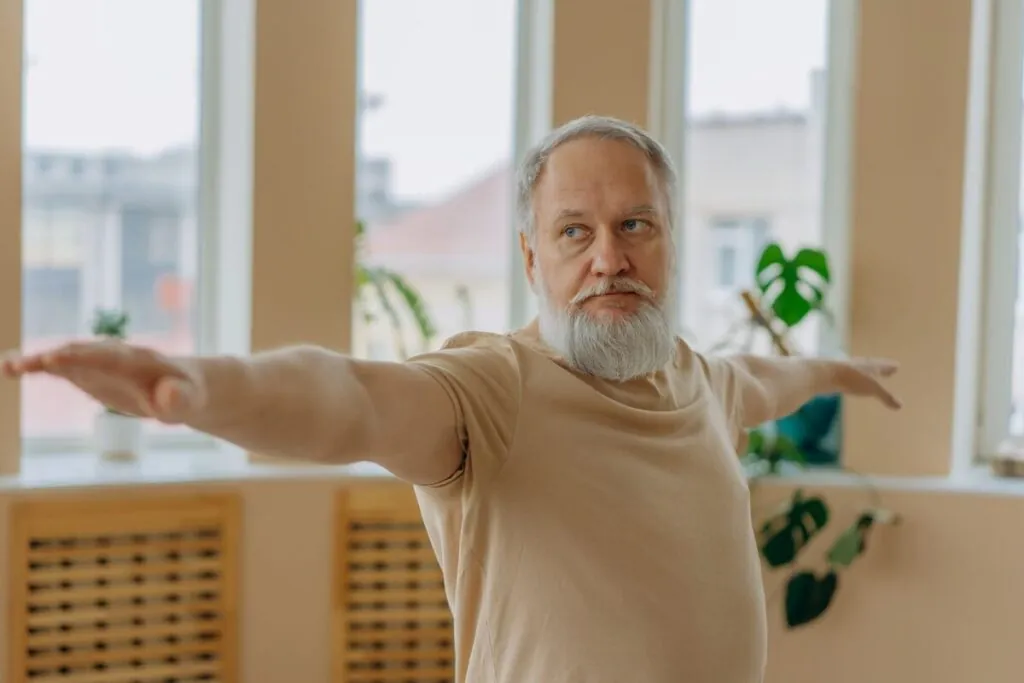
- Always exercise next to a counter, wall or heavy chair you can grab.
- Clear loose rugs, wires and wet patches; avoid polished floors in socks.
- Stand up slowly from lying or sitting, especially if you take BP medicine, to avoid dizziness.
- Practise the sit-to-stand (chair squat) without hands; it is the movement you use most in daily life.
- Have your eyesight checked and wear well-fitting footwear at home.
- Exercise when someone else is at home if you have fallen before.
Knee- and back-friendly modifications
If you have knee pain
- Use a higher chair for squats and only go as low as is pain-free.
- Lean on seated knee extensions, glute bridges and side leg raises; strong thighs and hips take load off the knee.
- Skip jumping, deep squats and kneeling on hard floors; put a folded towel under your knees for bird-dog.
- Mild discomfort that settles within a day is usually fine; swelling, locking or worsening pain needs a doctor or physiotherapist.
If you have back pain
- Keep cat-cow small and slow; never force the range.
- Bird-dog and glute bridges train the muscles that support the spine; keep your back neutral, not arched.
- Avoid toe-touches and sit-ups while your back is sore.
- See a doctor promptly if back pain comes with numbness, leg weakness, or bladder or bowel changes.
Safety rules before you start
- Warm up for 3–5 minutes every time, and cool down with slow breathing.
- Stop immediately if you feel chest pain or tightness, dizziness, unusual breathlessness, palpitations or sudden pain, and seek medical help if it does not settle.
- See a doctor first if you have heart disease, high or low blood pressure, diabetes, are recovering from surgery, or are pregnant.
- Use the talk test: you should be able to speak in short sentences while exercising.
- Respect the heat: in Indian summers, exercise early or in a fan-cooled room and sip water.
Common mistakes
- Doing too much in the first week, then quitting because of soreness.
- Rushing reps; slow, controlled movement is safer and works muscles harder.
- Holding your breath during effort.
- Skipping balance work because it feels too easy.
- Never progressing; add a rep, a set or a harder version every couple of weeks.
Frequently Asked Questions
Marching on the spot, chair squats, wall push-ups and heel raises are the easiest starting points. They need no equipment and you can hold a chair for support. Start with one set of 8–10 reps and build up over a few weeks.
Aim for strength moves on two or three non-consecutive days and some walking or light activity on most other days. Beginners can start with three short sessions a week. Consistency matters more than intensity.
Yes, they are low impact and can be done with support from a chair or counter. Seniors should start with the easier versions, practise balance daily and exercise near something sturdy. Anyone with heart, BP or diabetes issues should check with a doctor first.
Seated knee extensions, glute bridges and standing side leg raises strengthen the thigh and hip muscles that support the knee without stressing the joint. Keep movements in a pain-free range. If pain is severe, or the knee swells or locks, see a doctor or physiotherapist.
They help by building muscle and keeping you active, but weight loss depends mainly on your overall diet and daily movement. Combine this routine with walking and balanced meals for steady results. Expect gradual change over months rather than weeks.
The best time is the one you can stick to. Mornings are cooler and easier to protect from interruptions, while evenings may suit stiff joints better. Warm up a little longer if you exercise soon after waking.
Start small, stay steady
You do not need a gym or an hour a day to get stronger. Pick five of these moves, do them three times this week next to a sturdy chair, and add a little each week. In a couple of months, everyday tasks will feel lighter, and that is the real goal of exercise at every age.