How to Get Glowing Skin in 7 Days: A Realistic Plan (2026)
A realistic 7-day plan for glowing skin: daily AM/PM routine, one gentle exfoliation, tan removal that works, safe home remedies and when to see a dermatologist.


You can get noticeably glowing skin in 7 days by doing a few simple things every day: wash gently, moisturise well, wear sunscreen every morning, exfoliate once, and sleep and drink water properly. In one week your skin can look more hydrated, smoother and less dull, and a fresh tan can start to fade, but dark spots and pigmentation take weeks to months, and nothing will change your natural skin tone.
That is good news, not bad news. “Glow” is mostly about light bouncing evenly off a smooth, well-hydrated surface, and that part responds quickly. This guide gives you a realistic day-by-day plan, the tan removal steps that actually work, the home remedies worth trying (and the ones to skip), and the signs that mean you should see a dermatologist instead.
Quick answer: glowing skin tips for the next 7 days
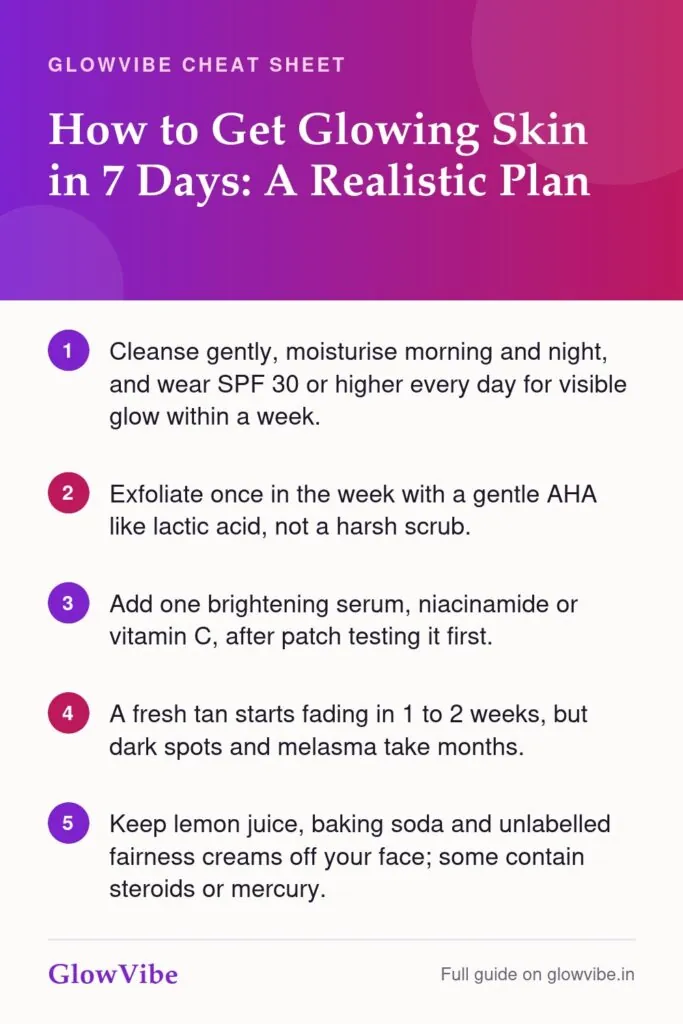
- Cleanse gently twice a day with a mild, non-stripping face wash. Squeaky-clean skin looks dull, not glowing.
- Moisturise morning and night. Hydrated skin reflects light better within a day or two.
- Wear Broad spectrumA sunscreen label meaning it protects against both UVB rays (which cause burning) and UVA rays (which cause tanning and ageing).See glossaryRead the guide SPF (sun protection factor)A measure of protection against UVB rays, which cause sunburn. SPF 30 blocks about 97% of UVB and SPF 50 about 98%, if you apply enough and reapply.See glossaryRead the guide 30 or higher every morning, and reapply if you are outdoors. Without it, no brightening step works.
- Exfoliate once this week with a gentle AHA (alpha hydroxy acid)Water-soluble exfoliating acids such as glycolic, lactic and mandelic acid. They loosen dead cells on the surface for smoother, brighter-looking skin.See glossaryRead the guide such as Lactic acidA gentle AHA (first found in milk) that exfoliates and also hydrates. A good starter acid for dry or sensitive skin.See glossary, not a harsh scrub.
- Add one brightening serum: NiacinamideA form of vitamin B3 that helps with oiliness, the look of large pores, uneven tone and barrier support. Gentle and easy to pair with most ingredients.See glossaryRead the guide or Vitamin CAn antioxidant that brightens dull skin, helps fade the look of dark spots and supports sunscreen against daily damage. Best used in the morning.See glossaryRead the guide. Pick one and stick with it.
- Sleep 7 to 8 hours, drink enough water and eat fruit and vegetables. Tired, dehydrated skin shows first on the face.
What 7 days can and cannot do for your skin
Your skin renews its outer layer roughly every four weeks, and slower as you age. So a one-week plan works on the surface: water content, dead cells and puffiness. Deeper pigment sits lower down and fades only as new cells replace old ones.
| Concern | Realistic in 7 days? | What to expect |
|---|---|---|
| Dullness and dry, flaky patches | Yes | Visible change in 2 to 4 days with moisturiser and one ExfoliationRemoving dead skin cells from the surface, either with acids and enzymes (chemical) or scrubs and tools (physical). Two to three times a week is plenty for most people.See glossary |
| Rough texture | Partly | Smoother feel after one gentle AHA session |
| Fresh tan (a few weeks old) | Starts to fade | Noticeable lightening in 1 to 2 weeks if you stop new sun damage; full fade can take 4 to 6 weeks |
| Old tan, dark spots, acne marks | No | Usually 8 to 12 weeks of daily sunscreen plus actives |
| Melasma | No | Needs a dermatologist; months of treatment |
| Natural skin tone | Never | Your genetic colour is healthy and does not need “fixing” |
Keep this in mind when you see “fair in 7 days” claims online. Healthy glowing skin can be any shade, from fair to deep brown. The goal here is even, bright, comfortable skin, not a lighter colour.
How to get glowing skin in 7 days: the day-by-day plan
The basic routine stays the same every day. Each day adds one small focus so you are not trying everything at once. If you already have a routine, slot these steps in; if you are starting from scratch, our simple AM and PM daily skincare routine explains each step in more detail.
Every morning: gentle cleanse (or just water if your skin is dry), brightening serum, moisturiser, sunscreen. Every night: cleanse (Double cleansingCleansing twice at night: an oil or balm first to dissolve sunscreen and makeup, then a gentle face wash to clean the skin.See glossaryRead the guide if you wore sunscreen or makeup), serum, moisturiser.
| Day | Morning (AM) | Night (PM) | Lifestyle focus |
|---|---|---|---|
| Day 1 | Cleanse, moisturise, SPF 30+. Start the habit of a full two-finger amount of sunscreen. | Cleanse, moisturiser. Patch-test your new serum behind the ear or on the jaw. | Fill a 1 to 1.5 litre bottle and finish it by evening, plus your usual drinks. Set a fixed bedtime. |
| Day 2 | Add niacinamide or vitamin C serum before moisturiser (if the patch test was fine). | Cleanse, serum, moisturiser. | Add one fruit and one bowl of vegetables or dal you would not normally eat. |
| Day 3 | Same routine. Reapply sunscreen at lunch if you go out. | Exfoliation night: a gentle lactic acid or mild AHA product, then moisturiser. Skip the serum tonight. | Aim for 7 to 8 hours of sleep. No phone for 30 minutes before bed. |
| Day 4 | Moisturiser and SPF only; let skin settle after exfoliation. Add serum back if there is no stinging. | Cleanse, moisturiser. A slightly richer cream if skin feels tight. | Cut back on fried snacks and sugary drinks today. |
| Day 5 | Full routine with serum and SPF. | Hydration mask: honey or a hydrating sheet/gel mask for 10 to 15 minutes, rinse, moisturise. | 20 to 30 minutes of walking, yoga or exercise. |
| Day 6 | Full routine. Wear a cap or carry an umbrella if you are out between 11 am and 3 pm. | Cleanse, serum, moisturiser. Optional rice water toner after cleansing. | Another early night. Limit alcohol and late-night tea or coffee. |
| Day 7 | Full routine with SPF. | Cleanse, serum, moisturiser. Take a photo in the same light as Day 1 to compare. | Decide which steps you will keep. Sunscreen and moisturiser are non-negotiable. |
Choosing your moisturiser and serum
Oily or acne-prone skin does well with a light gel moisturiser; dry skin needs a cream with ceramides, glycerin or shea butter. If you want help picking one, see our list of the best daily face cream for glowing skin.
For the serum, niacinamide is the easiest place to start because it suits most skin types, helps with oiliness and gradually evens tone. Our guide to the best niacinamide serum in India covers strengths and how to use it. Not sure whether vitamin C or something else suits your concern better? Read which face serum you should use.
How to remove tan from face: what actually works
A tan is your skin making extra melanin to protect itself from UV rays. To remove tan from the face, you need to do two things at once: stop adding new tan, and help the tanned outer cells shed faster. In Indian sun, the first part matters more than any pack or cream.
- Sunscreen every single day. Use SPF 30 or more with good UVA protection (look for PA+++ or PA++++), even on cloudy days and indoors near windows. Apply enough (roughly two finger-lengths for face and neck) and reapply every 2 to 3 hours outdoors.
- Gentle chemical exfoliation. Lactic acid and mandelic acid are milder AHAs that suit most Indian skin. Once a week is enough at the start; you can go to twice a week later if your skin is comfortable. Avoid gritty scrubs, which cause micro-irritation and can darken brown skin further.
- Vitamin C in the morning. It is an antioxidant that supports sunscreen and helps fade dullness over weeks. Store it away from heat and light, and stop using it if it turns dark brown.
- Niacinamide daily. It reduces the transfer of pigment to surface cells and is well tolerated. Results build over 4 to 8 weeks.
- Physical protection. A cap, dupatta, umbrella or sunglasses cut down sun exposure on your commute far more than you might think.
Be careful with lemon, baking soda and bleach creams
Lemon juice is very acidic and can cause burns and dark patches when skin is exposed to sunlight afterwards. Baking soda is strongly alkaline and disrupts your skin barrier, leaving it red, dry and more prone to pigmentation. Both are common in tan removal videos, and both are best kept in the kitchen.
Bleach creams only hide tan by lightening facial hair, and they can sting or irritate sensitive skin. Be especially wary of unlabelled “fairness” or “instant whitening” creams from local shops or online sellers. Some contain steroids or mercury, which can cause thin skin, acne, stubborn pigmentation and other health problems. If a cream promises dramatic lightening in days, do not use it.
Glowing skin home remedies worth trying
If you want to brighten skin naturally, a few kitchen ingredients are gentle enough for most people. They will not remove pigmentation, but they can add a little softness and hydration. Always patch-test first, even with natural ingredients.
- Honey mask: raw honey is a natural humectant that draws water into the skin. Apply a thin layer to clean skin for 10 to 15 minutes, then rinse with lukewarm water. Our honey for face guide has easy face pack combinations.
- Rice water: used as a toner after cleansing, it feels soothing and lightly hydrating. Make a fresh batch every few days and keep it in the fridge. Here is how to make and use rice water for your face.
- Curd and besan pack: plain curd (which contains a little lactic acid) mixed with gram flour is a traditional, gentle pack. Use it once or twice a week, not daily, and rinse without scrubbing.
- Aloe vera gel: calming after a day in the sun. Use pure gel and stop if it stings.
- Turmeric: a small pinch in a curd or honey pack is fine for most people, but it can stain and irritate sensitive skin. It is not a cure for tan.
Skip hot facial steaming. It feels relaxing, but heat can trigger redness, aggravate melasma and dry out skin. A short facial massage with your moisturiser gives a similar fresh, flushed look without the risk.
Food and lifestyle habits for glowing skin
Diet will not change your skin overnight, but a week of better habits often shows as less puffiness and a fresher look. Focus on these:

- Water: sip through the day, especially in summer heat or air-conditioned offices. Coconut water, buttermilk and lemon water (to drink, not to apply) count too.
- Vitamin C foods: amla, guava, oranges, papaya and tomatoes support normal collagen production.
- Healthy fats: walnuts, flaxseeds, almonds and fish help skin feel less dry.
- Protein: dal, paneer, eggs, sprouts and curd give your skin the building blocks it needs.
- Less sugar and fried food: some people notice fewer breakouts when they cut back.
- Sleep: 7 to 8 hours makes the biggest single difference to dark circles and dullness in a week.
- Movement and stress: a daily walk or yoga improves circulation and can help stress-related breakouts.
Common mistakes that make skin look dull
- Over-exfoliating: scrubbing daily or stacking acids leaves skin red, shiny-tight and more likely to darken.
- Starting five new products at once: if you react, you will not know which one caused it.
- Skipping sunscreen on “indoor” days: UVA comes through windows and undoes your brightening work.
- Using too little sunscreen: a pea-sized dab gives far less protection than the label says.
- Harsh soaps and very hot water: both strip natural oils, especially in winter or with hard water.
- Picking at pimples: this leaves dark marks that take months to fade on Indian skin.
When to see a dermatologist
Home care is fine for dullness and a fresh tan. See a dermatologist if you notice any of these:
- Brown or grey-brown patches on the cheeks, forehead or upper lip that keep returning, especially during pregnancy or on hormonal pills. This may be melasma, which needs proper treatment.
- Sudden dark patches, or patches on the neck and underarms that feel velvety.
- A mole or spot that changes in size, shape or colour, bleeds or itches.
- Burning, peeling or swelling after using any cream or home remedy.
- Pigmentation or acne marks that have not improved after 3 months of daily sunscreen and a consistent routine.
A dermatologist can offer prescription creams, peels or other treatments that are safer and more effective than strong over-the-counter products.
Frequently Asked Questions
Yes, if by glowing you mean hydrated, smoother and less dull. Moisturiser, sunscreen, one gentle exfoliation, sleep and water can make a visible difference within a week. Dark spots, old tan and melasma take much longer.
Protect your skin from the sun every day, keep it moisturised, and use gentle packs like honey or curd with besan once or twice a week. Eat fruit and vegetables, drink enough water and sleep well. Avoid lemon juice and baking soda on your face.
A fresh tan usually starts fading in one to two weeks and can clear in about four to six weeks, as long as you wear sunscreen daily. Older or deeper tan can take two to three months. Gentle AHAs, vitamin C and niacinamide can speed things up a little.
Both help. Niacinamide is gentler and also controls oil, so it suits oily, acne-prone and sensitive skin. Vitamin C is a strong antioxidant best used in the morning under sunscreen. If you are new to actives, start with niacinamide.
No. Daily scrubbing damages the skin barrier and can cause redness and darkening, especially on brown skin. Once a week with a gentle chemical exfoliant is enough to start.
No, and it should not. No safe product changes your natural skin tone. This plan helps your skin look even, healthy and bright in its own shade, and helps fade tan back to your normal colour.
Keep the core steps: gentle cleansing, moisturiser, daily sunscreen and one serum. Exfoliate once or twice a week depending on how your skin feels. Consistency over months is what fades pigmentation.
Quick poll
How many steps are in your skincare routine?
The bottom line
Seven days is enough to give your skin a fresher, smoother, more hydrated look and to start fading a recent tan. Keep it simple: cleanse gently, moisturise, wear sunscreen every day, exfoliate once and look after your sleep and diet.
Treat this week as the start of a habit, not a quick fix. Stay consistent for two to three months and you will see the deeper changes in tone and texture that no one-week plan can promise.