How to Build a Fitness Routine: Step-by-Step Guide (2026)
A step-by-step guide to building your own fitness routine: set a goal, balance cardio, strength and mobility, plan your week, progress gradually and track it.


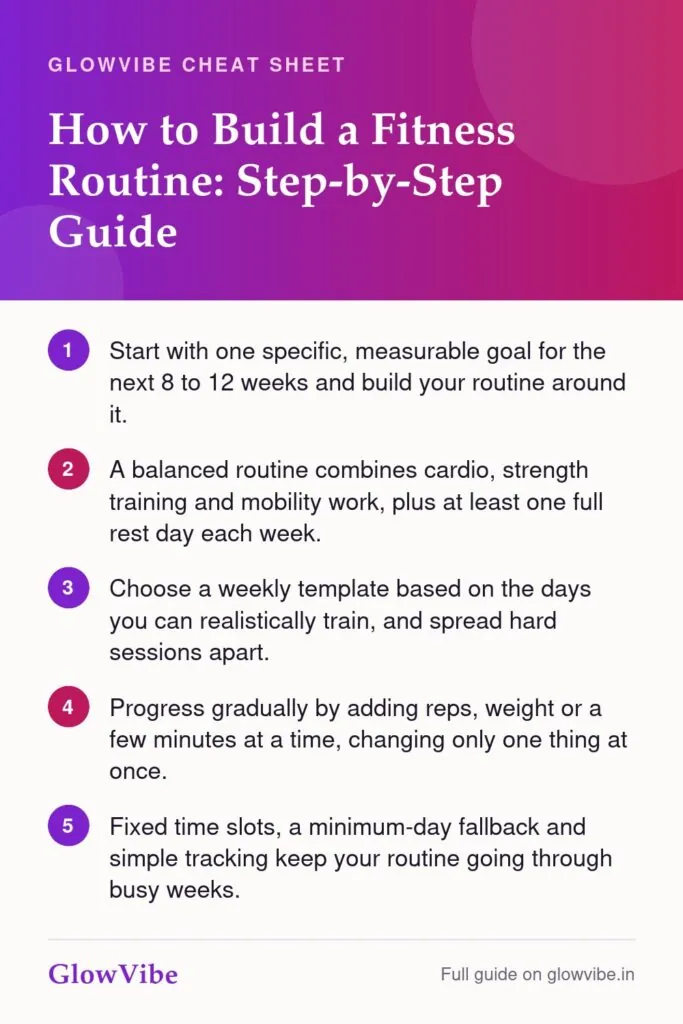
To build a fitness routine that lasts, pick one clear goal, then plan a week that mixes cardio, strength training and mobility around the days you can realistically train. Start a little easier than you think you need to, add a small amount of work each week, and track what you do so you can see progress and adjust.
This guide shows you how to design that routine yourself, step by step. If you would rather follow a ready-made schedule, our free workout plans for home, gym, walking and busy days are a good place to start. Come back here when you want to tweak one or build your own.
How to build a fitness routine: the quick version
- Set one main goal for the next 8–12 weeks and make it specific and measurable.
- Count your real training days: 2, 3, 4 or 5 per week, and how long each session can be.
- Cover the three components: cardio, strength and mobility, weighted towards your goal.
- Lay out the week so hard days are spread out and you get at least one full rest day.
- Progress slowly: one extra rep, a little more weight or a few more minutes at a time.
- Build habits and track so the routine survives busy weeks, travel and festivals.
Step 1: Set a goal your routine can be built around
“Get fit” is a wish, not a plan. A useful goal tells you which kind of training to prioritise and gives you a way to check that it is working. Write down one main goal and, if you like, one smaller secondary goal.
Good goals are specific, measurable and time-bound. Compare “lose weight” with “walk-jog 5 km without stopping by March” or “do 10 full push-ups in 10 weeks”. The second versions tell you exactly what to train and when to reassess.
- Fat loss: strength training to keep muscle, plus regular cardio and daily steps. Food matters most here, so pair it with enough protein (see our guide to protein-rich Indian foods for weight loss).
- Muscle and strength: 3–5 strength sessions a week, with cardio kept lighter so it does not eat into recovery.
- Stamina: more cardio, built up gradually, with two short strength sessions to protect knees, hips and back.
- General health: a balanced mix. Current WHO guidance for adults is at least 150–300 minutes of moderate activity a week, plus muscle-strengthening work on two or more days.
If you have a heart condition, diabetes, high blood pressure, a past injury, or you are pregnant or recovering from surgery, talk to your doctor before starting a new routine. They can tell you what to avoid and what intensity is safe for you.
Step 2: Understand the three components of a fitness routine
Almost every good routine is built from the same three components. Your goal decides how much of each you do, but leaving one out completely usually catches up with you as stiffness, poor stamina or a plateau.

Cardio
Cardio is anything that raises your heart rate for a sustained period: brisk walking, cycling, jogging, swimming, skipping, dance classes or a game of badminton. Most of it should be at a moderate, conversational pace, where you can talk but not sing.
Once you have a base, you can add one shorter, harder interval session a week. Beginners can ease in with our 6-week walk-jog interval plan.
Strength training
Strength work builds muscle, supports your joints and bones, and makes daily tasks easier. You do not need a gym to start: bodyweight squats, push-ups (against a wall or table at first), lunges, glute bridges and rows with a backpack all count.
Build each session around movement patterns rather than random exercises:
- Squat: squats, goblet squats, step-ups
- Hinge: glute bridges, Romanian deadlifts, hip thrusts
- Push: push-ups, overhead press, chest press
- Pull: rows, lat pulldowns, band pull-aparts
- Core and carry: planks, dead bugs, farmer’s carries (our core exercise routine at home has form cues)
Mobility and flexibility
Mobility work keeps your hips, shoulders and upper back moving freely, which matters if you sit at a desk or on a two-wheeler for hours. Use dynamic moves such as leg swings, arm circles and cat-cow to warm up. Save longer, held stretches or a yoga flow for after training or a separate short session.
Ten minutes, two or three times a week, is enough for most people. Yoga counts too, and many people find it the easiest way to make mobility a habit.
Rest and recovery
Rest is when your body adapts to the training. Plan at least one full rest day a week, aim for 7–9 hours of sleep, and drink enough water, especially in Indian summers when you sweat far more than you realise. Light walking on rest days is fine and often helps stiffness.
Step 3: Plan your weekly workout structure
Be honest about how many days you can train in a normal week, not your best week. Three good sessions done every week will beat five planned sessions you keep skipping. Then pick the template that matches.

| Days per week | Suggested structure | Best for |
|---|---|---|
| 2 days | 2 full-body strength sessions with 10 minutes of cardio each; daily walks on other days | Very busy schedules, complete beginners |
| 3 days | Mon, Wed, Fri full-body strength + 15–20 min cardio; mobility at the end | Most beginners, general health, fat loss |
| 4 days | Upper body / lower body split twice a week; 2 separate cardio sessions on lighter days or after training | Beginners after 2–3 months, muscle and strength goals |
| 5 days | 3 strength days (e.g. push, pull, legs) + 2 cardio days, one of them intervals | Experienced exercisers with good recovery |
A few rules make any template work better:
- Space out hard days. Avoid heavy leg training the day before a long run or interval session.
- Leave 48 hours before training the same muscle group hard again.
- Keep sessions realistic. 30–45 minutes is plenty: a 5–10 minute warm-up, 20–30 minutes of main work, and a short cool-down.
- Fit the Indian climate. In summer and monsoon, move outdoor cardio to early morning or evening, or switch to indoor options. In winter smog, check the air quality before running outside.
If you train five or six days and want a proven split, the push pull legs workout routine shows how to arrange it at home or in the gym.
Step 4: Choose your exercises and set your starting point
For each strength session, pick one exercise from four or five of the movement patterns above. Do 2–3 sets of 8–15 reps, and choose a version or weight that leaves you with about two good reps “in the tank” at the end of each set.
For cardio, start with what you can do comfortably today. That might be 15 minutes of brisk walking, not 45. Write down your starting numbers: reps, weights, minutes, distance. These become your baseline for progression.
Step 5: Progress gradually so you keep improving
Your body adapts to whatever you ask of it, so the same workout gets easier over time. To keep improving, you need to add a little more challenge on purpose. This is called progressive overload.
- Reps first: once you can do the top of your rep range (say 12) for all sets with good form, add a little weight or move to a harder version.
- Cardio time: increase total weekly cardio by roughly 10% at most, for example from 60 to 66 minutes.
- One change at a time: do not add more days, weight and intensity all in the same week.
- Lighter week: every 4–6 weeks, cut your volume by about a third for a week to let your body catch up.
Reassess at the end of each 8–12 week block. If you hit your goal, set a new one. If progress has stalled for three or four weeks despite consistent training, look at sleep, food and stress before blaming the plan.
Step 6: Build consistency habits that stick
Motivation fades within a few weeks; habits are what keep a routine alive. The aim is to make training the default, not a daily decision.
- Fix a time slot and treat it like a meeting. Early mornings work well for many people because fewer things get in the way.
- Stack it onto an existing habit, such as a walk straight after your morning chai or a session before dinner.
- Lower the barrier: keep your shoes and clothes ready the night before, and keep a 20-minute home workout for days you cannot reach the gym.
- Use a “minimum day”: on bad days, do just the warm-up and one exercise. Showing up keeps the habit going.
- Plan for disruptions such as travel, exams, weddings and festivals with a shorter version of your routine instead of stopping completely.
It also helps to remember why you started. Our article on the benefits of exercise covers what regular training does for energy, mood and long-term health.
Step 7: Track your workouts and progress
Tracking turns guesswork into decisions. A notebook or notes app is enough; a fitness watch is optional.
- Every session: exercises, sets, reps and weights, or cardio time and distance, plus a quick note on how it felt.
- Every week: number of sessions completed and your average daily steps.
- Every month: one or two outcome measures linked to your goal, such as a timed walk, max push-ups, waist measurement or progress photos.
Sample beginner week you can adapt
Here is how the steps above come together in a three-day routine for a beginner with a general fitness goal:
- Monday: full-body strength (squat, push-up, glute bridge, row, plank), 2–3 sets each, then 15 minutes of brisk walking.
- Tuesday: rest or an easy 20–30 minute walk.
- Wednesday: full-body strength (step-up, overhead press, Romanian deadlift, band pull-apart, dead bug), then 10 minutes of mobility.
- Thursday: rest or a yoga session.
- Friday: repeat Monday’s strength session, trying to add one rep per set, then 20 minutes of cycling or walk-jog intervals.
- Saturday: an activity you enjoy, such as a long walk, a sport, swimming or dancing.
- Sunday: full rest.
Common mistakes when building your own routine
- Doing too much in week one. Extreme soreness and fatigue are the fastest way to quit. Start easy and build.
- Only doing cardio. Skipping strength training means you lose muscle as you lose weight, and your joints get less support.
- Changing the plan every week. Constant variety stops you progressing on anything. Keep your main exercises for at least 6–8 weeks.
- Skipping the warm-up. Five to ten minutes of light cardio and dynamic moves prepares your body and helps you train better.
- Ignoring pain. Muscle soreness is normal; sharp, joint or worsening pain is not. Stop that exercise and get it checked if it persists.
- Expecting exercise to fix diet. For fat loss, food and sleep matter as much as the workouts.
Frequently Asked Questions
Three to four days a week suits most beginners, with at least one full rest day and light activity such as walking on the other days. You can make progress on as few as two strength sessions a week if they are done consistently. Increase days only once your current schedule feels manageable.
A balanced routine includes cardio for heart health and stamina, strength training for muscles and joints, and mobility or flexibility work. It also needs planned rest. Your goal decides the proportions, but most people benefit from some of each every week.
Spend 5–10 minutes on light cardio such as brisk walking, marching on the spot or easy cycling, then do dynamic moves like leg swings, arm circles and bodyweight squats. Finish with one or two lighter sets of your first exercise. Save long, held stretches for after the workout.
Most people feel more energetic and find workouts easier within two to four weeks. Visible changes in muscle tone or body shape usually take eight to twelve weeks of consistent training and sensible eating. Tracking your sessions helps you notice progress before the mirror does.
Yes. Bodyweight squats, lunges, push-ups, glute bridges, planks and brisk walking or skipping cover all three components. To progress without weights, slow the tempo, add reps, or move to harder versions such as single-leg bridges. A resistance band is a useful, inexpensive next step.
Yes. Your muscles, joints and nervous system adapt during rest, not during the workout itself. Training hard every day without a break raises your risk of fatigue, niggling injuries and stalled progress. Take at least one full rest day a week and keep other easy days genuinely easy.
Keep the same core exercises for 6–8 weeks while you progress them. Change things when progress has stalled for three or four weeks despite good sleep and nutrition, when your goal changes, or when you are genuinely bored. Swap a few exercises rather than starting from scratch.
Final thoughts
The best fitness routine is the one built around your goal, your schedule and the life you actually live. Cover cardio, strength and mobility, spread your hard days across the week, progress a little at a time, and track what you do. Start small this week, and if you want a head start, pick one of our ready-made workout plans and adjust it using the steps above.