Body Lotion for Dry Skin: Ingredients to Look For
Which ingredients in a body lotion actually help dry, itchy skin, how to read the label in under a minute, and how much to apply.

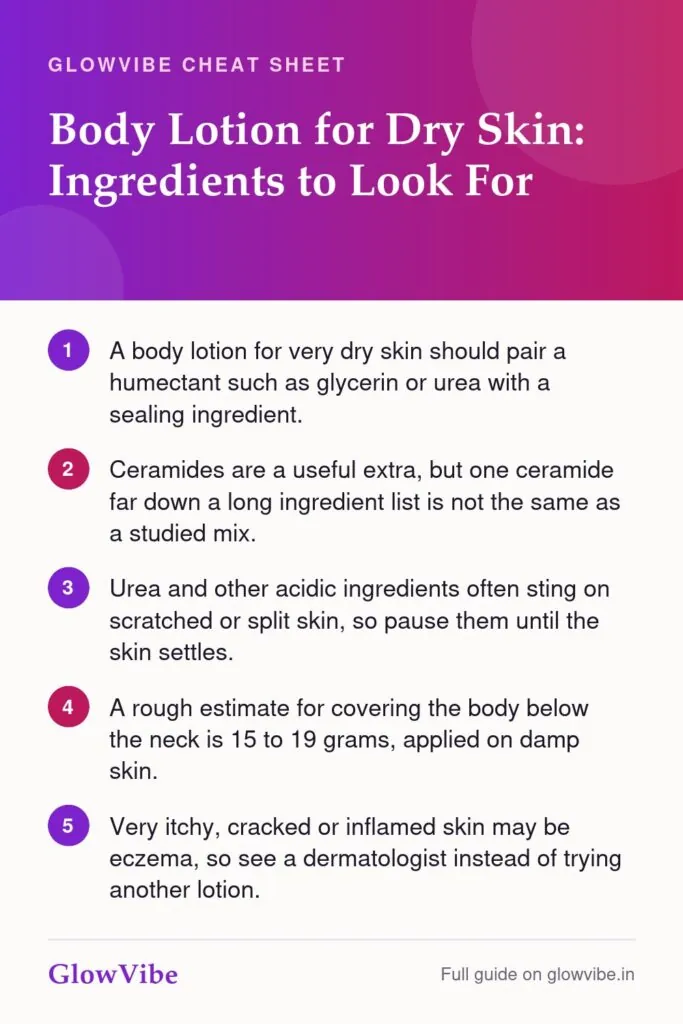
The best body lotion for very dry skin pairs a water-binding ingredient such as GlycerinOne of the most common and effective humectants. It draws water into the skin and is found in most moisturisers and cleansers.See glossary or urea with something that slows water loss, such as petrolatum, mineral oil, SiliconesIngredients like dimethicone that coat hair (and skin) for slip, shine and frizz control. Heavier ones can build up and need a clarifying wash.See glossaryRead the guide or shea butter. CeramidesFats that naturally hold skin cells together like mortar between bricks. Moisturisers with ceramides help support a dry or damaged skin barrier.See glossaryRead the guide are a useful extra. As a rough guide, covering the body below the neck takes about 15 to 19 grams, a figure worked out from a measure meant for medicated creams.
This guide is about reading the back of the bottle, so it names ingredients rather than brands. If your skin is very itchy, cracked or red, the label may not be the real issue, and the section on when to see a dermatologist matters more than the rest.
The quick answer
- Look for a HumectantAn ingredient that attracts water, such as glycerin or hyaluronic acid. Humectants hydrate best when sealed in with a moisturiser.See glossaryRead the guide: glycerin, urea, Hyaluronic acidA humectant that holds water in the skin for a plump, hydrated look. Despite the name, it is not an exfoliating acid. Apply on damp skin.See glossaryRead the guide or PanthenolPro-vitamin B5, a soothing and hydrating ingredient used in skin and hair products to calm and soften.See glossary.
- Look for a sealing ingredient too: petrolatum, mineral oil, dimethicone, lanolin or shea butter.
- Treat ceramides as a bonus: helpful for a weak Skin barrierThe outermost layer of skin that keeps water in and irritants out. A damaged barrier feels tight, stings and reacts more easily.See glossaryRead the guide, but the label rarely tells you how much is inside.
- Be careful with: fragrance if your skin reacts easily, and urea or Lactic acidA gentle AHA (first found in milk) that exfoliates and also hydrates. A good starter acid for dry or sensitive skin.See glossary on scratched or split skin.
- Use enough: a thin smear will not do much. Apply on damp skin straight after your bath.
Why two types of ingredient matter
Dry skin has two problems at once: the outer layer holds too little water, and it loses what it has too quickly. Low humidity, air conditioning, fan heaters, frequent bathing and soap can all add to this, according to DermNet, the New Zealand dermatology resource.
Moisturising ingredients fall into three working groups. Humectants pull water into the outer skin layer. Occlusives form a thin oily film that slows water escaping. Emollients fill the tiny gaps between skin cells, which is why skin feels smoother soon after you apply them.
The pairing is the part most people miss. A 2017 paper on moisturisers in Clinical Medicine & Research notes that humectants can also increase water loss from the skin, so they are often combined with occlusives. A watery lotion that is all humectant may feel pleasant for an hour and still leave your shins tight by evening.
Ingredients to look for on the label
The American Academy of Dermatology lists jojoba oil, dimethicone, glycerin, hyaluronic acid, lactic acid, lanolin, mineral oil, petrolatum and shea butter as ingredients that can help dry skin. Here is what each main one does and what to watch for. The skincare ingredients glossary explains more of the names you will meet on a bottle.
| Ingredient | Its job | Good to know |
|---|---|---|
| Glycerin (may appear as glycerine) | Humectant | A dependable basic. Works better when the formula also has an occlusive. |
| Urea | Humectant, and softens scaly skin | Often stings on scratched or split skin. |
| Hyaluronic acid | Humectant | Needs a sealing ingredient with it on very dry skin. |
| Ceramides | Barrier lipids | May help when skin feels sore, tight and easily irritated. |
| Petrolatum | Occlusive | Very effective at slowing water loss. Can feel heavy in humid weather. |
| Mineral oil (Paraffinum Liquidum) | Occlusive | Common in body lotions. May feel heavy to some people. |
| Dimethicone | Occlusive, silky feel | Gives a less greasy finish, so it can suit humid months. |
| Shea butter | Softening, sealing | Comfortable on rough areas. Richer formulas may not suit acne-prone backs. |
| Lanolin | Softening, sealing | A known cause of contact allergy in some people. |
| Lactic acid | Humectant, mild exfoliant | An alpha hydroxy acid (AHA). Can raise sun sensitivity. |
Glycerin: the everyday starting point
If you only learn one word on a label, make it this one. Glycerin near the top of the list, with an oil, butter or petrolatum somewhere close by, is a reasonable sign that a lotion is built for dry skin. The 2017 paper reports that glycerol combined with occlusives eases dryness better than either alone.
Urea: useful, with one catch
Urea draws in water and also helps loosen thick, scaly build-up, so it often appeals to people with rough shins and heels. That paper cites 10% urea as having reduced water loss in people with atopic skin. A percentage printed on the bottle is helpful, but plenty of lotions list urea without saying how much is in there.
The catch is stinging. DermNet says urea and other acidic preparations often sting on scratched or fissured skin. If you have open cracks or fresh scratch marks, wait until they settle, or choose a plainer formula for now.
Ceramides: helpful, but read the claim carefully
Ceramides are fats that occur naturally in your skin and help it hold water. Low ceramide levels are linked with atopic dermatitis, and the same paper reports that a topical mix of ceramides, cholesterol and fatty acids sped up barrier repair. That result was for that specific mix, so one ceramide far down a long list is not the same thing.
Look for the word “ceramide” often followed by letters or a number, ideally alongside cholesterol or fatty acids. If your skin stings even with gentle products, read this guide to a damaged skin barrier before you buy anything new.
Lactic acid: for rough skin, not sore skin
Lactic acid can help with a rough, flaky feel, but it is an AHA. The US FDA says AHAs increase skin’s sensitivity to UV and advises sun protection while using them and for a week afterwards. In India, that matters for arms and legs that are out in the sun, so pair it with this advice on sunscreen even in winter, and skip it on irritated skin.
Ingredients to approach with care
- Fragrance: usually listed as “Fragrance” or “Parfum”. The word can cover many compounds, and fragrances are a recognised cause of allergic contact dermatitis. If your skin is itchy or reactive, fragrance-free is the simpler choice.
- Essential oils: they can add scent even to a lotion sold as natural, so check for them if you are avoiding fragrance.
- Drying alcohol near the top: “alcohol denat” high on the list can sting cracked skin. Don’t confuse it with cetyl or stearyl alcohol, which are fatty alcohols that soften skin.
- Lanolin and propylene glycol: perfectly fine for many people, but both are listed as possible causes of contact dermatitis. Avoid them if you have reacted to them before.
How to read a lotion label in under a minute
Words like “intensive” or “deep repair” on the front tell you nothing about the formula. Turn the bottle over and do this instead.
- Find the ingredient list. India’s Cosmetics Rules 2020 say ingredients above 1% must be listed in descending order of weight or volume, followed by those at 1% or less in any order. So position late in the list means little. Packs of 60 ml or 30 g or less don’t have to carry a list at all.
- Scan the first five or six names. Water usually comes first. You want a humectant and at least one sealing or softening ingredient in this stretch.
- Look for the star ingredient. If a bottle sells itself on one ingredient, see where it sits. Right at the end, it may be a very small amount.
- Check for what you avoid. Fragrance, essential oils, or anything that has irritated you before.
When a lotion is not enough
Texture counts as much as the ingredient list. The NHS describes lotions as thin and easy to spread but “not very moisturising”, and the American Academy of Dermatology says ointments and creams work better than lotions for dry skin. So if a good lotion leaves your legs tight by midday, the next step is usually a thicker cream, not a longer ingredient hunt.
Lotions still have their place. They spread easily over large or hairy areas and feel comfortable in Indian summers and humid monsoon months, when a heavy cream can feel sticky. Many people do well with a lotion on most of the body and a cream on shins, elbows, hands and feet. If your skin is oily or acne-prone in places, this guide to non-greasy body lotions for oily skin will suit those areas better.
How much body lotion to use
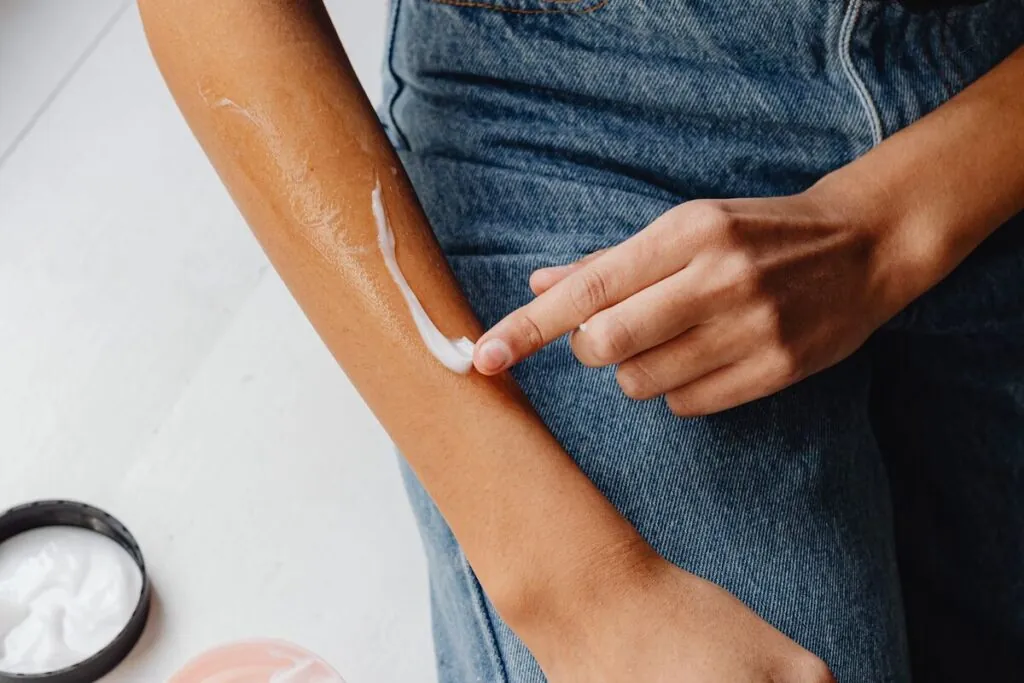
It is easy to use too little lotion. A handy measure is the fingertip unit: a line of product squeezed along the length of an adult index finger. DermNet puts it at about 0.5 grams for men and 0.4 grams for women. Those figures come from its guidance on steroid creams, not lotions, and lotion is runnier, so the table below is an estimate of scale rather than a dose. If you use a prescribed steroid cream, follow the amount your doctor gave you instead.
| Area | Fingertip units | Rough amount |
|---|---|---|
| Both arms and hands | 8 | 3 to 4 g |
| Both legs and feet | 16 | 6.5 to 8 g |
| Trunk, front and back | 14 | 5.5 to 7 g |
| Whole body below the neck | 38 | 15 to 19 g |
Worked out from those figures, and taking 1 ml of lotion as about 1 gram, a 200 ml bottle would last roughly 10 to 13 days if you covered your whole body once a day. If yours lasts far longer on whole-body use, your layer is thinner than this, which is worth changing only if your skin still feels dry. People with eczema can need much more: DermNet gives weekly amounts averaging up to 500 grams for adults.
How to apply it
- Keep baths to about 5 to 10 minutes in warm, not hot, water, as the American Academy of Dermatology advises.
- Pat dry gently with a towel and leave skin slightly damp.
- Apply straight away. DermNet says moisturisers work best on damp skin.
- Smooth it on in the direction your hair grows rather than rubbing hard, which is the NHS method.
- Top up whenever skin feels dry, and after washing your hands. The NHS says emollients can be used as often as you like, and for dry skin conditions suggests at least three or four times a day.
For the full seasonal plan, see this winter skincare routine for dry skin. For soap swaps, oils and other home care, the dry skin remedies guide goes further.
When to see a dermatologist
Very itchy, cracked or inflamed skin may be eczema rather than simple dryness, and a lotion alone may not control it. The NHS says eczema can look red, white, purple or grey, or lighter or darker than the surrounding skin, depending on your skin tone. So on brown skin, don’t wait for redness before you take it seriously.
See a dermatologist if your skin stays dry despite regular moisturising, keeps you awake with itching, or burns or stings with products. Dry skin can also be linked to other conditions, including psoriasis, kidney disease and low thyroid, or to certain medicines. Get seen urgently if skin is blistered, crusty, leaking fluid, painful, swollen or warm, or if you have a fever or feel unwell, because these can be signs of infection.
For babies and children, in pregnancy, or if you have a medical condition, ask your doctor before starting a new active such as urea or lactic acid.
Common mistakes
- Applying acids or urea to split skin. Stinging is a signal to pause, not a sign that it is working.
- Undoing it in the bath. Long, hot baths and harsh soap can leave you back where you started, however good the lotion is.
- Skipping the patch test. Try anything new on a small area of your inner arm for a few days first.
- Forgetting flames. The NHS warns that clothing and bedding that have been in contact with emollients can catch fire easily, paraffin-free ones included. Take care near stoves, heaters, diyas and cigarettes, and wash fabrics often.
Frequently Asked Questions
Both are humectants, and neither is better for everyone. Urea also softens rough, scaly skin, but it can sting on cracks and scratches. If your skin is sore, a plainer glycerin-based formula may be more comfortable.
No. Mineral oil is a standard occlusive and appears on the American Academy of Dermatology’s list of ingredients that help dry skin. It may feel heavy for some people, and thick occlusive products can worsen acne or inflamed hair follicles (folliculitis) on areas such as the back.
Not for everyone. Plenty of people use scented lotions with no trouble. If your skin is itchy, inflamed or prone to rashes, though, fragrance-free removes one possible trigger, and that makes it the safer place to start.
Skin usually feels softer right after applying. Give a lotion a fortnight of regular use before judging whether flakiness and tightness are easing. That is a practical checkpoint, not a medical rule, and if itching or cracking keeps going, see a dermatologist rather than switching bottles again.
No lotion can promise that. A good one can ease itch caused by simple dryness, but it won’t treat eczema, psoriasis or an allergy by itself. If itching is strong or lasting, a dermatologist can work out the cause.
Quick poll
How many steps are in your skincare routine?
The bottom line
Turn the bottle over and look for a humectant plus a sealing ingredient near the top of the list, with ceramides as a bonus and no fragrance if your skin reacts easily. Use enough to cover the skin properly, on damp skin, straight after a short warm bath. If your skin is still very itchy, cracked or inflamed after that, the next step is a dermatologist, not another lotion.