Skincare Routine Order: What Goes First, Morning and Night
Which product goes on first? A clear morning and night order, where serums, actives, spot treatments, oils and sunscreen fit, and how to judge the wait between layers.

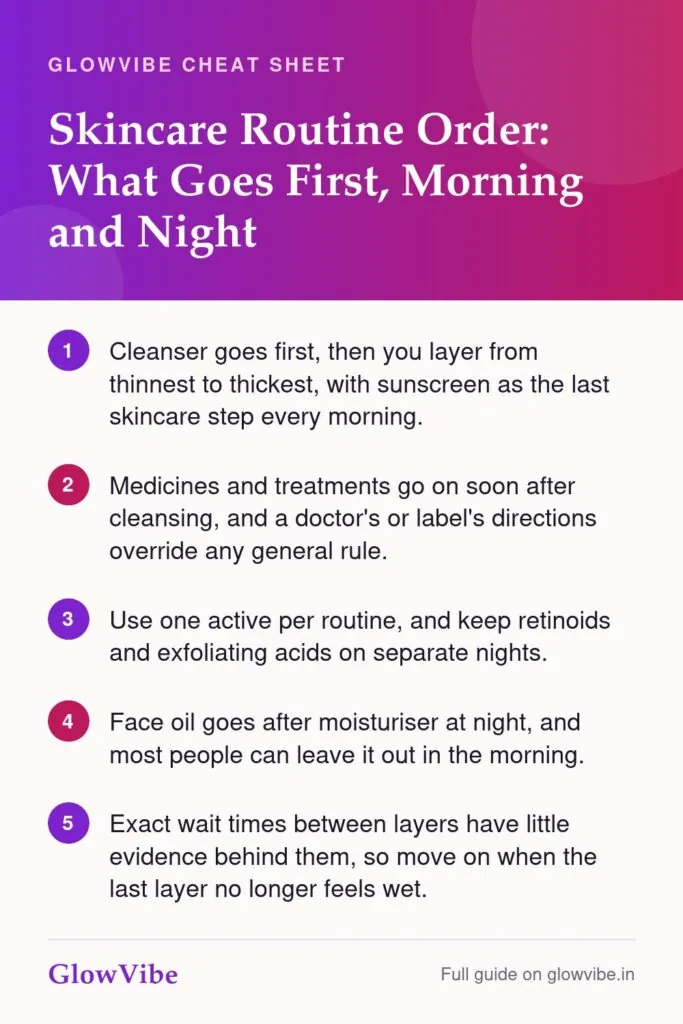
Cleanser always goes first, and after that you layer from thinnest to thickest: serum, then moisturiser, with sunscreen last in the morning. At night the order is the same without sunscreen, and any treatment such as a retinoid goes on clean skin before your moisturiser.
This guide covers only the order. If you are still deciding which steps you need, the basic CTM guide explains cleanser, toner and moisturiser, and the AM/PM routine builder can put together a routine for your skin. Come back here when you have a serum, an active or an oil in hand and no idea where it fits.
The quick answer
- Morning: cleanser, active serum, hydrating serum, moisturiser, sunscreen, then makeup if you wear it.
- Night: cleanser, one active or treatment, hydrating serum, moisturiser, then face oil if you use one.
- Prescription creams: follow your doctor’s instructions first, even when they differ from any general rule.
- Waiting: go by feel. Move on when the last layer no longer feels wet or slippery.
The one rule behind the order, and its exceptions
Thin to thick is a sensible convention, not a rule proven in trials. Watery products spread easily over bare skin, while creams and oils leave a slick film that a thin serum can struggle to spread over. If you can’t tell which of two products is thinner, put a little of each on the back of your hand. The one that runs goes first.
The American Academy of Dermatology (AAD) gives a short version of the same idea: wash your face, apply any medicine or treatment right after cleansing, then apply moisturiser and/or sunscreen, then makeup. Everything else in this guide fills in the gaps around those steps.
Texture does not settle everything, though. Three things override it:
- Sunscreen stays on top of your skincare, even if it is thinner than your moisturiser. The AAD says to put it on after other skincare products and beneath makeup.
- Medicine goes close to the skin, even if it is a thick cream, unless your doctor tells you to do it differently.
- Product directions win. If a label or a doctor gives a specific order, use it.
Morning order, step by step
Skip any step you don’t use. The order of the remaining steps stays the same. For a full morning and evening plan rather than just the sequence, see the daily skincare routine guide.
| Order | Step | Where it fits and why |
|---|---|---|
| 1 | Cleanser | A gentle wash, then pat dry. |
| 2 | Hydrating toner or essence (optional) | Watery, so it goes on bare skin. |
| 3 | Active serum, such as Vitamin CAn antioxidant that brightens dull skin, helps fade the look of dark spots and supports sunscreen against daily damage. Best used in the morning.See glossaryRead the guide | Goes on early, with as little between it and your skin as possible. |
| 4 | Hydrating serum or NiacinamideA form of vitamin B3 that helps with oiliness, the look of large pores, uneven tone and barrier support. Gentle and easy to pair with most ingredients.See glossaryRead the guide (optional) | Light and water-based, so it comes before cream. |
| 5 | Eye cream (optional) | Pat on before moisturiser so a heavier layer doesn’t spread over it. |
| 6 | Moisturiser | In humid weather, a thin gel may be enough. |
| 7 | Sunscreen | Last skincare step. Apply about 15 minutes before you step out. |
| 8 | Makeup (optional) | Goes over sunscreen once it has settled. |
Night order, step by step
Night follows the same logic, with two changes: no sunscreen, and this is where stronger actives usually go. The night skincare guide covers which steps suit your skin type.
| Order | Step | Where it fits and why |
|---|---|---|
| 1 | Oil cleanser or micellar water (optional) | Use it first if you wore makeup or water-resistant sunscreen. |
| 2 | Face wash | Clears what’s left, then pat dry. |
| 3 | Hydrating toner (optional) | Skip it on prescription-treatment nights so the medicine goes right after cleansing. |
| 4 | One active: retinoid, exfoliating acid or treatment | Goes on dry skin, before anything rich. Keep it to one per night. |
| 5 | Hydrating serum (optional) | Adds water without weight, and can feel soothing after an active. |
| 6 | Eye cream (optional) | Before moisturiser, as in the morning. |
| 7 | Moisturiser | A richer texture is fine here, especially in winter. |
| 8 | Face oil or a heavy balm (optional) | Last, because thin layers spread poorly over oil. |
Where serums, actives, oils and sunscreen actually go
Two or more serums
Put the active one first, then the hydrating one, and apply watery before gel or milky. Two serums in one routine is plenty for most people. A third rarely adds much and makes pilling and irritation more likely, especially on a sticky monsoon morning.

Vitamin C
The AAD’s advice is to apply vitamin C after washing your face in the morning, before sunscreen. A moisturiser can sit between the two if your skin wants it. If a vitamin C serum stings, that is a reason to use it less often or stop, not to push through.
Retinoids
Retinoids belong at night. One dermatologist quoted by the AAD suggests applying a retinoid at night, 20 to 30 minutes after washing your face. If that feels too drying, the same AAD article says to apply a moisturiser straight after washing and the retinoid 20 to 30 minutes later.
Retinoids and exfoliating acids generally shouldn’t share a night, and some other pairs are better split as well. The guide to ingredients you should not mix explains each pair, and a simple way to take turns is in the skin cycling routine. Prescription retinoids such as tretinoin need your doctor’s directions, and if you are pregnant, planning a pregnancy or breastfeeding, ask a doctor before using any retinoid.
Exfoliating acids
A leave-on AHA (alpha hydroxy acid)Water-soluble exfoliating acids such as glycolic, lactic and mandelic acid. They loosen dead cells on the surface for smoother, brighter-looking skin.See glossaryRead the guide or BHA (beta hydroxy acid)An oil-soluble exfoliating acid that can get inside pores. Salicylic acid is the common BHA, popular for oily and acne-prone skin.See glossaryRead the guide goes on after cleansing and on dry skin, before serums and moisturiser. Use it at night, a few times a week, and treat it as that night’s one active. An exfoliating toner counts as an acid even though it is sold as a toner, so give it this slot and not the hydrating toner slot.
Niacinamide and hydrating serums
These are the easy ones. They usually go after any stronger active and before moisturiser, morning or night. A hydrating serum can go on slightly damp skin, in the same way the AAD suggests moisturising dry skin while it is still damp, which helps in dry winter air or air-conditioned rooms.
Spot treatments
Apply an acne gel or cream to clean, dry skin before moisturiser. For acne treatments, the AAD advises a thin layer over the whole acne-prone area, not just the visible spots, because that treats existing acne and helps prevent new breakouts. Check your own product’s directions, because some are made only for dabbing on single spots.
Pimple patches stick best to bare, dry skin, so put them on before any cream and work around them. If your acne hasn’t improved after a fair trial, see a dermatologist. The AAD says to give a treatment at least four weeks, and that clearing can take two to three months or longer.
Face oils
A face oil goes after moisturiser at night, as the final step. A water-based serum applied over oil tends to bead and slide instead of spreading, which is why the oil comes later. A heavy balm or OcclusiveAn ingredient that forms a protective layer to stop water escaping from the skin, such as petrolatum, shea butter or dimethicone.See glossaryRead the guide layer, as used in SluggingApplying a thin layer of an occlusive like petroleum jelly as the last night-time step to lock in moisture. Best for dry skin.See glossaryRead the guide, follows the same logic and goes last.
In the morning, most people can leave oil out. It can make sunscreen and makeup slide around, and that is especially annoying in Indian heat and humidity. Dry skin that still wants oil in winter can mix a drop into moisturiser, then let it settle before sunscreen.
Sunscreen
Sunscreen goes after all your other skincare and under makeup, every morning, gel or cream, mineral or chemical. The AAD says it takes about 15 minutes for skin to absorb sunscreen, so apply it before you leave, not at the door. If you are outdoors, reapply about every two hours, and again after sweating or getting wet.
How long to wait between layers
Exact wait times between skincare layers have little evidence behind them. The AAD’s own guide to application order lists the steps and gives no timings between them, and much of the minute-by-minute advice online comes from brands and blogs. So use texture as your guide. The exceptions are a specific instruction on a label or from your doctor, and the two AAD timings above: the gap before a retinoid and the 15 minutes before you head out in sunscreen.
| What you just applied | Move on when |
|---|---|
| Watery toner or essence | It is no longer dripping. A little dampness is fine. |
| Hydrating or niacinamide serum | It no longer feels wet. A slight tack is fine. |
| Vitamin C or acid | The skin feels dry to a light touch. |
| Retinoid or acne medicine | The surface feels dry, or after the time on the label or from your doctor. |
| Moisturiser before sunscreen | It no longer feels slippery when you touch it. |
| Sunscreen before makeup | It has set and doesn’t move when you touch it lightly. |
In humid weather, layers take longer to feel dry, so use thinner ones and fewer of them. A useful habit is to do something else in between, like brushing your teeth or making tea. Rolled-up bits or a gritty feel on your face (pilling) usually mean too much product or too little time between layers.
How to add a new product without confusion

- Check the label. Find out whether it is a rinse-off, an active, a hydrator or an oil. That tells you its slot.
- Patch testTrying a small amount of a new product behind the ear or on the inner arm for a few days to check for a reaction before using it widely.See glossary. Try a small amount on a small area, such as behind the ear or on the inner arm, for a few days.
- Add one thing at a time. If your skin reacts when you start two products together, you won’t know which one caused it.
- Start slowly with actives. Begin with a couple of nights a week, in place of your other active on those nights and not on top of it.
- Stop if it burns. Lasting stinging, redness or peeling means cutting back, and a doctor or dermatologist should see anything that doesn’t settle.
Common mistakes
- Putting serum over moisturiser. A thin serum can spread poorly over a cream, so it should go first.
- Mixing sunscreen into moisturiser or foundation. Mixing can change how evenly it covers, so keep it as its own layer.
- Stacking several actives in one routine. Correct order doesn’t make a harsh combination gentle. Split them across mornings, nights or days.
- Using oil before water-based layers. The serum tends to bead on top instead of spreading.
- Using a heavy layer in sticky weather. Sweat and thick layers can pill and feel uncomfortable, so drop what you don’t need.
- Applying sunscreen on the way out. Put it on before you leave so it has time to set, including before a two-wheeler commute.
Frequently Asked Questions
Before. Serums are usually thinner, so they go on closer to the skin, and moisturiser follows. The exception is an oil-based serum, which behaves more like a face oil and can go after moisturiser.
After. The AAD says to put sunscreen on after your other skincare products and beneath makeup. If your sunscreen feels moisturising enough, you may not need a separate moisturiser in the morning.
Usually after, with the retinoid on clean, dry skin. If it dries your skin out, AAD advice is to apply moisturiser first, right after washing, and the retinoid 20 to 30 minutes later. For a prescription retinoid, follow your doctor’s directions.
It is simpler to keep them apart. A common split is vitamin C in the morning under sunscreen and the retinoid at night, because both can irritate skin. That split also answers the order question, since they never have to share a layer.
The order stays the same, and what changes is how many layers you use and how thick they are. Oily skin in humid weather may do well with a gel moisturiser and no oil. Dry skin in winter may want a hydrating serum, a richer cream and sometimes an oil at night.
Rarely. One wrong morning won’t do harm, though your serum may not spread as well or your sunscreen may pill. The exception is sunscreen, which should stay your last skincare layer so it covers your face evenly.
Quick poll
How many steps are in your skincare routine?
The bottom line
Start with cleanser, go thin to thick, keep one active per routine, and end with sunscreen in the morning and moisturiser or oil at night. Let each layer stop feeling wet before the next one, since fixed gaps between layers have little evidence behind them. Order helps products spread and sit well, but it won’t replace a routine that suits your skin. If a prescription or a doctor’s advice says otherwise, follow that.