Exfoliating Face Mask: How Often to Use It and What to Avoid
Start once a week and treat twice a week as a cautious limit. Here is how to adjust by skin type, tell acid masks from scrubs, avoid bad pairings and spot over-exfoliation.

Start a wash-off exfoliating face mask once a week, and treat twice a week as a cautious upper limit even if your skin handles it well. No official schedule exists, so this is a judgement call: dry or sensitive skin usually needs less, and rosacea, broken skin or inflamed pimples are reasons to skip it altogether.
That number matters more than the brand on the tube. The American Academy of Dermatology (AAD) warns that exfoliating masks can cause irritation if used too often, and that the wrong mask for your skin can damage its barrier, leading to dryness or breakouts. This guide covers how often to use one for your skin type, how to read what kind of mask you have, what to keep away from it, and how to spot when you have gone too far.
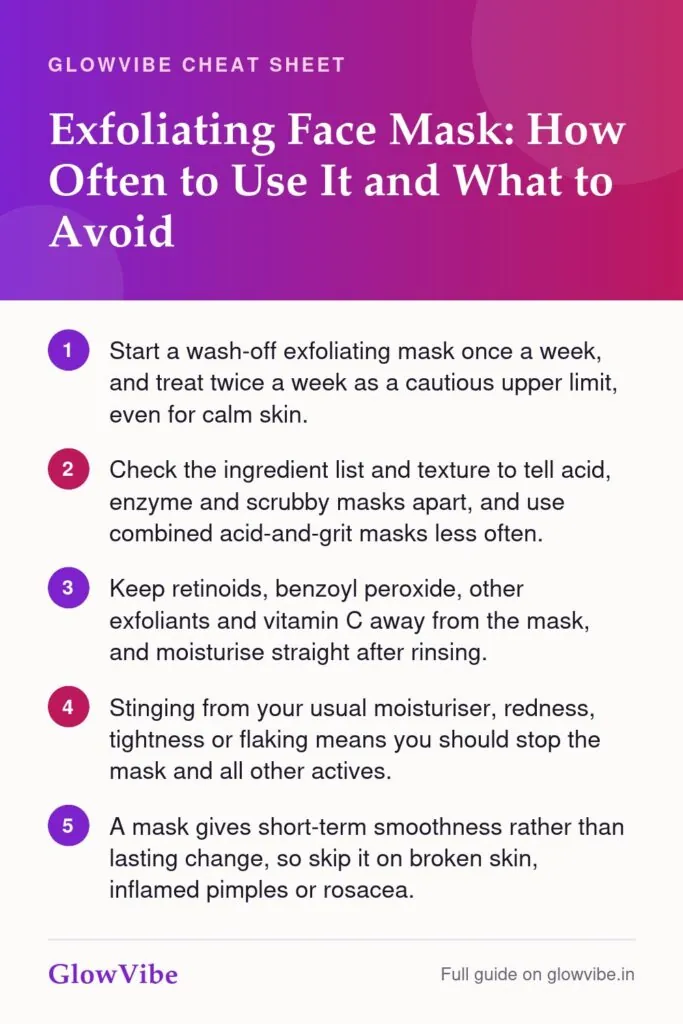
The quick answer
- Start: once a week, in the evening, after a Patch testTrying a small amount of a new product behind the ear or on the inner arm for a few days to check for a reaction before using it widely.See glossary.
- Timing: follow the label’s minutes exactly and rinse off with lukewarm water.
- Same night: moisturiser only, with no RetinolA vitamin A derivative that speeds up skin renewal for smoother texture, fewer clogged pores and fewer visible fine lines. Use at night and wear sunscreen by day.See glossaryRead the guide, Benzoyl peroxideAn acne ingredient that targets acne-causing bacteria. It can dry the skin and bleach towels and pillowcases, so start with a low strength.See glossaryRead the guide, acids or scrubs.
- Next morning: sunscreen, and keep it up daily for as long as you use the mask.
- Stop if: your skin stings, turns red or feels tight, or your usual moisturiser suddenly burns.
How often to use an exfoliating mask by skin type
There is no official schedule. The AAD says only that frequency depends on your skin type and the method, and that the more aggressive the ExfoliationRemoving dead skin cells from the surface, either with acids and enzymes (chemical) or scrubs and tools (physical). Two to three times a week is plenty for most people.See glossary, the less often you should do it. Dermatologists quoted by NBC News suggest one to three exfoliating sessions a week in general, three to four for oily or acne-prone skin, and one to two for sensitive skin.
Those figures cover all exfoliation, not masks alone, and none of these sources sets a mask schedule by skin type. The table below is this guide’s own judgement, kept deliberately lower than those figures because a mask sits on your face for several minutes. Treat it as a starting point rather than a medical rule, and let your skin overrule it.
| Your skin | Suggested start | Suggested limit | Type to consider |
|---|---|---|---|
| Oily, rarely irritated | Once a week | Twice a week | Salicylic acidThe most common BHA. It dissolves oil inside pores, which helps with blackheads, whiteheads and oily skin. Usually used at 0.5 to 2%.See glossaryRead the guide or a low-strength AHA (alpha hydroxy acid)Water-soluble exfoliating acids such as glycolic, lactic and mandelic acid. They loosen dead cells on the surface for smoother, brighter-looking skin.See glossaryRead the guide |
| Normal or combination | Once a week | Twice a week | Mild AHA or BHA (beta hydroxy acid)An oil-soluble exfoliating acid that can get inside pores. Salicylic acid is the common BHA, popular for oily and acne-prone skin.See glossaryRead the guide, on oily areas only if cheeks run dry |
| Dry | Once in two weeks | Once a week | Low-strength lactic or Glycolic acidThe smallest AHA, so it works quickly but can sting. Used in toners and peels for dullness and rough texture; always follow with sunscreen.See glossaryRead the guide, no grit |
| Sensitive | Once in two weeks, after a patch test | Once a week, or not at all | Mild chemical type, no grit |
| Acne-prone | Once a week, away from inflamed spots | Twice a week if calm and not on prescription creams | Mild chemical type, no grit |
| Rosacea | Skip | Ask a dermatologist | None without medical advice |
Two groups need extra thought. The AAD advises against strong exfoliation for people with a darker skin tone or dark spots from acne, burns or bug bites, because aggressive exfoliation can increase pigmentation in some people. Many Indian skin tones fall in this group, so stay at the gentle end, skip grit and increase slowly. If you have rosacea, the AAD lists exfoliators and glycolic and lactic acid among things to avoid on the face. If you have eczema, advice varies, so check with your dermatologist first.
Seasons can shift your number too. Humid months make skin feel oily and tempt people to mask more, but shine alone does not mean you need more exfoliation. In a dry North Indian winter, you may need to drop back a step. If you exfoliate on other nights, a simple four-night skin cycling routine shows how to space it out, and the mask takes that exfoliation night rather than adding a new one.
Acid mask or scrubby mask: how to tell
Words like “glow”, “polish” and “resurfacing” on the front of a pack tell you little. The ingredient list and the texture tell you what the mask really does, and that decides how you should use it.
| Type | Look for on the label | How it works | Who should be careful |
|---|---|---|---|
| Acid (AHA) | Glycolic acid, lactic acid | Dissolves dead skin cells | Sensitive skin, rosacea, heavy sun exposure |
| Acid (BHA) | Salicylic acid | Softens keratin and helps break down blackheads and whiteheads | Irritated or reddened skin, pregnancy (ask a doctor) |
| Acid (PHA) | Gluconolactone, lactobionic acid | Larger molecules that penetrate skin less | Anyone assuming it cannot irritate |
| Enzyme | Papain, bromelain | Fruit enzymes that loosen dead cells | People with sensitive skin or known allergies |
| Scrubby | Walnut shell, apricot kernel or rice powder, beads | Physically rubs dead cells away | Dry, sensitive or acne-prone skin, deeper skin tones with dark marks |
Some masks combine an acid with grit, so count those as the stronger kind and use them less often. A plain clay mask mainly absorbs oil, so check the list before you assume it exfoliates at all.
PHAs are often sold as the gentle choice. The idea has some logic because the molecules are larger, but that doesn’t rule out irritation, so they still need a patch test. If a label states acid strength, a US safety panel cited by the FDA considers glycolic and lactic acid products safe for consumers at 10 percent or less, with a pH of 3.5 or higher, plus sun protection directions.
How to use one correctly
Patch test first. The AAD’s method for any new product is to choose a coin-sized spot on your inner arm or the bend of your elbow. For a rinse-off product, leave it on as long as the label says (or five minutes), wash it off, and repeat twice daily for 7 to 10 days. This schedule is for the test spot only, never your face. Stop if the spot turns red, itchy or swollen.

Your arm is not your face, so stay alert the first time you use the mask properly. Then follow these steps:
- Choose the evening. Sun comes later, and your skin gets a night to settle.
- Cleanse gently and pat your face dry.
- Apply a thin, even layer. Stay clear of your eyes, lips and the inner corners of your nose.
- Set a timer for the label’s time. Longer does not mean better. Wash it off immediately if it itches, burns or stings.
- Rinse with lukewarm water. For a gritty mask, borrow the AAD’s general advice on scrubs: small, gentle circular motions for about 30 seconds, then rinse. Hot water adds to the dryness, and hard water can make skin feel tighter, so don’t skip the next step.
- Moisturise straight away. The AAD notes that exfoliating can dry the skin.
- Wear sunscreen the next morning, even if you are mostly indoors or it is cloudy. Your usual texture is fine, and this guide to gel and cream sunscreens can help if yours feels heavy in the heat.
The sunscreen step is not a formality for acid masks. The US FDA describes a study where four weeks of AHA use raised sensitivity to UV reddening by 18 percent, and the effect had gone a week after stopping. Its recommended label wording tells users to use sunscreen, wear protective clothing and limit sun exposure while using the product and for a week afterwards. A scooter commute or a walk at midday counts as sun.
What not to combine with an exfoliating mask
The AAD advises avoiding masks whose actives overlap with what you already use, because doubling up can trigger dryness and irritation. Here is what that means on a mask night.
- Retinol or a prescription retinoid: never the same night. Leave a moisturiser-only night between them.
- Benzoyl peroxide: it can dry and peel skin on its own, so keep it off mask days unless your dermatologist says otherwise.
- Other exfoliants: skip acid toners, peel pads, scrubs and cleansing brushes on the same day.
- Vitamin C: keep it to the morning rather than layering it after the mask.
- Threading, waxing, shaving or a salon facial: don’t mask right after these. Wait until any redness has gone completely.
For the wider picture, this guide to skincare ingredients that shouldn’t share a routine explains the pairings, and the skincare mix checker lets you test your own combination quickly.
Skip the mask completely and talk to your doctor if you take isotretinoin, which can leave skin fragile, or if you use any prescription acne cream. Don’t use one on sunburn, cuts or broken skin either. DermNet also says salicylic acid should not go on irritated, infected or reddened skin, so work around inflamed pimples instead of masking over them.
What over-exfoliation looks like
Over-exfoliated skin rarely looks dramatic at first. It often feels wrong before it looks wrong, and the signs may not show straight away.

- Stinging or burning from a moisturiser or sunscreen that never bothered you before
- Redness or patchy flushing, which on deeper skin tones may show as darkening or an ashy patch rather than pink
- Tightness soon after washing your face
- Flaking or roughness, sometimes alongside oily shine
- A tight, plastic-looking shine on the forehead or cheeks
- New breakouts in places that don’t usually get them
The usual reaction is to treat the flaking or breakouts with another exfoliating session, which makes things worse. Stop the mask and all other actives, keep to a mild cleanser, moisturiser and sunscreen, and follow this step-by-step plan for repairing a damaged skin barrier. If you have a prescription cream, ask your doctor before stopping it.
See a dermatologist if a reaction is severe, your skin blisters or swells, or dark patches appear and stay. The same applies if your skin isn’t improving after a few weeks of simple care.
What the “glow in 10 minutes” promise really means
You may well feel smoother after one use, because loosened dead cells have rinsed away and fresh moisturiser has gone on top. That effect is real, but it is a short-term change in surface feel. It isn’t lasting change in your skin, and it fades as skin keeps renewing itself.
A mask can’t detox your skin, permanently shrink pores or clear dark marks in one sitting. The AAD says masks don’t replace treatment for conditions such as acne or eczema, and even in-clinic superficial peels often need repeating before improvement shows. A lighter complexion is not the goal here either. Healthy skin comes in every shade, so judge a mask by comfort and texture.
If breakouts are the real concern, a mask won’t fix them. This realistic acne treatment timeline shows what to expect from proper treatment.
Common mistakes
- Trying a new mask just before a wedding or festival. The patch test alone takes 7 to 10 days, so start at least two weeks ahead, or stay with what your skin already knows.
- Leaving it on longer for a stronger effect. Stick to the time on the label.
- Making your own with sugar, lemon or baking soda. Kitchen scrubs and acidic or alkaline mixes can irritate skin, and you have no control over their strength. Leave them out.
- Counting only the mask. Acid toners, scrubs and peel pads all add to your weekly exfoliation.
- Pressing hard with a gritty mask. Light pressure is enough, and rubbing harder won’t remove more of what needs to go.
- Dropping sunscreen because the day is cloudy or the season is cold. If you need a reminder, this guide explains why sunscreen still matters in an Indian winter.
Frequently Asked Questions
No. Daily use leaves your skin no time to settle and raises the risk of irritation and barrier damage. Once a week is a cautious default, and twice a week is a sensible ceiling for skin that stays calm.
Night is the easier choice. It gives your skin hours away from the sun straight after exfoliating, and you can moisturise and sleep. Wear sunscreen the next morning either way.
Avoid inflamed, open or sore spots, and don’t use a gritty mask anywhere on acne-prone skin. If you use a prescription acne cream, ask your doctor before adding any exfoliating mask. A mask does not replace acne treatment.
Smoother-feeling skin can show up the same evening, but it is temporary. Any gradual change in texture needs regular, gentle use over time, and there is no guarantee of it. If you want treatment for dark marks or scars, a dermatologist can tell you what is realistic.
Ask your doctor first, especially if the mask contains salicylic acid, because it can be absorbed through the skin. The same applies while breastfeeding. Take the ingredient list along to the appointment so your doctor can see exactly what is in it.
Young skin rarely needs one, and children’s skin is more prone to irritation. A parent should check with a doctor before a child uses any acid mask. Teens with acne are usually better served by a simple routine and proper treatment advice.
Quick poll
How much do you usually spend on one beauty product?
The bottom line
Patch test, start once a week at night, and rinse on time. Moisturise straight away and wear sunscreen every morning. Go up to twice a week only if your skin stays comfortable, and drop back at the first sign of stinging, tightness or flaking. Comfortable skin matters far more than any quick, temporary smoothness.