Balanced Diet for Indians: How to Build Your Plate
What a balanced everyday plate looks like in Indian food terms, using ICMR-NIN amounts turned into thali, tiffin and hostel examples.

The quick answer
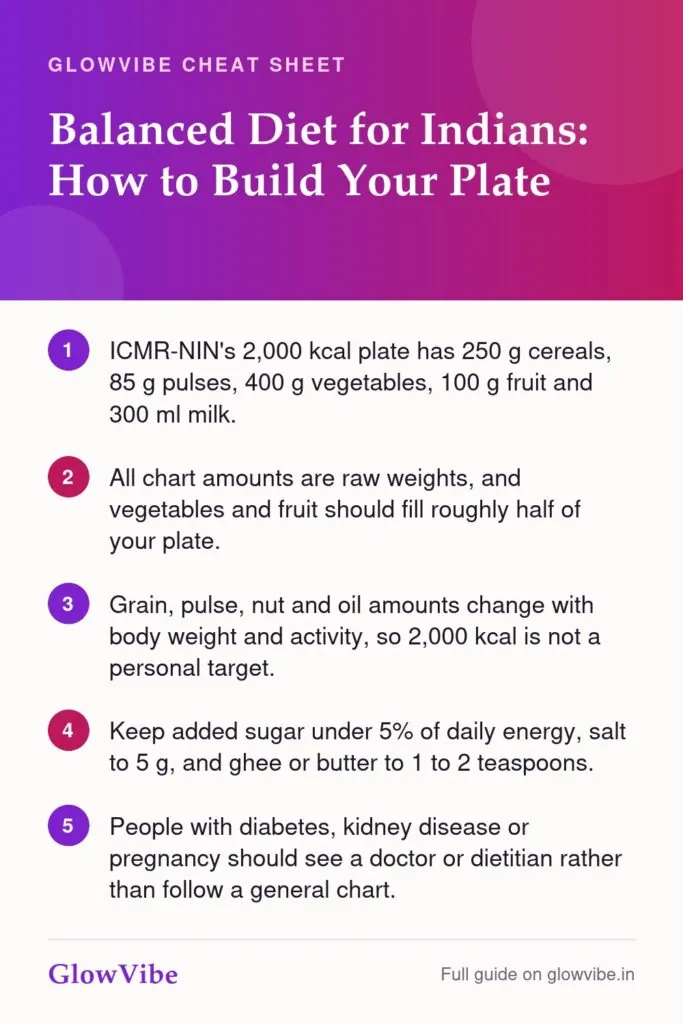
A balanced diet chart for Indians comes down to this daily reference from ICMR-NIN: about 250 g of cereals and millets, 85 g of pulses, 400 g of vegetables, 100 g of fruit, 300 ml of milk or curd, 35 g of nuts and seeds, and 27 g of oil. Those amounts are raw weights for a 2,000 kcal day, and vegetables and fruit should fill roughly half your plate.
ICMR-NIN is the National Institute of Nutrition under the Indian Council of Medical Research, and this model is called “My Plate for the Day”. It comes from the revised 2024 edition of the Dietary Guidelines for Indians.
Treat this as a general reference, not a weight-loss plan or a calorie target. If losing weight is your aim, a sustainable Indian weight-loss plan is the better starting point. This guide is general information rather than medical advice.
The daily chart: how much of each food group
The guidelines give a vegetarian and a non-vegetarian version of the same plate. Both are for a 2,000 kcal day, and every weight is before cooking.
| Food group | Vegetarian plate | Non-vegetarian plate | Everyday examples |
|---|---|---|---|
| Cereals and millets | 250 g | 260 g | Rice, atta, ragi, jowar, bajra |
| Pulses | 85 g | 55 g | Moong, masoor, chana, rajma, lobia |
| Chicken, meat or eggs | None | 70 g | Eggs, chicken, lean meat; fish can fill this slot |
| Milk or curd | 300 ml | 300 ml | Milk, dahi, chaas |
| Vegetables, including greens | 400 g | 400 g | Palak, methi, lauki, beans, carrot, beetroot |
| Fruit | 100 g | 100 g | Whole seasonal fruit rather than juice |
| Nuts and seeds | 35 g | 30 g | Peanuts, almonds, walnuts, flax seeds |
| Fats and oils | 27 g | 27 g | Cooking oil, plus any ghee or butter |
The note on vegetables matters: potato does not count towards the 400 g. Pulses can come down on days you eat fish or meat, and any sugar you take should replace part of your cereal, not sit on top of it.
Where most Indian plates differ
The guidelines say a balanced diet should get no more than 45% of its energy from cereals and millets. Their own data shows cereals actually supply 50% to 70%, while pulses, meat, poultry and fish together give only 6% to 9% against a recommended 14%.
So for many households the fix is not a new diet. It is a little less rice or roti, a proper serving of dal or another protein food, and far more sabzi than usual.
Which grains to pick
At least half your cereals should be whole grains. That can mean minimally polished rice, whole wheat atta, or millets such as ragi, jowar and bajra. The guidelines give the millet share as 20% to 30% in one table and 30% to 40% in another, so on a 250 g day, aiming for 50 g to 100 g of raw millets sits within that advice.
Ragi dosa at breakfast or a bajra roti at dinner both count towards it.
Why 2,000 kcal may not be your number
The 2,000 kcal plate is a teaching model. Your needs depend on age, sex, body weight, and how much you move. The guidelines change the amounts of grains, pulses, nuts and oil for that reason, while keeping the other groups the same for healthy adults.
| Adult | Cereals and millets | Pulses and beans | Nuts | Oil and fat |
|---|---|---|---|---|
| Man, 65 kg, sedentary | 260 g | 85 g | 40 g | 30 g |
| Man, 65 kg, moderately active | 370 g | 120 g | 45 g | 40 g |
| Woman, 55 kg, sedentary | 190 g | 60 g | 30 g | 25 g |
| Woman, 55 kg, moderately active | 270 g | 90 g | 40 g | 30 g |
All four adults get the same base: 100 g of greens, 200 g of other vegetables, 100 g of roots and tubers, 100 g of fruit and 300 ml of milk or curd. Non-vegetarians can swap 30 g of the pulses for meat or eggs.
These figures are for adults with a BMI of 18.5 to 23 at those reference weights, so read them as a guide and not a prescription. The guidelines also list different amounts for children, teenagers, adults over 60, and during pregnancy and breastfeeding. Those groups should ask a doctor or dietitian rather than work from this table.
Turning grams into katoris and spoons
Nobody weighs dal every day, but weighing once is worth it. Measure your usual raw rice, atta and dal for a day on a kitchen scale, then note how many katoris or rotis that makes. After that, you can judge by eye.
The guidelines’ household measures give you a starting point. Sizes vary from kitchen to kitchen, so treat these as rough:
- Medium katori: 200 ml. Small katori: 115 ml.
- Raw rice or other cereals: 100 g is about one small katori. The guidelines’ tables range from three-quarters of one to one full.
- Raw pulses: 30 g is about a quarter of a small katori.
- Fruit: 100 g fills about one medium katori when cut up.
- Chopped vegetables: 100 g is about one medium katori, so 400 g is around four medium katoris before cooking. Leafy greens take up much more room.
- Nuts: 20 g is about 4 teaspoons, or 16 cashews.
- Oil: the guidelines equate 20 g to 50 g with 4 to 10 teaspoons, so 1 teaspoon is about 5 g.
Remember that rice and dal swell as they cook, so a full cooked katori holds far less raw food than it seems. For the day’s split, the guidelines’ sample menu for a sedentary man gives lunch 100 g of cereals and 30 g of pulses, and dinner 80 g of cereals and 25 g of pulses, with breakfast built on whole grains and beans. It also says the timing and split are only indicative.
What this looks like at the thali, tiffin and mess
These examples are illustrations built from the chart above. They are not official ICMR-NIN menus and the portions are not weighed, so adjust them to your hunger, activity and family food.
Home thali
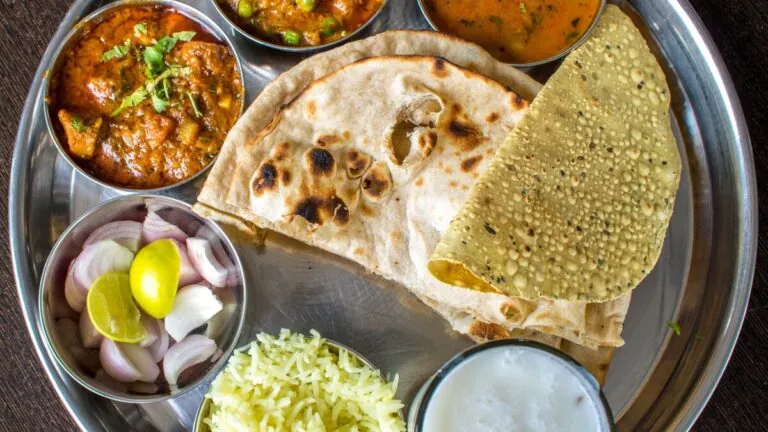
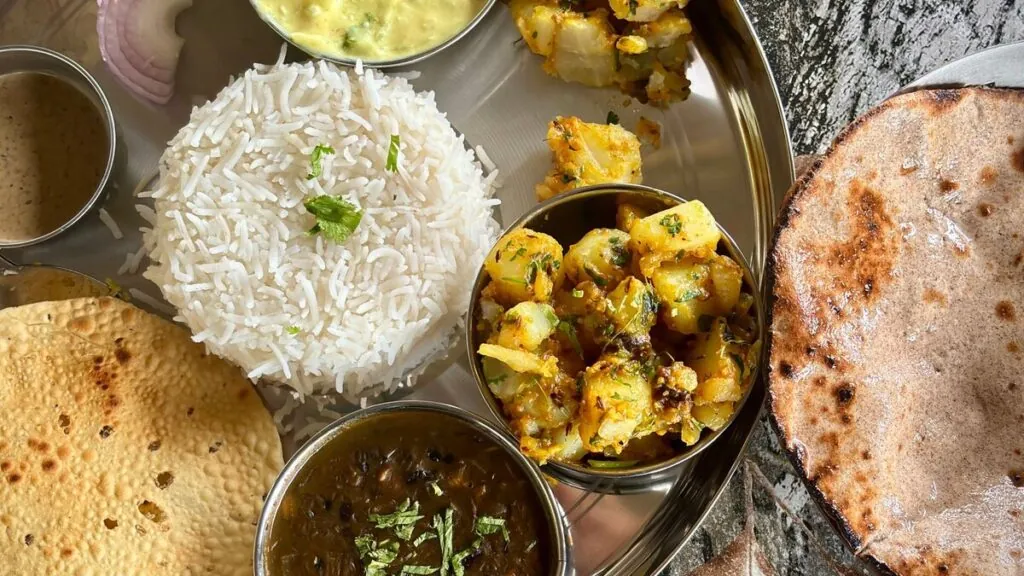
- North Indian: two rotis with some bajra or jowar in the mix, a katori of dal, a large serving of palak or lauki sabzi, salad, a small katori of dahi, and fruit afterwards.
- South Indian: a moderate mound of rice, sambar with plenty of vegetables, a beans or cabbage poriyal, keerai on some days, and curd. This 7-day South Indian veg plan has more dishes, though it is written for weight loss.
- Fish or chicken meal: rice or roti, one portion of fish or chicken curry, a smaller serving of dal, two vegetable dishes, and curd on the side.
Office or school tiffin
Tiffins tend to go wrong by being all grain, as with lemon rice, plain paratha or sandwiches alone. Add one protein food and one vegetable to whatever you pack.
- Roti rolled with chana or rajma sabzi, cucumber and carrot sticks, and a piece of fruit.
- Vegetable pulao with a boiled egg or a small box of sundal, plus chaas if you can keep it cool.
- Idli or ragi dosa with sambar in a leak-proof box, and a guava or orange.
Hostel or PG mess
You can’t control the menu, but you can control the serving order. Take vegetables and dal first, then rice or roti. Ask for extra sabzi or dal rather than a second round of rice, and take the curd whenever it is offered.
Keep a few simple foods in your room to cover what the mess misses: roasted chana, peanuts, bananas or other fruit, and milk if you have a safe way to store it. If the mess is short on protein, these protein-rich Indian foods can help you choose. For a daily handful, this guide covers how many dry fruits and nuts to eat.
Oil, sugar, salt and drinks
- Oil: keep to about 27 g to 30 g on a 2,000 kcal day, which is about 6 teaspoons. One section of the guidelines suggests 20 g for sedentary women, so aim low if that is you. Rotate oils instead of using only one.
- Ghee and butter: these count within the fat limit. The guidelines say to limit them to 1 to 2 teaspoons a day or avoid them.
- Sugar: added sugar should stay under 5% of daily energy. The guidelines put that at 20 g to 25 g in one place and 25 g to 30 g in another, so the lower figure is a sensible aim. Count the sugar in chai and mithai.
- Salt: use iodised salt and no more than 5 g a day, about 1 teaspoon. WHO sets a similar adult limit of under 5 g. Pickles, papad, namkeen and instant noodles use it up quickly.
- Water: about eight glasses, or roughly two litres, including other drinks. You need more in hot weather and during hard exercise.
- Tea and coffee: tannins interfere with iron absorption, so the guidelines advise avoiding them for at least an hour before and after meals.
The guidelines also advise avoiding ultra-processed foods and foods high in fat, sugar and salt. An occasional samosa will not undo a good week, but biscuits, chips and cold drinks shouldn’t be everyday fillers.
Adults are advised to get 30 to 60 minutes of moderate activity on at least five days a week, and a 30-minute home workout is one simple way to begin.
Common mistakes
- Reading raw weights as cooked. 250 g of cereals means raw grain or flour across the whole day, not 250 g of cooked rice.
- Counting potato as your vegetable. Aloo sabzi is fine to eat, but it does not count towards the 400 g.
- Drinking your fruit. The guidelines prefer fresh fruit and advise against juices.
- Skipping dal because there is rice. Cereals need pulses or beans alongside them for better-quality protein and fibre.
- Treating the plate as a daily exam. Aim for the pattern over a week, and don’t stress over one heavy wedding meal.
- Cutting whole food groups for quick weight loss. Crash diets can leave gaps. If you want to lose weight, get a plan suited to you.
When to see a dietitian instead
A general chart can be wrong for some people. See a doctor or registered dietitian before following it if you have diabetes, kidney disease, heart disease, or any other long-term condition. Pulses, milk, fruit and nuts can all need adjusting in these situations.
The same applies during pregnancy or breastfeeding, for children and teenagers, and for older adults. It is also wise to get help if food has started to feel stressful or you have a history of disordered eating.
Frequently Asked Questions
Not as written. It is a general reference for how much of each food group to eat, and its 2,000 kcal figure is not a personal target. For weight loss, speak to a dietitian if you have a health condition, and avoid crash diets.
The guidelines’ vegetarian plate provides about 72 g of protein on a 2,000 kcal day, mainly from cereals, pulses, milk, vegetables and nuts. That only works when you actually eat the pulses and dairy. Vegetarians should also know the guidelines flag vitamin B12 and omega-3 fats as harder to get, so ask a doctor if you are concerned.
No. The guidelines advise avoiding protein supplements to build muscle mass and say that adding them on top of a balanced diet won’t build more muscle. If you train regularly, read about Indian meals around gym sessions first, and ask a dietitian if you still think you need more.
The guidelines suggest two to three meals a day and advise against snacking in between. If you do need a snack, they suggest options such as fruit or vegetable salad with seeds, or roasted or boiled chickpeas, lobia and peanuts. People on diabetes treatment should follow their own doctor’s advice on meal timing.
Ghee isn’t forbidden, but the guidelines treat it as a saturated fat to limit. They suggest 1 to 2 teaspoons a day at most, or none. If you have high cholesterol or heart disease, ask your doctor what suits you.
The bottom line
A balanced Indian plate means half vegetables and fruit, a controlled portion of grains with at least half of them whole, plenty of dal or another protein food, some curd and nuts, and modest oil, sugar and salt. Use the ICMR-NIN amounts as a reference, adjust them for your body and activity, and ask a dietitian if you have a medical condition.
Sources
- Dietary Guidelines for Indians, revised edition 2024, ICMR-National Institute of Nutrition
- Policy Brief: Promotion of “My Plate for the Day” and physical activity among the population to prevent all forms of malnutrition and NCDs in the country, ICMR-National Institute of Nutrition
- Healthy diet, World Health Organization