10 Common Myths About Whey Protein, Debunked (2026)
Is whey a steroid? Does it damage kidneys or make women bulky? We separate 10 common whey protein myths from the facts, with safe dosing tips for Indians.


Most of the scary things you hear about whey protein, that it is a steroid, that it damages your kidneys, that it makes women bulky, are myths. Whey is simply a milk protein, and for healthy adults who take a sensible amount alongside proper meals, research shows it is a safe and convenient way to meet daily protein needs.
That said, a few concerns have a grain of truth, and some people genuinely should check with a doctor first. Below we go through the 10 most common whey protein myths in India, what the evidence actually says, and how to use whey without wasting money or upsetting your stomach.
What whey protein actually is
When milk is curdled to make paneer or cheese, it separates into solid curds and a watery liquid. That liquid is whey. It is filtered and dried into a powder that is rich in protein and naturally high in leucine, the amino acid that most strongly switches on muscle repair.
You will see three main types on the shelf. If you want a deeper look at each, read our guide to natural whey protein types and how to choose.
- Whey concentrate: roughly 70–80% protein, with some lactose and fat. Budget-friendly and fine for most people.
- Whey isolate: filtered further to around 90% protein, with very little lactose. Mid-range to premium, and easier on sensitive stomachs.
- Hydrolysed whey: partly pre-broken down. Premium, and rarely necessary for everyday gym-goers.
Whey protein myths vs facts: quick summary
| Myth | What the evidence says |
|---|---|
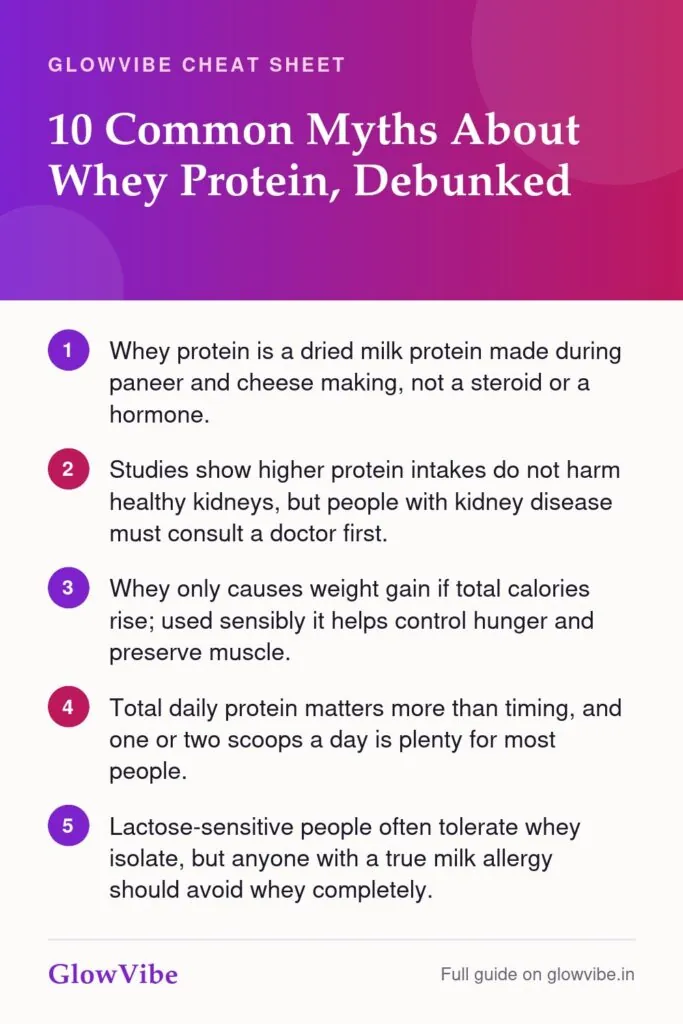
| Whey is a steroid | False. It is a dried milk protein, not a hormone. |
| Whey damages kidneys | No evidence of harm in healthy kidneys; people with kidney disease need medical advice. |
| Too much protein is dangerous | Moderate intakes are safe for healthy adults; excess just adds calories. |
| Whey makes you fat | Only if total calories go up. It can actually help control hunger. |
| Women will get bulky | False. Bulk comes from years of heavy training and surplus calories. |
| Whey causes hair fall | No good evidence. Hair fall usually has other causes. |
| Whey is only for bodybuilders | False. It suits anyone short on protein. |
| You must drink it within 30 minutes | Total daily protein matters far more than timing. |
| More scoops mean more muscle | False. Your body uses only so much protein per meal for muscle. |
| Lactose intolerant people can’t take whey | Many tolerate whey isolate well. |
Myth 1: Whey protein is a steroid
This is probably the most common myth in Indian households. Whey is a food made from milk, nutritionally closer to paneer than to any medicine. Steroids are synthetic hormones that change how your body works; whey protein simply supplies amino acids, just like dal, eggs or chicken do.
The real risk is adulteration. Fake or poorly made supplements have occasionally been found spiked with undeclared substances, or containing less protein than the label claims. Buy from the brand’s own store or authorised sellers, check for an FSSAI licence number, and be wary of prices that look too good to be true. Our guide to international whey protein brands in India covers how to spot fakes.
Myth 2: Too much protein is harmful
Many people believe any protein beyond a small amount is “dangerous”. In reality, most Indians eat too little protein, not too much, because typical meals lean heavily on rice, roti and sugar. Research shows that moderate protein intakes are safe for healthy adults.

As a rough guide, the basic requirement for sedentary adults is about 0.8 g of protein per kg of body weight per day. People who strength train regularly usually do well on around 1.2–2.0 g per kg. A 60 kg person who works out would aim for roughly 72–120 g a day, and one scoop of whey (typically 20–25 g of protein) helps close that gap.
Going far beyond your needs doesn’t build extra muscle. The surplus is simply used for energy or stored, and it can crowd out fibre-rich foods like vegetables, fruit and whole grains.
Myth 3: Whey protein damages your kidneys
Your kidneys do work a little harder to process protein, and that is a normal, healthy response. Studies in people with healthy kidneys have not shown that higher protein intakes cause kidney damage. Whey is no different from protein in food here.
The picture changes if your kidneys are already compromised. If you have chronic kidney disease, diabetes, high blood pressure, or a family history of kidney problems, speak to your doctor or a nephrologist before adding protein supplements. Drink enough water too, especially in Indian summers when you sweat heavily during workouts.
Myth 4: Whey protein makes you gain weight
One scoop of plain whey mixed in water usually has somewhere around 100–130 calories. Weight gain happens only when your total daily calories exceed what you burn, whatever the source. A whey shake blended with full-fat milk, bananas, peanut butter and honey is a different story, and that is how some people unknowingly turn a protein shake into a calorie bomb.
Used sensibly, protein actually supports weight loss. It keeps you fuller for longer and helps preserve muscle while you are in a calorie deficit. Pair it with whole foods from our list of protein-rich foods for weight loss so the shake tops up your meals rather than replacing them.
Myth 5: Whey protein will make women bulky
Women naturally have far lower testosterone levels than men, which makes building large muscles slow and difficult. Visible bulk comes from years of heavy, structured training combined with eating in a calorie surplus. A daily scoop of whey will not do that on its own.
What whey can do is help women reach their protein target more easily, which supports toned muscles, recovery after workouts and healthy ageing. If you are just starting out, our 4-week workout plan for weight loss for females pairs well with a sensible protein intake.
Myth 6: Whey protein causes hair fall and acne
There is no good evidence that whey protein causes hair fall. In India, hair fall is far more often linked to stress, thyroid issues, iron or vitamin deficiencies, crash dieting, hormonal changes or genetics. Ironically, a diet low in protein can itself worsen hair shedding.
Acne is more nuanced. Dairy and whey can trigger breakouts in some people, possibly through effects on hormones such as insulin and IGF-1. If you notice new acne after starting whey, try an isolate, cut back, or switch to a plant protein for a few weeks and see if your skin settles. For persistent acne or hair loss, see a dermatologist rather than guessing; our overview of hair loss treatment options in India explains what actually works.
Myth 7: Whey protein is only for bodybuilders
Whey is a protein source, not a bodybuilding drug. It can help anyone who struggles to get enough protein from meals: busy professionals, vegetarians who don’t eat eggs, older adults trying to preserve muscle, runners and cyclists who need recovery, and people in a weight-loss phase.

Whey is a complete protein, meaning it contains all nine essential amino acids, and it digests quickly. That makes it handy after strength training, but it is just as useful as a quick protein boost at breakfast when your usual poha or upma is low in protein.
Myth 8: You must drink whey within 30 minutes of a workout
The famous “anabolic window” is much wider than gym folklore suggests. Current research indicates that your total protein for the day, spread across meals, matters far more than the exact minute you drink your shake.
Having protein within a couple of hours before or after training is a sensible habit, especially if you train on an empty stomach early in the morning. But if you miss the 30-minute mark, your workout is not wasted.
Myth 9: More scoops mean more muscle
Muscle growth is driven by progressive training, sleep and adequate total calories, with protein as a supporting nutrient. Most people get a strong muscle-building response from about 20–40 g of protein per meal. Three scoops in one shake won’t triple your gains.
For most people, one or two scoops a day is plenty. Spend the effort on a good programme instead, such as a push pull legs workout routine, and get the rest of your protein from food.
Myth 10: If you are lactose intolerant, whey is off-limits
Lactose intolerance is common in India, and whey concentrate can cause bloating or gas in sensitive people. Whey isolate, however, has very little lactose, and many lactose-intolerant people tolerate it well. Start with half a scoop and see how your gut responds.
A true milk allergy is different. It is an immune reaction to milk proteins, and whey is one of them, so anyone with a diagnosed milk allergy should avoid whey and choose a plant protein such as pea or soy.
Who should be careful with whey protein
Whey is safe for most healthy adults, but check with a doctor or registered dietitian first if any of these apply to you:
- You have kidney or liver disease, or reduced kidney function on a blood test.
- You have a diagnosed milk allergy.
- You are pregnant or breastfeeding.
- You are under 18; teenagers can usually meet their needs from food.
- You take regular medication or have diabetes and are using a sweetened or “mass gainer” product.
How to use whey protein the right way
- Work out your daily target: multiply your body weight in kg by 1.2–1.6 if you train regularly.
- Count your food first: add up the protein from dal, paneer, curd, eggs, chicken, fish or soya, then use whey only for the shortfall.
- Start with one scoop: mix it in 200–300 ml of cold water or milk. Water keeps calories low; milk adds protein and creaminess.
- Pick a sensible time: after training, at breakfast, or as an evening snack in place of biscuits or namkeen.
- Store it well: keep the jar tightly closed in a cool, dry place. Humid Indian monsoons can make powder clump, and a damp scoop speeds this up.
Common mistakes to avoid
- Replacing meals with shakes: whey has no fibre and few of the vitamins and minerals found in a proper thali.
- Buying on price alone: unusually cheap tubs from unknown sellers are where fakes and under-dosed products show up.
- Ignoring the label: check protein per serving, added sugar and whether it is actually a mass gainer.
- Skipping water: higher protein intake and Indian heat both raise your fluid needs.
- Expecting whey to do the work: without regular training and good sleep, a supplement won’t change your body.
Frequently Asked Questions
Yes, for most healthy adults one or two scoops a day as part of a balanced diet is safe. Think of it as food, not medicine. If you have kidney or liver problems, a milk allergy, or are pregnant, ask your doctor first.
Whey comes from milk, so it suits lacto-vegetarians and is widely sold in India as vegetarian. Look for the green vegetarian mark on the pack. It is not suitable for vegans, who can choose pea, soy or other plant proteins.
It can, mainly from the lactose in whey concentrate or from sweeteners and gums in flavoured products. Switching to an isolate, using a smaller scoop, or mixing in water instead of milk often helps. If symptoms continue, stop and consult a doctor.
No. Muscle cannot turn into fat. If you keep training and get enough protein from food, you will keep your muscle. Changes happen only if your training, protein or calorie intake changes.
Yes, if your diet is low in protein. Whey is just a convenient protein source. However, without some form of exercise, especially strength training, you won’t see much change in muscle tone, so pair it with even simple home workouts.
Yes. Women often fall short on protein, and whey is an easy way to support recovery, muscle tone and weight management. It will not cause bulky muscles or hormonal problems in healthy women.
Start with one scoop a day, roughly 20–25 g of protein, and get the rest from food. Increase to two scoops only if you still can’t reach your daily protein target through meals.
The bottom line
Whey protein is not a steroid, it doesn’t harm healthy kidneys, and it won’t make you fat or bulky on its own. It is a convenient, high-quality milk protein that helps you hit your daily target when meals fall short.
Buy a genuine product from a trusted seller, stick to one or two scoops, keep eating real food, and train consistently. If you have a medical condition or notice side effects, talk to your doctor before carrying on.