How Stress Affects Your Skin and Hair, and What Helps
Stress can worsen acne and trigger delayed hair shedding, but it is not always the cause. Learn how to tell the difference, what helps and when to see a doctor.


The quick answer
Yes, stress can make acne worse, and it can set off a wave of hair shedding that usually starts a few months after the stressful event. It is often one contributor rather than the only cause, so hormones, thyroid problems, low iron, new products and medicines still need ruling out.
The useful response is simple: keep your skincare plain, treat the acne or scalp problem itself, work on the stress, and see a doctor about unexplained shedding, because a blood test may be needed. Stress-related shedding often settles, but only once you know stress is really what is behind it.
The GlowVibe guides to common face skin problems in India and hair fall treatments cover many causes. This one follows a single trigger across both skin and hair.
How stress shows up on your skin
Breakouts
The American Academy of Dermatology (AAD) says researchers have found a relationship between stress and acne flare-ups. It explains that stress prompts the body to make more androgens, hormones that stimulate oil glands and hair follicles.
The evidence is real but limited. A small study of 22 university students, published in 2003, found acne severity rose along with perceived stress during exams. A 2025 systematic review of 11 studies in Middle Eastern medical students reached a similar view, but most of those studies were snapshots that cannot prove stress causes acne. Acne can also cause stress, so the two can feed each other.
Flare-ups of existing skin conditions
The NHS lists stress among the things that can make atopic eczema worse, and among the triggers for psoriasis and rosacea. Stress does not explain these conditions on its own, and each has other triggers. For rosacea, those include sun, hot or cold weather, spicy meals and hot drinks, so a flushed face at a summer wedding may have several causes at once.
Slower barrier recovery
Your Skin barrierThe outermost layer of skin that keeps water in and irritants out. A damaged barrier feels tight, stings and reacts more easily.See glossaryRead the guide may also bounce back more slowly. In a small 2001 study of healthy women, a stressful interview delayed barrier recovery in 25 participants, and one night without sleep did the same in 11. These were lab tests of barrier function, not studies of everyday breakouts, but they are a fair reason not to pile strong actives on stressed skin. If your face stings or feels tight, read about repairing a damaged skin barrier.
Habits that make it worse
Stress also changes behaviour. The NHS notes that sleeping too much or too little can be a sign of stress, and many people also skip night routines or pick at spots when overwhelmed. The AAD warns that picking makes acne take longer to clear and raises the risk of scars and dark marks. On brown skin, those marks can stay long after the spot has gone.
How stress shows up in your hair
Stress-related shedding is usually a type of temporary hair loss called telogen effluvium. A shock to the system pushes more growing hairs into the resting phase, and they fall out later. That delay is why the shedding so often seems to come from nowhere.
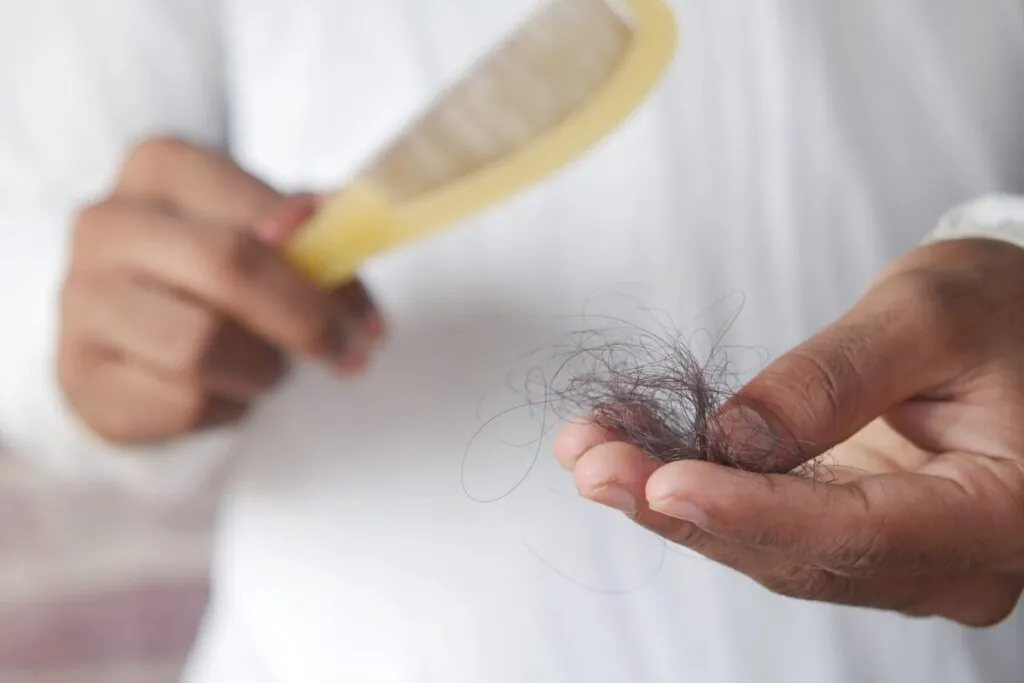
The AAD says it is normal to shed 50 to 100 hairs a day. It lists significant stress, such as job loss, divorce or caring for a sick loved one, among the triggers of excess shedding. Childbirth, high fever, surgery, recovery from illness, stopping birth control pills and losing 20 pounds (about 9 kg) or more can do it too.
Here is the usual pattern, based on the AAD and DermNet, a dermatology reference from New Zealand:
- When it starts: about 2 to 4 months after the trigger.
- What it looks like: thinning spread across the whole scalp rather than one bald spot, often with a fine fringe of new hair along the forehead.
- How long it lasts: shedding peaks after several months and tapers over about 6 to 9 months. The AAD says fullness typically returns within 6 to 9 months, though recovery can be incomplete for some people.
- What can prolong it: ongoing stress, which the AAD says can keep shedding going much longer.
This condition does not cause complete baldness, according to DermNet. It can, however, make a family tendency to pattern hair loss easier to see, which is one more reason to get checked.
Is it stress or something else?
Nobody can confirm stress as the cause from a mirror. A dated note on your phone helps, though: write down when the breakouts or shedding began, then look back 2 to 4 months for hair and at the past few weeks for skin. Take that timeline to your doctor.
| What you notice | What it may point to | What to do |
|---|---|---|
| Even shedding across the scalp, months after a hard period, illness or birth | Telogen effluvium, from stress or another shock | See a doctor and ask whether blood tests are needed |
| Widening parting or a thinner crown | Female pattern hair loss | See a dermatologist; this usually runs in families |
| Receding temples or thinning crown in men | Male pattern hair loss, though temple recession can also occur with shedding | See a dermatologist to sort out which one it is |
| Round, smooth bald patches | Possibly alopecia areata | See a dermatologist soon |
| Hair loss with tiredness and dry skin | Possibly an underactive thyroid | See a doctor; a blood test can check this |
| Acne with oily skin, irregular periods, or extra hair growth or hair loss | Possibly polycystic ovary syndrome (PCOS) | See a doctor or gynaecologist |
| Acne soon after a new cream, hair oil or medicine | A product or a medicine side effect | Stop the new product, but talk to your doctor before stopping any medicine |
Treat this table as a guide for your doctor’s visit, not a diagnosis. DermNet advises correcting abnormal thyroid, iron, vitamin B12 and folic acid levels as part of managing shedding, so these are worth asking about. Don’t start iron or other supplements on a guess. Take them only after a test and your doctor’s advice.
What helps your skin during a stressful stretch
Aim for a routine you can keep up on your worst day. A three-step minimalist routine is enough for most people, and you can buy product types rather than specific names:
- Morning: gentle cleanser, a light moisturiser, then sunscreen. In humid weather a gel moisturiser may feel better, and sunscreen helps stop acne marks from darkening.
- Night: gentle cleanser, your acne treatment if you already use one, then moisturiser.
- After sweating: rinse or wash gently. The AAD advises washing up to twice a day and after sweating, using your fingertips, not scrubs or cloths.
Choose products labelled Non-comedogenicA label meaning a product is formulated not to clog pores. Useful for acne-prone skin, though it is not a regulated or guaranteed claim.See glossaryRead the guide or oil-free, which the AAD says are least likely to cause acne. Patch testTrying a small amount of a new product behind the ear or on the inner arm for a few days to check for a reaction before using it widely.See glossary anything new on your inner arm first; the AAD suggests twice a day for 7 to 10 days. A new face wash on the morning of an exam or big meeting is a gamble you don’t need.
For mild acne, a pharmacist can suggest an over-the-counter treatment such as Benzoyl peroxideAn acne ingredient that targets acne-causing bacteria. It can dry the skin and bleach towels and pillowcases, so start with a low strength.See glossaryRead the guide. Give it time, because the AAD says results may take several weeks to a few months, and changing products too often can irritate skin. This realistic acne treatment timeline shows what to expect at each stage. If you are pregnant or breastfeeding, ask a doctor before using any acne treatment.
What helps your hair while it recovers
Be gentle and patient. DermNet describes telogen effluvium as self-correcting and suggests careful handling, a nutritious diet and treatment of any scalp or hormonal problem.
- Go easy on styling. Loosen tight plaits and buns, detangle from the ends up, and cut back on heat tools for now.
- Wash as often as your scalp needs. The hairs that fall have already reached the end of their cycle, so washing is not the cause, and skipping it won’t save them.
- Eat regular, balanced meals. Include good sources of protein such as dal, paneer, eggs or fish. This list of high-protein Indian foods gives you more options.
- Avoid crash diets. Rapid or large weight loss is a shedding trigger in its own right.
- Treat an itchy or flaky scalp. Ask a pharmacist or dermatologist about it instead of covering it with more oil.
Don’t expect an oil, serum or special shampoo to stop this kind of shedding, because the cause lies in the hair cycle and not on the surface. It is also worth pausing champi for now, because DermNet advises against any type of scalp massage during this kind of shedding. Skip anything that burns, and patch test home mixes and new products first.
Working on the stress itself
Skincare can’t remove the trigger, and no routine can promise clear skin or thicker hair just because you feel calmer. Managing stress is still worth doing for its own sake. These ideas draw on NHS advice:

- Talk to someone: a friend, a family member or a health professional.
- Move your body: start small, such as a 10-minute walk after dinner.
- Try slow breathing: a few minutes before bed or before a hard meeting.
- Set small targets: plan ahead for known busy days, and don’t try to do everything at once.
- Protect your sleep: keep a regular bedtime where you can, and move your phone out of reach.
- Skip harmful shortcuts: the NHS advises against relying on alcohol, cigarettes, gambling or drugs to cope.
If stress, anxiety or low mood has lasted a while or is making daily life hard, please speak to a doctor or counsellor. That is a good reason on its own, whatever your skin or hair is doing. In India, Tele-MANAS is a government mental health helpline that runs 24×7 and is toll-free on 14416 or 1-800-891-4416. If you or someone near you is in immediate danger, call emergency services or go to the nearest hospital.
When to see a doctor or dermatologist
- You are worried about how much hair you are losing, or the shedding has no clear explanation.
- You notice bald patches, a widening parting, or a sore, itchy or scaly scalp.
- Your spots are deep, painful or scarring, or look infected.
- Self-care or pharmacy treatment hasn’t helped.
- Your eczema, psoriasis or rosacea is flaring beyond your usual pattern.
- You also have irregular periods, unusual tiredness or other new symptoms.
- Your skin or hair is affecting your mood or confidence.
If the shedding started after childbirth or the concern is in a child, involve a doctor first rather than trying treatments at home.
Common mistakes
- Assuming it must be stress. This can delay finding a thyroid problem, low iron or PCOS.
- Blaming this week’s stress for today’s shedding. The trigger is usually a few months back.
- Adding more actives when skin flares. Strong layers can irritate skin that is already struggling.
- Stopping a medicine without advice. The AAD warns that stopping suddenly can cause serious side effects, so call your doctor first.
- Worrying about every hair. Some daily shedding is normal, and counting strands tends to add stress without telling you much.
Frequently Asked Questions
Yes, though the timing often differs. Acne can flare around a stressful period, while shedding usually begins 2 to 4 months later. If both appear together, also ask a doctor about hormonal causes such as PCOS.
Shedding typically peaks after several months and tapers over about 6 to 9 months. It can last much longer if the stress continues. Recovery varies, so see a doctor rather than simply waiting it out.
Often, yes. Regrowth usually follows once the trigger has gone, and you may spot fine new hairs along your hairline. Recovery can be incomplete for some people, and shedding can reveal pattern hair loss that needs separate care.
There is no special type of spot that proves stress is the cause. It looks like ordinary acne, and the clue is the timing, such as a flare during exams or a tough month at work. Periods, products and medicines can produce the same picture, so treat it as you would any acne.
Ask a doctor, especially if the shedding is heavy, unexplained or comes with other symptoms. They can decide what you need, which may include thyroid, iron, vitamin B12 or folate checks. Testing first also keeps you from taking supplements you may not need.
There is no good reason to expect that on its own. They may help you feel calmer and sleep better, which is worthwhile, but evidence that lowering stress directly clears acne is limited. Use them alongside proper acne treatment, not in place of it.
The bottom line
Stress can play a part in breakouts, skin flare-ups and delayed hair shedding, but it is rarely wise to assume it is the only cause. Keep your routine simple, get unexplained shedding checked, and give yourself months rather than days to see a change. Most of all, ask for support if the stress itself is hard to carry.
Quick poll
How much do you usually spend on one beauty product?
Sources
- Do you have hair loss or hair shedding?, American Academy of Dermatology
- Adult acne, American Academy of Dermatology
- Telogen effluvium (hair shedding), DermNet
- Get help with stress, NHS
- Impact of Stress on the Prevalence of Acne Among Medical Students in the Middle East: A Systematic Review, US National Library of Medicine (PubMed Central)