Minimalist vs The Derma Co Niacinamide Serum: Which Suits You?
Two popular 10% niacinamide serums with zinc, compared on formula, texture, skin type, layering and how to tell purging from irritation.


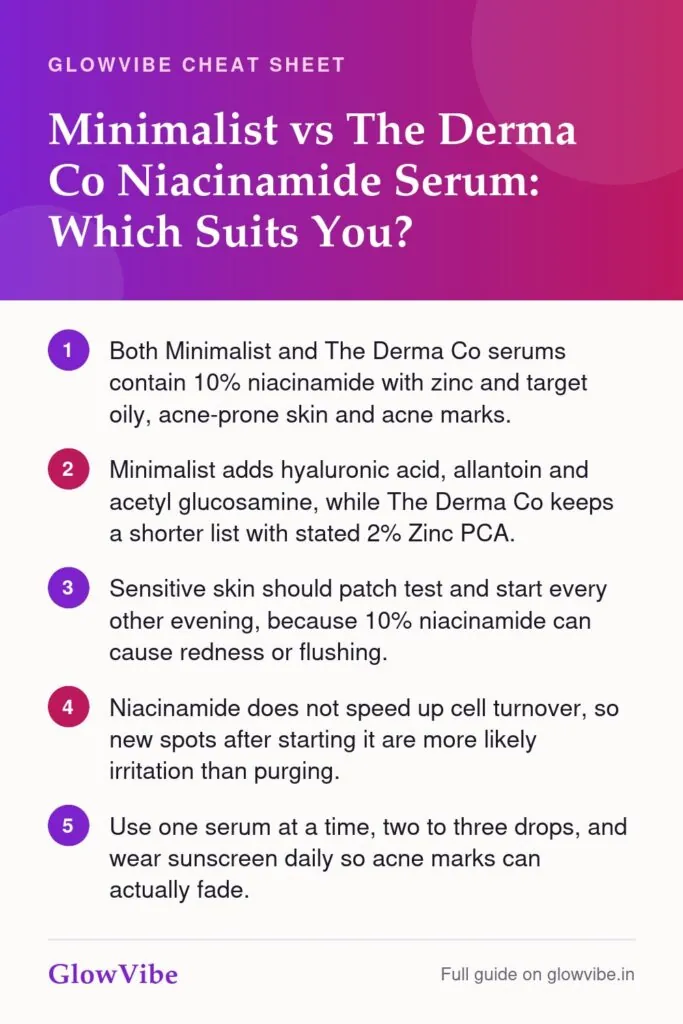
In the Minimalist vs The Derma Co NiacinamideA form of vitamin B3 that helps with oiliness, the look of large pores, uneven tone and barrier support. Gentle and easy to pair with most ingredients.See glossaryRead the guide serum choice, pick Minimalist Niacinamide 10% if you want a few extra soothing and hydrating helpers (Hyaluronic acidA humectant that holds water in the skin for a plump, hydrated look. Despite the name, it is not an exfoliating acid. Apply on damp skin.See glossaryRead the guide, allantoin, acetyl glucosamine) alongside the niacinamide and zinc; pick The Derma Co 10% Niacinamide Face Serum if you want a simpler, shorter formula built around 10% niacinamide and a stated 2% Zinc PCA. Both are 10% niacinamide serums aimed at oily, acne-prone skin and acne marks, so the real decision comes down to the supporting ingredients, how your skin handles 10%, and how you layer it.
Below, we compare both formulas from the brands’ own product pages, the texture, skin-type fit, layering, and how to tell adjustment from irritation. GlowVibe has not tested these products; this is a guide to what is in the bottle and what that means for your skin.
Quick verdict
- Choose Minimalist if your skin is oily but also gets dehydrated or easily stressed, and you like a serum with added HumectantAn ingredient that attracts water, such as glycerin or hyaluronic acid. Humectants hydrate best when sealed in with a moisturiser.See glossaryRead the guide and soothing agents.
- Choose The Derma Co if you want a stated zinc percentage on the label, a short ingredient list, and a serum the brand positions squarely for acne marks and oil control.
- Either works if you have oily or combination skin with post-acne marks and you tolerate 10% niacinamide well.
- Be careful with both if your skin is very sensitive, flushes easily or has rosacea. A 10% serum can be too much; start slowly or choose a lower-strength niacinamide product.
Side-by-side comparison
Here is how the two serums compare on the details each brand lists on its own website.
| Feature | Minimalist Niacinamide 10% | The Derma Co 10% Niacinamide Face Serum |
|---|---|---|
| Niacinamide | 10% | 10% |
| Zinc | Zinc PCA and zinc glycinate (no percentage stated on the current product page) | 2% Zinc PCA, stated on the label |
| Other notable ingredients | Matmarine (a marine ferment extract), acetyl glucosamine, allantoin, sodium hyaluronate, GlycerinOne of the most common and effective humectants. It draws water into the skin and is found in most moisturisers and cleansers.See glossary | Glycerin, pentylene glycol, algin; a shorter, more basic list |
| pH | 5.5 to 6.5, as stated by the brand | Not stated on the product page |
| Texture | Lightweight water-based serum; the brand says it leaves no sticky residue | Lightweight; the brand says it absorbs quickly without feeling heavy or greasy |
| Brand’s skin-type claim | Oily and acne-prone skin, acne marks | All skin types, positioned for oily and acne-prone skin, acne marks |
| Brand’s free-from claims | Fragrance-freeA product with no added perfume or essential oils for scent. Often the safer pick for sensitive or reactive skin. "Unscented" can still contain masking fragrance.See glossary, essential oil-free, Non-comedogenicA label meaning a product is formulated not to clog pores. Useful for acne-prone skin, though it is not a regulated or guaranteed claim.See glossaryRead the guide | Fragrance-free, dye-free, mineral oil-free, vegan |
| Suggested use | 2 to 3 drops, morning and night | 2 to 3 drops on face and neck, twice a day |
| Pack sizes listed | 10 ml, 20 ml, 30 ml, 60 ml | 30 ml, 50 ml |
Formulas and pack sizes change from time to time, so always check the current label on the bottle you buy.
The formulas, ingredient by ingredient
What both share: 10% niacinamide and zinc
Niacinamide (vitamin B3) is one of the best-studied skincare ingredients. It helps strengthen the Skin barrierThe outermost layer of skin that keeps water in and irritants out. A damaged barrier feels tight, stings and reacts more easily.See glossaryRead the guide, can reduce how shiny oily skin looks, calms redness, and slowly fades the brown marks that acne leaves on Indian skin by limiting how pigment moves to the surface. It works gradually, so give either serum 8 to 12 weeks of steady use before you judge it.

Both serums use 10%, which is on the higher side. Much of the published research on niacinamide used lower strengths, around 2% to 5%, so 10% is not automatically “twice as good” as 5%. It does raise the chance of tingling or flushing in reactive skin.
Zinc PCA appears in both. It is a zinc salt commonly added to oily-skin formulas because zinc is linked to SebumThe natural oil your skin and scalp make. Some is essential for a healthy barrier; too much can feel greasy and clog pores.See glossary regulation and has a calming effect on the skin. The Derma Co states 2% Zinc PCA. Minimalist lists both zinc PCA and zinc glycinate but does not give a percentage on its current product page.
What Minimalist adds
Minimalist’s list is longer. Alongside niacinamide and zinc, it includes acetyl glucosamine, an amino sugar often paired with niacinamide in pigmentation formulas; Matmarine, which the brand describes as a biotech extract from a marine microorganism; allantoin, a well-known soothing agent; and sodium hyaluronate and glycerin, both humectants that pull water into the skin.
In practice, if your skin is oily on the surface but feels tight after cleansing, those humectants and the allantoin may make 10% niacinamide easier to live with. The brand also states a pH of 5.5 to 6.5, which sits close to skin’s natural range.
What The Derma Co keeps simple
The Derma Co’s list is shorter and more stripped back: water, niacinamide, solvents such as propanediol, ethoxydiglycol and dimethyl isosorbide, glycerin, Zinc PCA, a few thickeners and preservatives. The brand describes a “deep penetration formula” built on penetration enhancers.
A shorter list makes it easier to spot an ingredient your skin dislikes, and suits people who add hydration through a separate moisturiser. The stated 2% Zinc PCA is also handy if you want to know exactly how much zinc you are applying.
Texture and how they feel in Indian weather
Both are thin, water-based serums thickened with gums such as xanthan gum and hydroxyethylcellulose, so neither is oily. The brands describe both as lightweight and quick to absorb. Gum-thickened serums can feel tacky or “pill” (roll into flakes) under heavy creams if you overuse them.
To avoid this, use only 2 to 3 drops, pat it over the face, and wait about a minute before your next step.
Who each serum suits
Oily and acne-prone skin
Both brands target this skin type first. If shine and enlarged-looking pores are your main concern, The Derma Co’s simpler formula with a stated zinc dose is a sensible pick. If you also deal with dehydration, often from strong face washes or acne treatments, Minimalist’s added hyaluronic acid and allantoin may be more comfortable. Pair either with a light routine like our oily face skincare routine.
Niacinamide supports acne-prone skin, but it does not treat active acne the way salicylic acid, benzoyl peroxide or prescription creams do. For painful, cystic or widespread acne, see a dermatologist.
Sensitive skin
This is where you should be most careful. Both serums are fragrance-free, which helps, but 10% niacinamide can sting or cause redness in reactive skin. The Derma Co’s own FAQ notes that some people with sensitive skin may get mild redness or dryness at first. Between the two, Minimalist’s soothing extras give it a slight edge on paper, but your own skin is the real test.
Start with one application every other evening, applied over a thin layer of moisturiser if needed, and build up. If your skin stays red, consider a lower-strength niacinamide product instead. Our guide to the best moisturiser for sensitive skin can help you build a calmer base.
Pigmentation and acne marks
Both brands market their serums for acne marks. Minimalist adds acetyl glucosamine, which is often paired with niacinamide for uneven tone, so it has a small edge if dark spots are your main goal. Whichever you choose, daily sunscreen matters more than the serum: without it, sun exposure keeps darkening marks faster than niacinamide can fade them.
For stubborn pigmentation, many people combine niacinamide with vitamin C. If you are deciding between the two ingredients rather than the two brands, read our comparison of niacinamide vs vitamin C for Indian skin.
How to layer a 10% niacinamide serum
The order is the same for both serums. Thin, watery layers go first, creams after, and sunscreen last in the morning.
Morning routine
- Cleanse with a gentle face wash and pat dry.
- Vitamin C (optional): if you use one, apply it first and wait a minute.
- Niacinamide serum: 2 to 3 drops pressed over face and neck. Wait about a minute.
- Moisturiser: a gel for oily skin, a cream for dry skin.
- Sunscreen: SPF 30 or higher with PA+++ or above, two finger-lengths for face and neck.
Night routine
- Cleanse, double cleansing if you wore sunscreen or makeup.
- Treatment: salicylic acid or retinol, on the nights you use them.
- Niacinamide serum, after the treatment has absorbed.
- Moisturiser to seal everything in.
Pairing rules
- Vitamin C: the old warning that the two cancel each other out comes from older lab work and does not apply to modern formulas. If your skin tingles, use vitamin C in the morning and niacinamide at night, as The Derma Co suggests.
- Salicylic acid: a common pairing for oily, acne-prone skin, and Minimalist itself suggests pairing with its salicylic acid serum. Introduce them one at a time, a few weeks apart.
- Retinol: niacinamide can make retinol nights more comfortable, but The Derma Co advises caution with strong actives. A rotation like skin cycling keeps things manageable.
If you prefer fewer steps overall, our minimalist skincare routine guide shows how a single serum fits into a simple three-step routine.
Purging vs irritation: what is really happening?
Many people start a niacinamide serum, see new spots, and assume they are “purging”. That is usually the wrong label. Purging happens with ingredients that speed up skin cell turnover, such as retinoids and exfoliating acids, which push existing clogs to the surface faster. Niacinamide does not work that way, so true purging from niacinamide alone is unlikely.
Here is how to read what you see:
| What you notice | What it likely means | What to do |
|---|---|---|
| Mild tingling for a few seconds, then nothing | Normal adjustment for some skin | Continue; apply on fully dry skin |
| Warm, red flush soon after applying | Niacinamide flushing or sensitivity to 10% | Cut to alternate nights or apply over moisturiser |
| Itching, burning, stinging that lasts, or rough dry patches | Irritation or a damaged barrier | Stop, wash off, use only a plain moisturiser until calm |
| New spots in areas you don’t usually break out | Breakout or reaction, not purging | Stop and check your other products |
| A few extra spots in your usual areas while also starting retinol or an acid | Possibly purging from the other active | Introduce one product at a time to know which is responsible |
| Swelling, hives or blistering | Possible allergic reaction | Stop immediately and see a doctor |
The Derma Co recommends a patch test before regular use, and it is a good habit with any new serum. Apply a small amount on the side of your neck or inner arm for a few days. And introduce only one new active at a time, so you always know which product caused a reaction.
Can you use both?
There is no benefit to layering both serums at once. Stacking two 10% serums simply doubles the niacinamide you apply, which raises the chance of redness without clear extra results. Pick one and use it consistently.
Switching between them is fine: finish one bottle, then start the other, keeping the rest of your routine the same so you can compare fairly.
Common mistakes
- Using too much. More drops means more pilling and more chance of irritation, not faster results.
- Skipping sunscreen. Acne marks will not fade if they keep getting sun exposure.
- Starting several actives in the same week. You won’t know what helped or what hurt.
- Expecting it to clear active acne. Niacinamide supports oily skin; it is not an acne medicine.
- Giving up after two weeks. Visible changes in oil and marks usually need two to three months.
Frequently Asked Questions
Neither is better for everyone. Both contain 10% niacinamide with zinc. Minimalist adds hydrating and soothing ingredients, while The Derma Co keeps a shorter list and states 2% Zinc PCA. Choose based on your skin’s needs and how it tolerates each formula.
Both brands say you can use it twice a day. Most oily skin handles daily use well. If you have sensitive skin, start with alternate evenings and increase slowly.
Niacinamide doesn’t speed up cell turnover, so true purging from it is unlikely. New spots after starting it are more likely a reaction or another product in your routine. If they appear in unusual areas or keep coming, stop using it.
Yes, most skin handles modern formulas of both together. If you feel tingling or see redness, separate them: vitamin C in the morning and niacinamide at night.
It can be, but 10% is a strong dose for reactive skin. Patch test first, start slowly, and buffer it with moisturiser. If redness or burning continues, switch to a lower-strength niacinamide product or ask a dermatologist.
Oil control may show within a few weeks, but acne marks and uneven tone usually take two to three months of daily use along with sunscreen.
Quick poll
How often do you wear sunscreen?
The bottom line
Minimalist and The Derma Co make closely matched 10% niacinamide serums for oily, acne-prone skin and acne marks. Go for Minimalist if you want built-in hydration and soothing extras, and The Derma Co if you prefer a short list with a clearly stated zinc dose. Whichever you pick, use a few drops, protect your skin with sunscreen every morning, and give it time.