Niacinamide vs Vitamin C: Which Suits Indian Skin? (2026)
Niacinamide or vitamin C? Compare them for pigmentation, oil, acne marks and dullness, and learn how to use both safely with sunscreen.


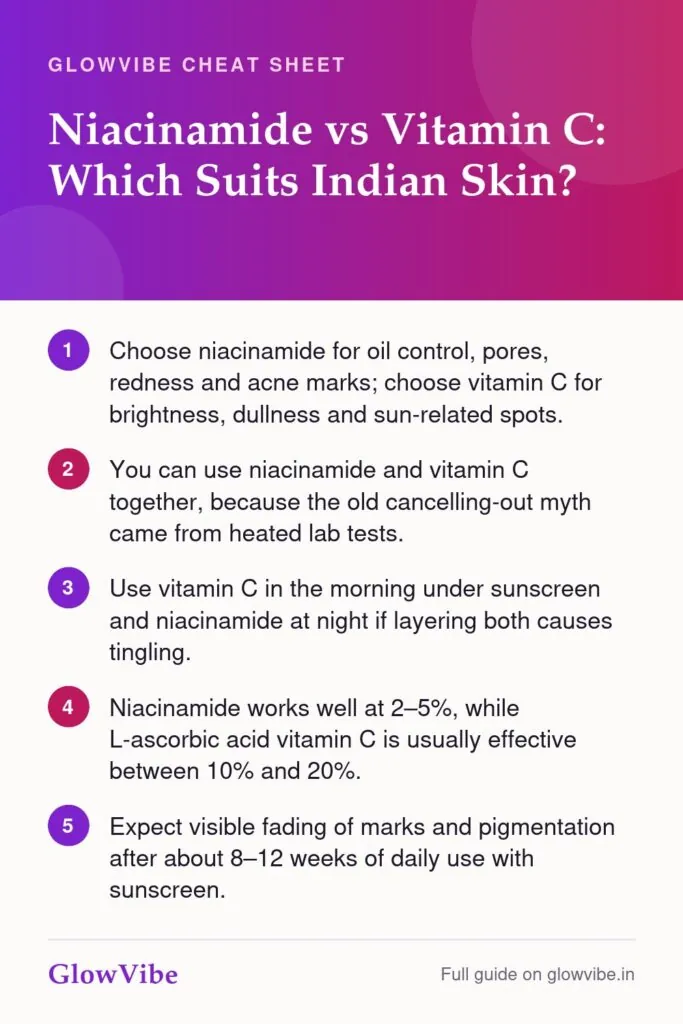
NiacinamideA form of vitamin B3 that helps with oiliness, the look of large pores, uneven tone and barrier support. Gentle and easy to pair with most ingredients.See glossaryRead the guide vs Vitamin CAn antioxidant that brightens dull skin, helps fade the look of dark spots and supports sunscreen against daily damage. Best used in the morning.See glossaryRead the guide comes down to your main concern: choose niacinamide if you want oil control, smaller-looking pores, calmer skin and gradual fading of acne marks; choose vitamin C if your priority is brightness, dullness, sun-related pigmentation and extra antioxidant protection under sunscreen. You can also use both together, because the old warning that they cancel each other out does not hold up for modern skincare.
Both ingredients are popular in India for good reason. Our skin tends to tan easily, holds on to dark marks after pimples and deals with heat, humidity and pollution for much of the year. This guide compares the two honestly: what each does, which suits your skin, how to layer them with sunscreen, what the percentages really mean and how long you should wait before judging results.
Quick verdict: which one should you pick?
- Oily, acne-prone skin with marks: start with niacinamide.
- Dull, tired-looking skin or tanning: start with vitamin C.
- Sensitive skin: niacinamide at 2–5% is usually the gentler first step.
- Dry skin: either works, but pick a hydrating base and avoid very strong vitamin C at first.
- Stubborn pigmentation or post-acne marks on brown skin: use both, at different times of day, with daily sunscreen.
- Total beginner: pick one, use it for eight weeks, then decide whether to add the other.
Niacinamide vs vitamin C: side-by-side comparison
| Factor | Niacinamide | Vitamin C |
|---|---|---|
| What it is | A form of vitamin B3 | Ascorbic acid (L-ascorbic acid)The pure, most researched form of vitamin C. It works best in low-pH serums but oxidises (turns orange) with air and light, so store it closed and away from sunlight.See glossaryRead the guide or one of its derivatives |
| Best for | Oil, pores, redness, acne marks, barrier support | Dullness, uneven tone, sun-related spots, antioxidant protection |
| Pigmentation | Fades marks slowly by reducing pigment transfer | Brightens and fades spots by slowing pigment production |
| Oil control | Yes, helps regulate visible shine | Not really |
| Texture and stability | Stable, easy to formulate | Pure vitamin C oxidises with air, light and heat |
| Useful strength | 2–5% (10% is common but not essential) | 10–20% L-ascorbic acid; derivatives vary |
| Best time | Morning or night | Morning, under sunscreen, is ideal |
| Irritation risk | Low; higher strengths can sting or cause redness | Moderate; acidic forms can tingle or sting |
| Beginner-friendly | Very | Fairly, if you choose a gentle form |
What each ingredient does for Indian skin
Pigmentation and dark spots
Indian skin produces melanin readily, which is why tans linger and every pimple seems to leave a brown mark. Both ingredients help, but they work at different steps.
Vitamin C interferes with tyrosinase, the enzyme your skin uses to make melanin, so it slows down new pigment. It also neutralises some of the free radicals created by UV and pollution, which is one reason it pairs so well with sunscreen. Niacinamide works further along the chain by reducing how much pigment is transferred to the surface skin cells. The result is that niacinamide tends to soften existing marks gradually, while vitamin C gives a more visible overall brightness.
Neither replaces sunscreen. Without daily SPF (sun protection factor)A measure of protection against UVB rays, which cause sunburn. SPF 30 blocks about 97% of UVB and SPF 50 about 98%, if you apply enough and reapply.See glossaryRead the guide, any pigmentation you fade will simply come back.
Oil control and pores
This is where niacinamide clearly wins. With regular use it can reduce visible shine and make pores look smaller, which is why it suits oily T-zones in humid cities like Mumbai, Chennai or Kolkata. Vitamin C does not meaningfully control oil, and some vitamin C serums in oil or SiliconesIngredients like dimethicone that coat hair (and skin) for slip, shine and frizz control. Heavier ones can build up and need a clarifying wash.See glossaryRead the guide bases can even feel heavy on oily skin.
Acne marks
Red or purple marks left after acne (post-inflammatory erythema) and brown marks (post-inflammatory HyperpigmentationPatches of skin that are darker than the surrounding skin, such as acne marks, sun spots or tanning. Very common on Indian skin tones.See glossary) are common on Indian skin. Niacinamide calms redness and supports the Skin barrierThe outermost layer of skin that keeps water in and irritants out. A damaged barrier feels tight, stings and reacts more easily.See glossaryRead the guide, so it helps with both. Vitamin C is more useful for the brown marks. Neither ingredient treats active acne the way Salicylic acidThe most common BHA. It dissolves oil inside pores, which helps with blackheads, whiteheads and oily skin. Usually used at 0.5 to 2%.See glossaryRead the guide, benzoyl peroxide or prescription treatments do. If you have painful cysts or acne that keeps scarring, see a dermatologist.
Dullness and uneven tone
For skin that simply looks flat, tired or tanned, vitamin C usually gives the faster, more noticeable glow. Niacinamide improves tone too, but more slowly and subtly. If dullness comes from dryness or a damaged barrier, fixing hydration may help more than either; our guide to repairing a damaged skin barrier explains the signs.
Which to choose by skin type and concern
Oily and acne-prone skin
Start with a niacinamide serum in a water or gel base. Use it morning and night under a light gel moisturiser. Once your skin is used to it, a vitamin C derivative in the morning can help with lingering marks. For the full step-by-step plan, see our morning and night routine for an oily face.
Dry skin
Dry skin can use both, but choose formulas with glycerin, hyaluronic acid or panthenol. Very acidic L-ascorbic acid serums can sting on dry, cracked skin, especially in winter, so a gentler derivative such as sodium ascorbyl phosphate or ascorbyl glucoside may be more comfortable.
Combination skin
Use niacinamide all over, and treat dull or pigmented areas with vitamin C in the morning. Combination skin is often the best candidate for using both.
Sensitive skin
Begin with niacinamide at 2–5% and introduce it every other day. Skip high-strength vitamin C until your skin is calm. If your skin reacts to almost everything, our guide to sensitive skin products for Indian skin can help you build a simpler base routine first.
Melasma
Melasma is a stubborn, hormone-linked pigmentation that often returns. Both ingredients can support treatment, but melasma usually needs a dermatologist’s plan, strict sun protection and sometimes prescription creams. Do not rely on over-the-counter serums alone.
Can you use niacinamide and vitamin C together?
Yes. The idea that niacinamide and vitamin C cancel each other out, or turn into something harmful, comes from older lab research that used pure, unstabilised forms of both ingredients under high heat. In those conditions they could form a complex and some niacinamide could convert to nicotinic acid, which causes temporary flushing.
That is not how modern serums behave on your face at room temperature. Today’s formulas are stabilised and used at skin temperature, so any reaction is minimal. Many well-formulated products even contain both. Our wider guide to skincare ingredients you should not mix covers the pairings that genuinely need care.
What is true is that some people feel more tingling or redness when a strong, low-pH vitamin C goes on right before a high-percentage niacinamide. That is usually irritation from layering two actives, not the ingredients destroying each other. If it happens to you, simply separate them.
Three easy ways to use both
- Split by time of day: vitamin C in the morning, niacinamide at night. This is the simplest option and suits most people.
- Layer in the morning: apply vitamin C first on clean, dry skin, wait a minute or two, then niacinamide, moisturiser and sunscreen.
- Use one combined product: a serum or moisturiser that already contains both, which keeps your routine short.
How to layer them with sunscreen
Serums go on after cleansing and before moisturiser. Sunscreen always goes last in the morning.

Morning routine
- Gentle cleanser.
- Vitamin C serum (3–4 drops for face and neck).
- Niacinamide serum, if you are layering both.
- Light moisturiser, or skip it if your skin is oily and the serum is hydrating.
- Broad-spectrum sunscreen, SPF 30 or higher with PA+++ or above, in a generous amount.
Vitamin C in the morning makes sense because its antioxidant effect supports your sunscreen against UV and pollution. It does not replace sunscreen, though.
Night routine
- Cleanser (double cleanse if you wore sunscreen or makeup).
- Niacinamide serum.
- Moisturiser.
If you also use retinol, niacinamide pairs well with it at night and can make it feel less drying. Keep vitamin C and retinol at different times of day; our guide to using retinol and vitamin C serums explains how to fit both into one routine.
Concentrations, explained honestly
Bigger numbers on the bottle are good marketing, but they are not always better for your skin.
Niacinamide
Much of the published research on niacinamide used concentrations around 2–5%, and those levels already help with oil, redness and marks. Many Indian brands sell 10% serums, such as the Minimalist Niacinamide 10% + Zinc 1% serum. These can work well for oily skin, but some people find 10% causes redness, itching or small bumps. If that happens, a lower strength may actually suit you better. Going above 10% has no clear extra benefit.
Vitamin C
L-ascorbic acid is the best-studied form. It is usually effective between 10% and 20%, and it needs a low pH to absorb, which is why it can tingle. Going beyond 20% generally does not add benefit and raises the chance of irritation.
Derivatives such as ethyl ascorbic acid, sodium ascorbyl phosphate, magnesium ascorbyl phosphate and ascorbyl tetraisopalmitate are more stable and gentler. Percentages are not directly comparable to L-ascorbic acid, so a 10% derivative is not the same as 10% pure vitamin C. These are good choices for sensitive or dry skin, and for anyone who finds pure vitamin C too strong.
Packaging and storage matter
Vitamin C breaks down with air, light and heat, which is a real issue in Indian summers. Choose dark or opaque bottles, close the cap tightly and store the serum away from a hot, steamy bathroom. If your serum turns dark orange or brown, it has oxidised and is past its best. Niacinamide is far more stable and does not have this problem.
Irritation and patch testing
Both ingredients are generally well tolerated, but any new active can irritate. Watch for:
- Stinging that lasts more than a minute or two
- Redness, itching or a rash
- Small bumps or a sudden breakout in a new area
- Dry, tight or flaky patches
How to patch test: apply a small amount behind your ear or along the side of your jaw once a day for three to five days. If there is no reaction, start using it on your whole face every other day for the first week, then daily. Introduce only one new product at a time so you know what is causing any problem.
If you develop swelling, a burning rash or blistering, stop using the product and see a dermatologist.
How long until you see results?
Patience is the most underrated part of using either ingredient. Skin renews itself over several weeks, so judge results over two to three months, not days.
| Goal | Niacinamide | Vitamin C |
|---|---|---|
| Less shine and oil | About 2–4 weeks | Not its main job |
| Brighter, fresher look | About 4–8 weeks | About 3–4 weeks |
| Fading acne marks | About 8–12 weeks | About 8–12 weeks |
| Softer pigmentation and tan | About 8–12 weeks or longer | About 8–12 weeks or longer |
These timelines assume daily use and daily sunscreen. Without sun protection, results will be slower or may not show at all.
Common mistakes to avoid
- Expecting overnight results: most people give up just before the serum starts working.
- Skipping sunscreen: both ingredients help with pigmentation only if you stop new damage.
- Using the strongest percentage first: start lower and build up.
- Layering too many actives: adding acids, retinol, niacinamide and vitamin C all at once is a fast route to irritation.
- Using oxidised vitamin C: a brown serum is no longer doing its job.
- Treating active acne with serums alone: for moderate or severe acne, see a dermatologist.
Choosing a niacinamide serum? Compare Minimalist vs The Derma Co niacinamide.
Frequently Asked Questions
Both help. Niacinamide is better for red marks and also suits acne-prone skin generally, while vitamin C is better at fading brown marks. Many people with Indian skin get the best results by using vitamin C in the morning and niacinamide at night, with daily sunscreen.
Yes. Modern formulas do not cancel each other out. If you feel tingling or redness, use vitamin C in the morning and niacinamide at night instead of layering them.
If you layer them, apply vitamin C first on clean, dry skin, then niacinamide. A general rule is to go from thinnest to thickest texture, then moisturiser and sunscreen.
You can, and it still works. Morning use is preferred because its antioxidant effect supports your sunscreen during the day, but if vitamin C irritates your skin in the morning or you prefer a simple night routine, night use is fine.
Not for everyone, but it is more than most skin needs. Many people do well on 10%, especially those with oily skin. If you notice redness, itching or small bumps, switch to a 2–5% product.
No. They do not change your natural skin colour. They help fade marks, tan and uneven patches so your tone looks more even and brighter.
Quick poll
How much do you usually spend on one beauty product?
The bottom line
Niacinamide is the steady, oil-balancing, barrier-friendly choice; vitamin C is the brightening, antioxidant partner for your morning sunscreen. Pick the one that matches your biggest concern, give it eight to twelve weeks, and add the other if you want more. Whichever you choose, daily sunscreen is what makes the results last.