Minimalist vs The Ordinary Retinol: Which Suits Beginners in India?
Minimalist 0.3% or The Ordinary Retinol in Squalane? Compare strengths sold in India, bases and ladders, plus a safe beginner routine for Indian skin.

In the Minimalist vs The Ordinary RetinolA vitamin A derivative that speeds up skin renewal for smoother texture, fewer clogged pores and fewer visible fine lines. Use at night and wear sunscreen by day.See glossaryRead the guide choice for beginners, pick Minimalist Retinol 0.3% Face Serum if you want a starter retinol with added antioxidants and BakuchiolA plant extract (from babchi seeds) often marketed as a gentler alternative to retinol for smoother-looking skin. It is generally less irritating.See glossary in a light, water-free oil base. Pick The Ordinary Retinol 0.2% in SqualaneA light, stable oil similar to the oils your skin makes. It moisturises without feeling heavy and suits most skin types.See glossary (or the 0.5% if that is what your Indian retailer stocks and you already tolerate retinoids) if you want a simple, squalane-led formula with a clear three-step strength ladder.
Both brands use a water-free base to keep retinol stable, both sell gentler and stronger options, and both say the same thing on safety: go slow, use sunscreen and skip it in pregnancy. GlowVibe has not tested these products. This guide compares the formulas from the brands’ own product pages and explains how to start retinol on Indian skin without wrecking your barrier or triggering dark patches.
Quick verdict
- Choose Minimalist Retinol 0.3% if you are a first-time user who wants a beginner strength that is easy to find across India, plus supporting antioxidants (coenzyme Q10, Vitamin E (tocopherol)An antioxidant and moisturising ingredient. It is often paired with vitamin C to make it more stable.See glossary) and bakuchiol in the same bottle.
- Choose The Ordinary Retinol in Squalane if you prefer a short ingredient list built on squalane and jojoba oil, suits dry skin by the brand’s own description, and gives you a clear 0.2% to 0.5% to 1% path.
- Choose a Granactive retinoid from either brand if your skin is sensitive and you want a water-based, lighter option to test your tolerance first.
- Skip all of them if you are pregnant, trying to conceive or breastfeeding, or your Skin barrierThe outermost layer of skin that keeps water in and irritants out. A damaged barrier feels tight, stings and reacts more easily.See glossaryRead the guide is currently damaged.
Which retinoids each brand sells in India
Minimalist is an Indian brand, so its full retinoid range is sold on its own website and major Indian retailers. Its current lineup is Retinol 0.3% Face Serum, Retinol 0.6% Face Serum, Retinal (retinaldehyde)A retinoid one step closer to the active form than retinol, so it tends to work faster. It can still cause dryness, so introduce it slowly.See glossaryRead the guide 0.1% Face Serum, Granactive Retinoid 2% Face Cream and a Vitamin K + Retinal eye cream.
The Ordinary came to India in 2022 through Nykaa. Globally, it sells Retinol 0.2%, 0.5% and 1% in Squalane, Granactive Retinoid 2% Emulsion and Retinal 0.2% Emulsion. In India, Retinol 0.5% in Squalane, Granactive Retinoid 2% Emulsion and Retinal 0.2% Emulsion appear on Nykaa, but the 0.2% and 1% retinols are not always listed. Check which strengths your retailer actually carries before you plan your ladder, and buy The Ordinary only from authorised sellers.
Side-by-side comparison
| Feature | Minimalist Retinol 0.3% Face Serum | The Ordinary Retinol in Squalane (0.2% / 0.5%) |
|---|---|---|
| Retinol strength | 0.3% (entry level; 0.6% is the brand’s medium strength) | 0.2% (mild), 0.5% (moderate, “intermediate”), 1% (high) |
| Base | Water-free; caprylic/capric triglyceride, isododecane and squalane | Water-free; squalane first, then caprylic/capric triglyceride and jojoba oil |
| Supporting ingredients | Bakuchiol (the brand says 1%), coenzyme Q10, vitamin E | Tomato and rosemary extracts, hydroxymethoxyphenyl decanone |
| Brand’s skin-type claim | The brand says it is Fragrance-freeA product with no added perfume or essential oils for scent. Often the safer pick for sensitive or reactive skin. "Unscented" can still contain masking fragrance.See glossary, essential-oil-free and Non-comedogenicA label meaning a product is formulated not to clog pores. Useful for acne-prone skin, though it is not a regulated or guaranteed claim.See glossaryRead the guide | The brand says it suits dry skin; alcohol- and silicone-free |
| Brand’s starting advice | PM, 2–3 times a week, then build up | PM, a few drops, start at 0.2% and work up |
| Gentler option | Granactive Retinoid 2% Face Cream (water-based) | Granactive Retinoid 2% Emulsion (water-based) |
| Stronger option | Retinol 0.6%, Retinal 0.1% | Retinol 1%, Retinal 0.2% Emulsion |
Formulas change from time to time, so always check the current ingredient list on the pack before you buy.
The bases: why “in squalane” matters
Retinol breaks down when exposed to water, light and air. That is why both brands put their retinol serums in water-free oil bases instead of water-based gels. A stable base helps the retinol stay effective until the bottle is finished.
The Ordinary leads with squalane, a light, skin-friendly emollient, plus jojoba oil. On very oily skin in humid Mumbai or Chennai weather it can feel slightly slick. On dry skin in a Delhi winter it can feel comforting.
Minimalist leads with caprylic/capric triglyceride and isododecane, a fast-evaporating emollient often used to make oil serums feel less heavy, with squalane third. It also adds bakuchiol, a plant compound often marketed as a gentler retinol alternative, plus coenzyme Q10 and vitamin E as antioxidants. The 0.6% version also adds rosehip oil.
Neither base is “better”. If you like minimal ingredient lists, The Ordinary is simpler. If you like a few extra antioxidants in the mix, Minimalist gives you that. If you react to plant extracts, compare both lists against your known triggers.
Strength ladders, and retinol vs retinal vs Granactive
Your skin has to convert retinol into retinoic acid, the form that actually works on skin cells. The conversion goes retinol, then retinal (retinaldehyde), then retinoic acid. Each step closer to retinoic acid usually means stronger effects and more chance of irritation.
- Granactive retinoid (hydroxypinacolone retinoate): a retinoic acid ester that is generally considered gentler. Both brands sell a 2% water-based version. It is a good first step for sensitive skin. Minimalist suggests using its cream twice a week to start.
- Retinol: the classic option with the most research behind it. Minimalist’s 0.3% and The Ordinary’s 0.2% are beginner strengths. Minimalist’s 0.6% and The Ordinary’s 0.5% are medium, and both brands say you should build tolerance first.
- Retinal: one step closer to retinoic acid, so it tends to act faster and can irritate more. Minimalist calls its Retinal 0.1% “mid-strength”. It also contains oleyl adapalenate and bakuchiol. The Ordinary calls its Retinal 0.2% Emulsion high strength. These are next steps, not starting points.
Don’t compare percentages across ingredient types. A 0.1% retinal is not “weaker” than 0.3% retinol just because the number is smaller. A sensible beginner ladder looks like this:
- Sensitive or very reactive skin: Granactive Retinoid 2% for 8–12 weeks.
- Normal or oily skin, first retinoid: Minimalist 0.3% or The Ordinary 0.2% for at least 3 months.
- Tolerating nightly use well: move to Minimalist 0.6% or The Ordinary 0.5%.
- Experienced users only: retinal or The Ordinary 1%.
How to start: 2–3 nights a week and the sandwich method
The biggest beginner mistake is too much, too often. Retinol is a night-time step, and both brands advise starting slowly. Here is a simple first-month plan.
Weeks 1–2: two nights a week
Patch test first on your jawline or inner arm for a few nights. Then use retinol on two non-consecutive nights, for example Monday and Thursday. On other nights, keep it to cleanser and moisturiser.
Weeks 3–4: three nights a week
If there is no stinging, burning or peeling, add a third night. A structured plan like a beginner skin cycling routine builds rest nights in automatically.
Month 2 onwards: alternate nights, then nightly if happy
Increase only if your skin feels comfortable. Many people stay on alternate nights for good, and that is fine.
The sandwich method
- Cleanse gently and pat your face completely dry. Damp skin can increase irritation.
- Apply a thin layer of a plain moisturiser.
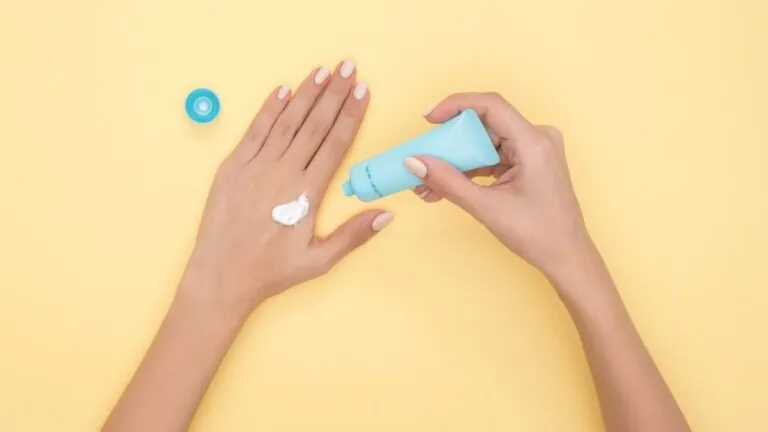
- Apply 2–3 drops of retinol (a pea-sized amount for the whole face), avoiding the corners of your nose, lips and eyes.
- Finish with another layer of moisturiser.
Sandwiching cushions the retinol, which helps with both of these oil-based serums. Every morning, wear a broad-spectrum sunscreen, because both brands warn that retinoids increase sun sensitivity. You need it even in winter, when the sun feels mild.
Purging vs irritation: how to tell them apart
Retinoids speed up cell turnover, so some people get a short “purge” of breakouts in the first few weeks. Irritation is different, and it means you need to slow down.
| Sign | Likely purging | Likely irritation |
|---|---|---|
| Where | Areas where you usually break out | Anywhere, often around the nose, mouth and eyes |
| What it looks like | Small bumps and whiteheads that come and go quickly | Redness, burning, stinging, tightness, flaking, rough patches |
| How long | Usually settles within about 4–6 weeks | Persists or worsens while you keep using it |
| What to do | Keep going at a steady frequency; don’t add new actives | Pause for a few days, then restart less often, or switch to a gentler retinoid |
If your face stings when you apply plain moisturiser, feels tight all day or looks shiny-raw, stop retinol and follow our guide on how to repair a damaged skin barrier before you try again. For painful cysts, spreading rashes or swelling, see a dermatologist.
Retinol and pigmentation on brown skin
Retinoids can gradually even out tone and fade acne marks by speeding up skin renewal, but results take months, not weeks. On Indian and other brown skin tones, there is a catch. Irritation and inflammation can themselves leave dark marks, called post-inflammatory hyperpigmentation.
For brown skin, slow is the effective route. A low strength used consistently with sunscreen will usually do more for pigmentation than a strong retinol that leaves you red and peeling. Don’t pick at flakes, don’t combine retinol with scrubs or peels in the same week when you start, and use sunscreen every morning. For stubborn melasma or patches that keep spreading, a dermatologist can suggest prescription options.
Pregnancy and breastfeeding caution
Both brands advise against their retinoids if you are pregnant or breastfeeding. Minimalist says pregnant or breastfeeding individuals should not use its retinoid products without consulting a healthcare provider, and The Ordinary advises avoiding retinoid-containing products. If you are trying to conceive, stop and talk to your doctor or dermatologist about alternatives. Azelaic acid and niacinamide are often discussed as options, but your doctor should confirm what is right for you.
Pairing retinol with niacinamide or vitamin C
Niacinamide generally pairs well with retinol. It is often used to support the barrier and calm oiliness. You can apply a niacinamide serum before your sandwiched retinol, or use it in the morning.
Vitamin C is best kept to the morning, under sunscreen, with retinol at night. The Ordinary lists “direct vitamin C” and direct acids as conflicts on its retinol pages, so the AM/PM split matches its own advice. If you are deciding which of the two to add first, our niacinamide vs vitamin C guide covers which one suits your skin concern. For a deeper look at running both actives in one routine, see how to use retinol and vitamin C serums together.
Avoid stacking retinol with AHAs, BHAs or other retinoids on the same night. Our list of skincare ingredients you should not mix covers the full set of clashes.
Can you use both brands?
Yes, but not at the same time. Never layer two retinoids in one routine. The Ordinary specifically says not to combine its retinols with other retinoids. What works is using one brand for one rung of your ladder and the other brand for the next. For example, you could start on Minimalist 0.3% for three months, then move to The Ordinary 0.5% if that is the strength your retailer stocks.
You can also mix brands across steps. A Minimalist niacinamide in the morning and The Ordinary retinol at night is a perfectly reasonable routine.
Common mistakes
- Starting with 0.5%, 0.6% or retinal as a first retinoid.
- Using it every night from day one, or on damp skin.
- Skipping sunscreen, or not reapplying on long outdoor days.
- Adding retinol in the same week as a new acid toner, scrub or facial peel.
- Starting retinol a few days before a wedding or big event. Begin at least 6–8 weeks ahead, or wait until after.
- Quitting at week three because of a mild purge, or pushing on through real burning.
Frequently Asked Questions
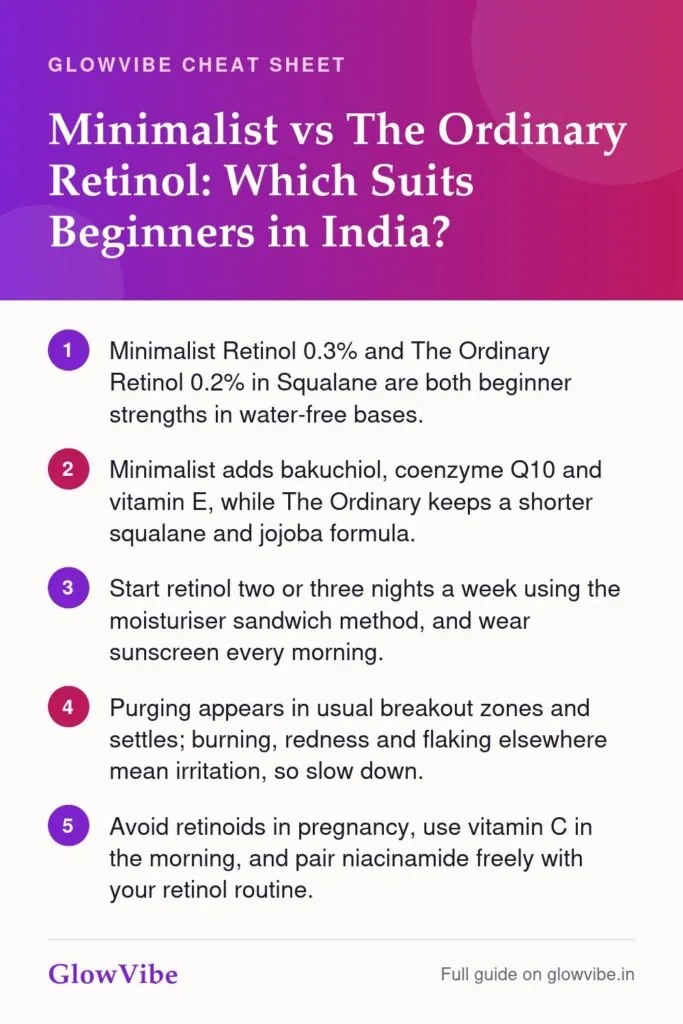
Both are beginner strengths in water-free oil bases. Minimalist adds bakuchiol and antioxidants, while The Ordinary keeps a shorter, squalane-led formula. Choose based on which ingredient list your skin likes and which one you can reliably buy in India.
The brand calls it an intermediate strength and suggests starting at 0.2%. If 0.5% is all you can find, use it only twice a week with the sandwich method, or start with a Granactive retinoid instead.
Many oily-skinned people use them without trouble, because a few drops goes a long way. Minimalist says its retinol serums are non-comedogenic. The Ordinary notes its retinols are not an acne treatment, so for active acne, ask a dermatologist about prescription options.
Smoother texture can show within a few weeks. Changes to marks, tone and fine lines usually take three months or more of consistent use alongside daily sunscreen.
Keep face serums away from the eye area at first, since the skin there is thin and irritates easily. If you want to treat under-eye lines later, choose a product made for the eye area and patch test it.
Minimalist says adults can begin from their mid-20s and that it isn’t meant for under-18s. There is no rush. Daily sunscreen does more for prevention than starting retinol early.
Quick poll
What is your biggest skin concern right now?
The bottom line
Minimalist and The Ordinary both make solid, water-free beginner retinols. Choose Minimalist 0.3% for an easy-to-find starter with added antioxidants. Choose The Ordinary in Squalane for a simple squalane base and a clear strength ladder. Whichever you pick, start low, use it two or three nights a week, sandwich it, and wear sunscreen every single morning.