Hair Fall Home Remedies vs Medical Treatment: What Works (2026)
An evidence-based look at home remedies for hair fall: what helps, what is hype, what can harm your scalp, and when medical treatment or a dermatologist visit is needed.


Home remedies for hair fall can make your scalp healthier and cut down breakage, but none of them has strong proof that it regrows hair or reverses genetic thinning. If your hair fall is heavy, lasts more than three months, or shows as a widening parting or receding hairline, medical treatment such as MinoxidilA topical drug used for pattern hair loss. It needs ongoing use to keep results, so check with a dermatologist before starting.See glossary, or treating a cause like low iron, thyroid problems or PCOS, is what actually changes the outcome.
Gentle care, a good diet and oiling still do real work. This guide sorts the common options by evidence, flags the ones that can hurt your scalp, and tells you when to see a dermatologist.
Quick answer: what actually works for hair fall
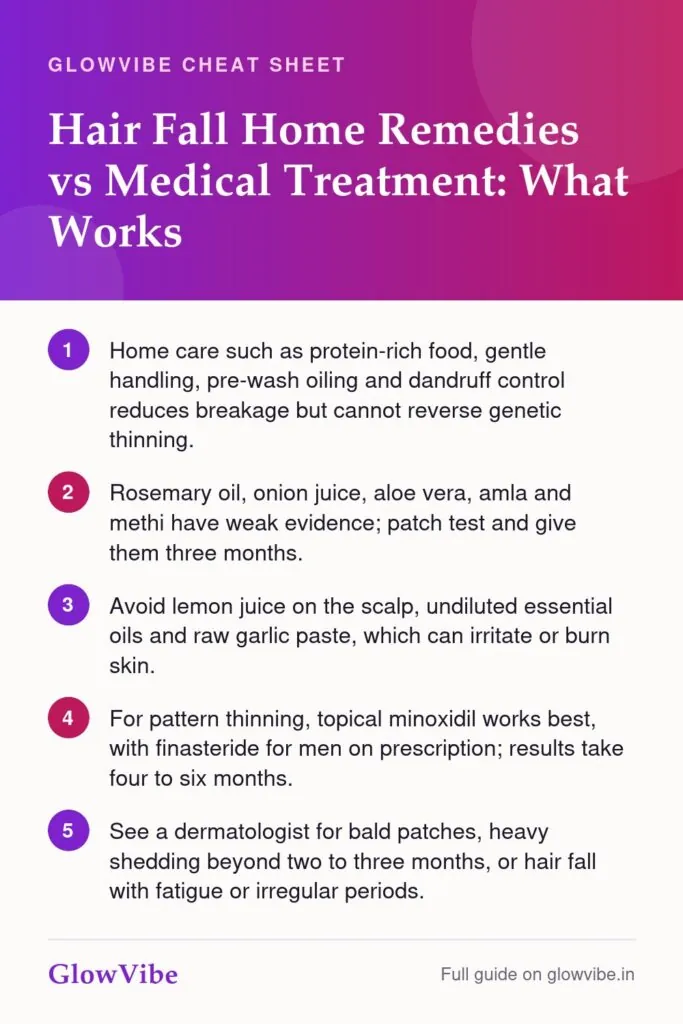
- Worth doing for everyone: eating enough protein and iron, gentle washing and combing, oiling before a wash to reduce breakage, and managing dandruff.
- Weak evidence but low risk: Rosemary oilAn essential oil popular in scalp routines. Always dilute it in a carrier oil like coconut or jojoba before applying.See glossaryRead the guide, onion juice, aloe vera, AmlaIndian gooseberry, used in Ayurvedic hair oils, powders and packs. It is valued for conditioning hair and adding shine.See glossaryRead the guide and methi. Fine to try, not to rely on.
- Risky, skip them: lemon juice on the scalp, undiluted essential oils and raw garlic paste.
- Medical options with the best evidence: topical minoxidil (men and women), finasteride for men on prescription, and treatment of the underlying cause (iron deficiency, thyroid disease, PCOS).
- See a doctor: if you notice patches, sudden heavy shedding, scalp pain or redness, or hair fall along with fatigue, weight change or irregular periods.
First, understand why your hair is falling
Losing roughly 50 to 100 hairs a day is normal. What matters is whether that has clearly gone up, and the cause decides what will help.
- Breakage: short, snapped pieces caused by rough combing, tight styles, heat or chemical treatments. Home care helps a lot here.
- Telogen effluvium (temporary shedding): a sudden increase in fall about two to three months after a trigger such as high fever, dengue, typhoid, COVID, childbirth, surgery, a crash diet or severe stress. It usually settles on its own.
- Pattern hair loss (androgenetic alopecia): gradual thinning at the crown or temples in men, or a widening centre parting in women. It is genetic and hormone-linked, and home remedies cannot stop it.
- Medical causes: low iron (very common in Indian women), thyroid disorders, PCOS, vitamin B12 or vitamin D deficiency, and scalp conditions such as severe dandruff or fungal infection.
- Alopecia areata: smooth, round bald patches. This is an autoimmune condition that needs a dermatologist.
Home remedies vs medical treatment: comparison table
“Evidence” here means the quality of human research, not social media popularity.
| Remedy / treatment | Evidence | Who it may help | Caution |
|---|---|---|---|
| Protein- and iron-rich diet | Good (when you are deficient) | Vegetarians, people who diet or have heavy periods | Supplements only after a blood test |
| Gentle care and pre-wash oiling | Good for breakage | Dry, frizzy, long or chemically treated hair | Do not leave heavy oil on an itchy or flaky scalp for days |
| Rosemary oil (diluted) | Weak: one small trial | Mild thinning, alongside other care | Always dilute; Patch testTrying a small amount of a new product behind the ear or on the inner arm for a few days to check for a reaction before using it widely.See glossary |
| Onion juice | Weak: one small study in patchy hair loss | People who want a low-cost trial | Smell, irritation; patch test |
| Aloe vera gel | Very weak for hair fall | Itchy or dry scalp | Rare allergy; patch test |
| Methi (fenugreek) | Very weak for hair fall | Conditioning hair packs | Can irritate sensitive skin |
| Lemon juice on scalp | None for hair fall | Nobody | Stinging, dryness, worse with sun |
| Undiluted essential oils / garlic paste | None | Nobody | Contact dermatitis, chemical burns |
| Topical minoxidil | Strong | Pattern hair loss in men and women | Initial shedding; must continue to keep results |
| Finasteride | Strong (men) | Male pattern hair loss | Prescription only; not for women who may get pregnant |
| Treating iron, thyroid, PCOS | Strong when the cause is present | Anyone with a diagnosed deficiency or condition | Needs blood tests and a doctor |
| PRP and laser devices | Moderate, variable | Pattern hair loss, usually with minoxidil | Cost, repeat sessions |
Tier 1: Home care that genuinely helps your scalp and breakage
These habits will not regrow lost follicles, but they protect the hair you have and visibly reduce breakage and frizz.
Eat enough protein, iron and nutrients
Hair is built from protein, and many Indian vegetarian diets fall short on it. Include dal, paneer, curd, eggs, chicken, fish, soy, chana or rajma in most meals.
Iron deficiency is one of the most common treatable causes of hair fall in Indian women. Get a blood test before you buy iron, zinc or BiotinA B vitamin (B7) common in hair supplements. It tends to help mainly when someone is actually low in it; it can also affect some blood test results.See glossary pills, because taking them when you are not deficient does not help your hair and can cause side effects. High-dose biotin can also distort thyroid blood test results, so tell your doctor if you take it.
Oil before washing, not as a cure
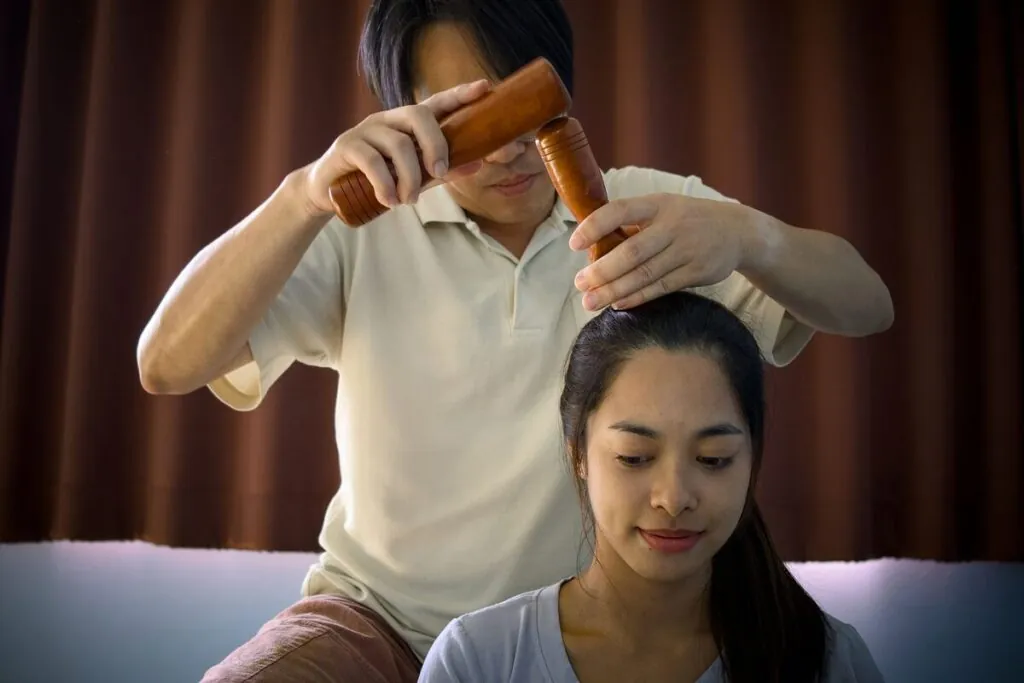
Coconut oilA common Indian hair oil that can soak into the hair shaft, which may reduce protein loss during washing. It can feel heavy on fine hair.See glossary before a wash is one of the better-studied traditional habits: it can reduce protein loss and makes hair less likely to snap. Apply it 30 minutes to a few hours before shampoo, massage gently, and wash it out.
Think of oiling as breakage control, not a hair fall cure. For oil choices by hair type, see our honest guide to hair oils for growth.
Handle hair gently
- Use a wide-tooth comb on wet hair and start from the ends.
- Avoid very tight buns, braids and ponytails every day, as they can cause traction hair loss at the hairline.
- Use a Heat protectantA spray, cream or serum applied before blow-drying, straightening or curling to reduce heat damage to the hair.See glossary and lower heat on straighteners, and space out smoothening, rebonding and bleaching.
- Use a mild shampoo and condition the lengths, especially with hard water. More everyday habits are in our natural hair care tips at home.
Keep dandruff under control
An itchy, flaky scalp leads to scratching and a poor environment for hair. Medicated shampoos with ketoconazole, zinc pyrithione or selenium sulphide, used two or three times a week, often help. Our guide to hair fall and dandruff care covers a full routine.
Tier 2: Popular remedies with weak but low-risk evidence
Each of these has a little research or a long tradition behind it, but none has the large trials that medicines have. If you try one, give it at least three months, do a patch test, and keep using the Tier 1 basics.
Onion juice for hair fall
The hype comes mainly from one small, older study in people with patchy hair loss (alopecia areata), where some saw regrowth. It has not been properly tested for everyday shedding or pattern hair loss.
How to try it: blend one onion, strain the juice, apply to the scalp for 15 to 20 minutes, then shampoo. Once or twice a week is plenty.
- Pros: cheap, easy to make at home.
- Cons: strong smell, can sting or cause redness, weak evidence.
Rosemary oil
Rosemary oil became famous after a small six-month trial compared it with 2% minoxidil in men with pattern hair loss and found similar results in both groups. Encouraging, but one small study does not prove rosemary matches minoxidil.
How to try it: mix a few drops of rosemary essential oil into a tablespoon of coconut, almond or another carrier oil. Never apply it neat. Massage into the scalp and wash out after a few hours.
- Pros: pleasant, easy to add to oiling.
- Cons: can irritate if not diluted; evidence is limited.
Aloe vera
Fresh aloe gel soothes an itchy or dry scalp, but there is no reliable evidence that it reduces hair fall. Use it as a calming scalp mask for 20 to 30 minutes before washing.
Amla
Amla is a healthy food and amla oil works fine for pre-wash oiling, but claims that it stops hair fall come from tradition and lab studies, not solid human trials.
Methi (fenugreek)
Soaked, ground methi seeds make a conditioning hair pack, but evidence for hair fall is very limited and it can irritate, so patch test first. For more pack ideas, see our DIY hair pack recipes.
Tier 3: Risky remedies to avoid
Natural does not mean safe. Skip these:
- Lemon juice on the scalp: it is acidic, stings broken skin, dries the scalp and can react with sunlight. It does nothing for hair fall.
- Undiluted essential oils: neat rosemary, tea tree, peppermint or clove oil can cause contact dermatitis. Always dilute in a carrier oil.
- Raw garlic paste: left on the skin, garlic can cause chemical burns and blisters.
How to do a patch test
Do this before trying any new remedy, oil blend or medicated product, even a “natural” one.
- Apply a small amount on the inner forearm or behind the ear.
- Leave it for the time you would use it on your scalp, or as the label directs.
- Wait 24 to 48 hours without washing that area if possible.
- If you notice redness, itching, burning, swelling or blisters, do not use it. Wash it off and see a doctor if the reaction is severe.
When medical treatment for hair fall is needed
If you have pattern thinning or hair fall that has not improved after a few months of good care, medical treatment gives you the best chance of keeping your hair. For a deeper look at each option, read our guide to hair loss treatment in India, ranked by evidence.
Minoxidil
Topical minoxidil, available as a solution or foam in 2% and 5% strengths, is the most widely used treatment for pattern hair loss in both men and women. It can slow thinning and help some people regrow hair, but results take four to six months and fade if you stop.
- Many people notice extra shedding in the first few weeks. This is common and usually temporary.
- Possible side effects include scalp itching, dryness and unwanted facial hair.
- Do not use it during pregnancy or breastfeeding without medical advice.
Finasteride (for men, on prescription)
Finasteride is an oral medicine that lowers DHT, the hormone that drives male pattern hair loss. It is one of the most effective options for men, but it must be prescribed and monitored by a doctor. Some men experience side effects such as reduced libido, and it is not for women who are or may become pregnant, as it can affect a male foetus.
Treating the cause: iron, thyroid, PCOS and more
When hair fall is caused by an underlying problem, fixing that problem is the treatment. A doctor may check:
- Haemoglobin and ferritin for iron deficiency.
- Thyroid function (TSH), since both underactive and overactive thyroid can cause hair fall.
- Vitamin B12 and vitamin D, which are often low in India.
- Hormones if you have irregular periods, acne or excess facial hair, which can point to PCOS.
PRP, laser and hair transplant
Platelet-rich plasma (PRP) injections and low-level laser therapy have moderate, variable evidence and usually work best alongside minoxidil. A hair transplant moves existing hair but does not stop future thinning, so medical treatment usually continues afterwards.
When to see a dermatologist
Book an appointment with a dermatologist or trichologist working with a doctor if you have any of the following:
- Round bald patches, or hair loss in the eyebrows or beard.
- Sudden, heavy shedding (handfuls in the shower) lasting more than two to three months.
- A visibly widening parting, receding hairline or thinning crown.
- Scalp pain, burning, redness, pus, or thick scaling.
- Hair fall with fatigue, weight change, irregular periods, acne or feeling cold all the time.
A simple hair fall routine to follow at home
- Eat protein at every meal and get a blood test if you suspect low iron, B12, vitamin D or thyroid problems.
- Oil once or twice a week, 30 minutes to a few hours before washing.
- Wash two to three times a week with a mild shampoo, or a medicated one if you have dandruff, and condition the lengths.
- Detangle gently with a wide-tooth comb and avoid tight hairstyles.
- If you see no improvement or things get worse, see a dermatologist rather than switching remedies again.
Common mistakes that make hair fall worse
- Waiting too long: pattern hair loss is easier to slow early than to reverse later.
- Stopping minoxidil after the first shed: early shedding is common and usually passes.
- Crash dieting: rapid weight loss is a classic trigger for shedding two to three months later.
Frequently Asked Questions
There is no single best remedy. The most useful home steps are eating enough protein and iron, handling hair gently, oiling before washing to reduce breakage, and keeping dandruff in check. Rosemary oil and onion juice have small studies behind them but are not proven treatments.
The evidence is weak. The main study was small and looked at patchy hair loss, not everyday shedding or pattern thinning. It is low-risk to try once or twice a week after a patch test, but it should not replace medical advice if your hair fall is heavy.
Start by finding the cause: recent illness, stress, diet, or a deficiency. Eat a balanced diet with protein, treat dandruff, avoid tight hairstyles and harsh heat. If shedding has not settled within a few months, see a doctor.
Hair grows slowly, so most treatments need at least three to six months before you can judge them. Minoxidil often takes four to six months to show a difference.
Yes. Both thyroid disorders and PCOS are common causes of hair fall and thinning, especially in women. A simple blood test can check thyroid function, and a doctor can assess PCOS if you also have irregular periods, acne or excess facial hair.
Quick poll
How often do you wash your hair?
The bottom line
Home remedies are good at caring for your scalp and reducing breakage, but they are no substitute for medical treatment when hair fall is heavy, persistent or patterned. Look after the basics, skip harsh DIY ingredients, patch test everything, and see a dermatologist early.