Human Hair Growth Per Day: How Fast Hair Really Grows (2026)
Hair grows about 0.3–0.4 mm a day, or roughly 15 cm a year. Learn the growth cycle, normal shedding, myths about faster growth and what genuinely helps.


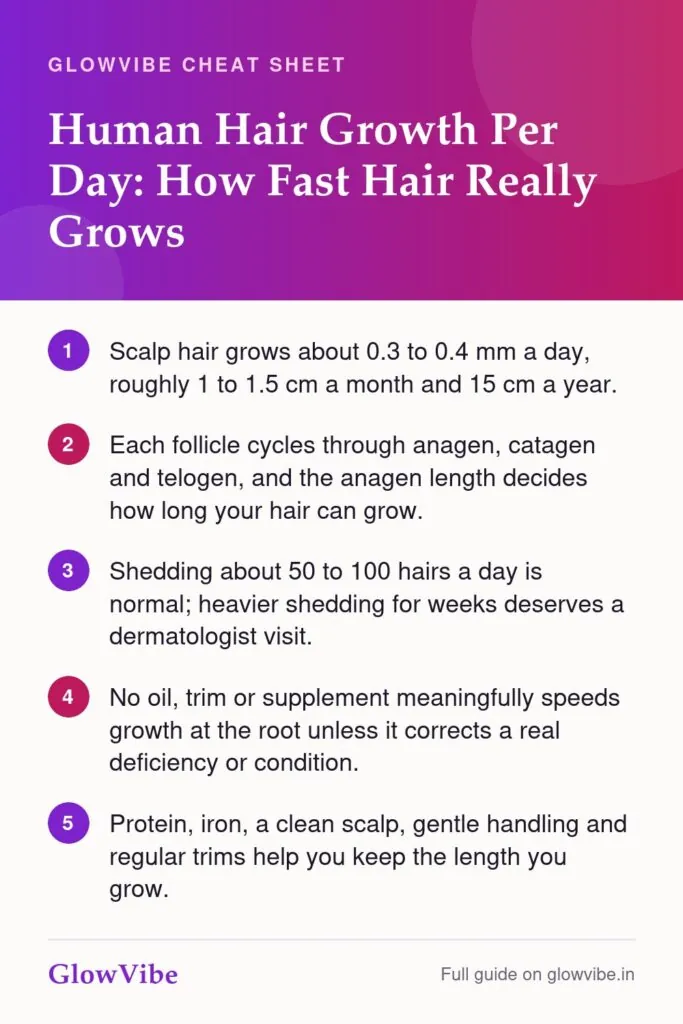
Human hair grows about 0.3 to 0.4 mm per day, which works out to roughly 1 to 1.5 cm a month and around 15 cm (about 6 inches) a year. Your exact speed depends mostly on genetics, age and health, and no oil, shampoo or supplement can push it far beyond your natural rate.
What you can control is how much of that growth you keep. This guide explains the hair growth cycle in plain language, what is normal (including daily shedding), what slows growth down, which “fast hair growth” claims are myths, and the habits that genuinely help Indian hair reach its potential length.
How much does hair grow per day, month and year?
A daily figure of a third of a millimetre is too small to notice in the mirror, which is why hair seems to “not grow at all” for weeks. It helps to look at the numbers over longer stretches. These are average figures for healthy adult scalp hair; your own rate may sit a little above or below them.
| Time period | Average scalp hair growth | What it looks like |
|---|---|---|
| 1 day | about 0.3–0.4 mm | Invisible to the eye |
| 1 week | about 2–3 mm | Visible only at a fresh parting or root touch-up line |
| 1 month | about 1–1.5 cm | Roughly half an inch; colour roots start to show |
| 6 months | about 6–8 cm | A short bob growing towards the shoulders |
| 1 year | about 12–15 cm | Around 6 inches, before any trims or breakage |
Keep in mind that these numbers describe growth at the root. If your ends are splitting and snapping, the length you actually see each year can be far less than 15 cm, even though your scalp is producing hair at a perfectly normal speed.
The hair growth cycle: anagen, catagen and telogen
Your scalp has roughly 100,000 hair follicles, and each one runs its own cycle independently. That is why you never shed all your hair at once. Every follicle moves through three main phases, followed by the release of the old hair.
| Phase | What happens | Typical length | Share of scalp hairs |
|---|---|---|---|
| Anagen (growth) | The follicle actively builds new hair | 2–7 years | About 85–90% |
| Catagen (transition) | Growth stops and the follicle shrinks | About 2–3 weeks | About 1–2% |
| Telogen (resting) | The hair rests while a new one starts below it | About 3 months | About 10–15% |
| Exogen (shedding) | The old hair falls out, often while washing or combing | Part of the end of telogen | A few dozen hairs a day |
Why some people can’t grow very long hair
The length of your anagen phase decides your maximum length. Someone with a two-year growth phase will top out at around 30 cm before those hairs naturally rest and fall, while someone with a six- or seven-year phase can grow hair well past the waist. This is largely inherited, so if the women in your family have always had very long hair, you probably have a long anagen phase too.
How many hairs fall out a day is normal?
Losing about 50 to 100 hairs a day is normal, because that many follicles reach the end of telogen on any given day. You may see more on hair-wash days, since washing and detangling release hairs that were already loose. If you oil and plait your hair and only wash twice a week, a bigger clump in the drain on wash day is usually just two or three days of shedding collected together.
Shedding becomes a concern when you notice a widening parting, a thinner ponytail, patches, or handfuls of hair for weeks on end. That is a pattern worth discussing with a dermatologist.
What affects how fast your hair grows
Growth speed and growth phase length are both shaped by a mix of internal and external factors. Most of them you cannot change overnight, but knowing them helps you spot when something is off.
Genetics and age
Your genes set your baseline speed, your anagen length and your follicle size. Growth is usually at its best from the late teens to the thirties and tends to slow with age, when follicles may produce finer, shorter hairs and the growth phase gets shorter.
Hormones
Thyroid problems, PCOS, pregnancy, the months after delivery, and menopause can all change the hair cycle. Many women notice thicker hair during pregnancy and heavy shedding two to four months after giving birth, which usually settles on its own. In people prone to androgenetic alopecia (pattern hair loss), hormones gradually shrink follicles and shorten the growth phase.
Nutrition
Hair is made mostly of a protein called KeratinThe protein that hair is made of. "Keratin treatments" are salon smoothing services, and some contain formaldehyde-releasing chemicals.See glossary, so a diet short on protein, iron, vitamin D, zinc or vitamin B12 can lead to thinning or extra shedding. Low iron is especially common in Indian women, and crash diets are a frequent trigger. Correcting a real deficiency can help; taking extra nutrients when you are not deficient generally does not.
Stress, illness and telogen effluvium
A major shock to the body, such as high fever, dengue or typhoid, surgery, a big emotional event or rapid weight loss, can push many follicles into telogen at once. This is called telogen effluvium. The shedding usually starts two to three months after the trigger, which is why people rarely connect the two, and it typically improves within six months once the cause has passed.
Medical conditions and treatments
Alopecia areata (an autoimmune condition that causes round bald patches), scalp infections, some medicines and chemotherapy can all interrupt growth. Hair lost during chemotherapy usually starts growing back a few weeks to months after treatment ends, sometimes with a different texture at first.
Breakage from styling and climate
This one doesn’t change growth at the root, but it changes the length you keep. Daily straightening, bleaching, tight buns and rough towel-drying weaken the hair shaft. Hard water in many Indian cities can leave hair feeling rough and tangle-prone, and summer sun, sweat and humidity add more friction and dryness, so ends split faster.
Can you make hair grow faster? Myths vs facts
Social media is full of promises like “grow 2 inches in a week”. Here is what the evidence actually supports.
- Myth: Trimming makes hair grow faster. Growth happens at the follicle, not the tips. Regular trims remove split ends so they don’t travel upwards and snap, which helps you keep length, but they don’t speed up the root.
- Myth: Shaving a baby’s or your own head makes hair grow back thicker. Shaving cuts hair at the surface and has no effect on the follicle. Regrowth only feels coarser because the cut end is blunt.
- Myth: Oiling makes hair grow overnight. Oiling can reduce friction, dryness and breakage, which is a real benefit for length. There is little evidence that any oil changes the daily growth rate. Our guide to the best hair oil for hair growth in India covers what each oil can realistically do.
- Myth: BiotinA B vitamin (B7) common in hair supplements. It tends to help mainly when someone is actually low in it; it can also affect some blood test results.See glossary makes everyone’s hair grow faster. Biotin helps people who are genuinely deficient, which is uncommon. High-dose biotin can also interfere with some blood tests, including thyroid tests, so tell your doctor if you take it.
- Fact: Some treatments help with hair loss. Topical MinoxidilA topical drug used for pattern hair loss. It needs ongoing use to keep results, so check with a dermatologist before starting.See glossary is approved for pattern hair loss and can lengthen the growth phase and thicken thinning hair. It does not turn normal hair into fast-growing hair, and it should be started on medical advice.
What genuinely helps healthy hair growth
Since you can’t change your genetic speed, the realistic goal is to keep your follicles in good health and stop losing length to breakage. These habits are simple, cheap and supported by mainstream dermatology advice.

Eat enough protein and iron
Include a protein source at every meal: dal, paneer, curd, eggs, chicken, fish, soya, chana or rajma. Pair iron-rich foods like green leafy vegetables, ragi and lentils with a Vitamin CAn antioxidant that brightens dull skin, helps fade the look of dark spots and supports sunscreen against daily damage. Best used in the morning.See glossaryRead the guide source such as lemon or AmlaIndian gooseberry, used in Ayurvedic hair oils, powders and packs. It is valued for conditioning hair and adding shine.See glossaryRead the guide to improve absorption. If you need ideas, this list of Indian protein-rich foods works just as well for hair as it does for weight goals.
Massage your scalp gently
A few minutes of fingertip massage, with or without oil, is relaxing and may improve blood flow to the scalp. Small studies suggest regular massage might help hair thickness over months, but treat it as a supportive habit rather than a growth accelerator.

Use the pads of your fingers, not your nails, and move in small circles for three to five minutes. Avoid vigorous rubbing on wet hair, when strands are weakest.
Keep your scalp clean
A healthy scalp is a better environment for growth. In humid Indian summers, sweat and leftover oil can build up and worsen dandruff, so wash two to three times a week, or more often if you work out. Rinse oil out within a few hours to a day rather than leaving it on for days. For flaky scalps, see our tips on hair fall and dandruff care.
Protect the length you already have
- Use conditioner after every wash, focusing on the lengths and ends.
- Detangle with a wide-tooth comb, starting from the ends and working up.
- Pat hair dry with a soft cotton T-shirt or microfibre towel instead of rubbing.
- Keep heat styling occasional and always use a Heat protectantA spray, cream or serum applied before blow-drying, straightening or curling to reduce heat damage to the hair.See glossary.
- Choose loose plaits or soft scrunchies over tight buns and rubber bands.
- Trim split ends every two to three months.
Simple home routines can also help with softness and manageability; our guide to natural hair care tips at home covers which ones are worth your time.
Sleep, stress and steady habits
Regular sleep, physical activity and stress management through walking, yoga or breathing practice support your overall health, and your hair follows. Avoid crash diets, which are one of the most common triggers of telogen effluvium a few months later.
Common mistakes that hold back hair length
- Judging progress too soon. At about 1 cm a month, you need at least three months of consistent care to see a visible difference.
- Switching products every few weeks. Constant changes make it impossible to tell what is working and can irritate your scalp.
- Applying raw onion, lemon or garlic straight to the scalp. These can cause irritation or burns in sensitive skin. Always patch-test any new oil, pack or treatment on your inner arm or behind the ear 24 to 48 hours before using it widely.
- Self-treating real hair loss with supplements. Taking multiple hair gummies without a blood test can mask the real cause and delay proper treatment.
- Ignoring breakage. If your hair is stuck at one length, the problem is usually broken ends, not slow growth.
When to see a dermatologist or trichologist
Book an appointment if you notice sudden or heavy shedding lasting more than a few weeks, round bald patches, a visibly widening parting or receding hairline, an itchy, painful or scaly scalp, or hair loss along with tiredness, irregular periods or weight changes. A dermatologist can check for thyroid issues, anaemia, PCOS or pattern hair loss and suggest proven options. Our overview of hair loss treatments in India explains what a doctor may recommend.
Frequently Asked Questions
On average, scalp hair grows about half an inch (1 to 1.5 cm) a month. That adds up to roughly 6 inches a year, although the length you see may be less if your ends break.
No. At about 0.3 to 0.4 mm a day, a week of growth is only 2 to 3 mm. Any product claiming an inch a week is exaggerating, and photos showing it usually involve different lighting, styling or extensions.
Some studies suggest growth may be very slightly faster in warmer months, but the difference is small and not something you can rely on. Many people also notice a bit more shedding at certain times of year, which is a normal seasonal pattern.
Yes, shedding about 50 to 100 hairs a day is considered normal, and wash days can look heavier. See a dermatologist if shedding stays clearly higher than usual for several weeks or your hair looks visibly thinner.
Oiling mainly helps by reducing dryness, friction and breakage, so you retain more length. There is limited evidence that oils such as coconut or rosemary speed up growth at the root, so think of oiling as protection rather than a growth booster.
After temporary shedding like telogen effluvium, new hairs usually start growing within a few months of the trigger settling, and noticeable fullness can take six months to a year. Pattern hair loss and alopecia areata need medical assessment, as they don’t always recover on their own.
The daily growth rate is broadly similar for men and women. Women often keep longer hair because their growth phase tends to last longer and they are less prone to early pattern hair loss.
Quick poll
How often do you wash your hair?
The bottom line
Human hair growth per day is about 0.3 to 0.4 mm, or roughly 15 cm a year, and that pace is mostly set by your genes. Rather than chasing miracle products, focus on good nutrition, a clean and comfortable scalp, gentle handling and regular trims so you keep every centimetre you grow.
Give any new routine at least three months, patch-test new products, and see a dermatologist if shedding or thinning worries you. Patience and consistency are what turn slow, steady growth into long, healthy hair.