Hybrid Training Plan for Beginners: Mix Strength and Cardio in a Week
How to combine strength with running or cycling without one ruining the other: session order, spacing, rest days and sample 3 and 4-day weeks.


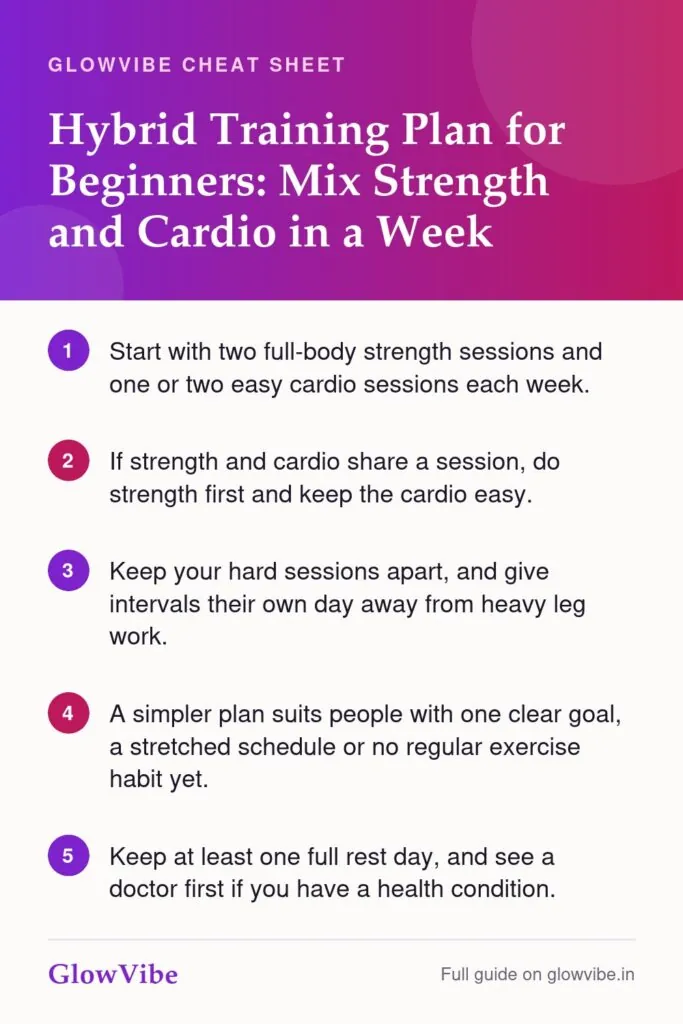
A good hybrid training plan for beginners is two full-body strength sessions plus one or two easy runs or rides each week, with at least one full rest day. Keep your hardest leg work and your hardest cardio on different days, and when both must share a session, lift first.
That covers most of it. The rest of this guide shows you how to order and space the sessions, gives you a sample 3-day and 4-day week, and explains who is better off with something simpler.
The quick answer
- Volume: two strength sessions and one or two cardio sessions a week. That is enough to begin with.
- Order: if both fall in one session, do strength first and keep the cardio easy.
- Spacing: separate days are ideal. If you only have one day, a morning and evening split is the next best thing.
- Intensity: most of your cardio should be easy enough that you can still talk. Add one harder session only once the routine feels settled.
- Rest: keep at least one full rest day each week, and take a second whenever sleep or work has been rough.
What hybrid training means, and whether you need it
Hybrid training simply means training for strength and endurance in the same week. For a beginner, that usually looks like lifting weights or doing bodyweight work, plus running, cycling or brisk walking. It is not a special method, and it is not the smartest way to train for everyone.
It does suit a common goal, which is to feel stronger and fitter at the same time without chasing a competition. It also lines up neatly with general health advice. The NHS suggests adults aim for 150 minutes of moderate activity or 75 minutes of vigorous activity a week, plus strengthening activity on at least 2 days.
Who is better off with a simpler plan
- You have never exercised regularly. Get the habit first with one style. These free workout plans include walking and busy-day options that are easier to keep up.
- You have one clear goal. If you mostly want to build muscle, a dedicated routine such as push pull legs makes more sense. If you are training for your first long race, put running first and keep strength short.
- Your life is stretched right now. Shift work, a new baby, exams or a heavy work patch can make four sessions unrealistic. Two sessions you actually finish will do more for you than four you skip.
- You are coming back from an injury. Follow the plan your doctor or physiotherapist gives you before adding a second type of training.
See a doctor first if this applies to you
Speak to a doctor before you start if you have a heart problem, diabetes, high blood pressure, joint trouble or any other ongoing health condition, if you are pregnant, or if the plan is for a child. Ask which types of activity are safe for you, then adjust the plan around that answer.
During any session, stop and rest if you get chest pain, dizziness, an irregular heartbeat, unusual breathlessness or nausea. Tell a doctor about it, and get medical help right away if the symptoms are severe or don’t settle when you stop.
Will cardio ruin your strength gains?
Probably not at this level. A large analysis in the journal Sports Medicine, pooling 1,090 healthy adults, found that adding aerobic training made no meaningful difference to gains in maximal strength or muscle size compared with strength training alone. Explosive strength, the kind used for jumping and sprinting, did show a small reduction, and mostly when both were done in the same session rather than at least 3 hours apart.
A second analysis in the same journal looked at training experience. It found no significant negative effect on lower-body strength in untrained people, and a modest one in trained people. It covered lower-body strength only, and most of its studies were small and short. So the worry about one type of training cancelling out the other mostly belongs to experienced lifters, not to you in your first few months.
The bigger problem for a beginner is plain tiredness. Sore legs make for a bad run, and a hard run makes for a bad squat session. The rest of this plan is designed around that everyday problem more than any lab finding.
How to order and space your sessions
Which comes first on the same day
Lift first if you have to do both together. One analysis of same-session training found slightly better lower-body strength gains when strength came before endurance, and no difference in aerobic capacity either way. There is a practical reason too: squats and deadlifts need good form, and that is harder to hold when you are already tired.
The difference was small, though. If you prefer an easy jog before weights, keep it short and carry on.
How far apart to keep them
Separate days are the easiest choice for recovery. If you need both on one day, leave a few hours between them where you can. The evidence on an exact gap is thin, with one analysis pointing to at least 3 hours and another to more than 2, the latter resting largely on a single study. Treat these as helpful guides, not cut-offs.
| Your situation | What to do | Keep in mind |
|---|---|---|
| You have time on separate days | Strength one day, cardio on another | Easiest to recover from |
| One day, two free slots | Run or ride in the morning, lift in the evening, or swap them | Eat something between sessions |
| One day, one slot | Strength first, then 10 to 20 minutes of easy cardio | Keep the cardio gentle |
| Hard intervals planned | Give them their own day | Avoid the day after heavy leg work |
Three scheduling rules to follow
- Keep one hard session away from another. A hard session means heavy legs, intervals or your longest run.
- Put easy cardio next to strength days, not hard cardio. A gentle ride the day after lifting often leaves you feeling looser.
- Change one thing at a time. Add a set or add a few minutes of cardio, but not both in the same week.
Sample 3-day hybrid training week
This is the version to start with if your weeks are full. Move the days around to fit your job, but keep at least one day between the two strength sessions.
| Day | Session | Time |
|---|---|---|
| Monday | Strength A | 40 to 45 minutes |
| Tuesday | Rest or a relaxed walk | Optional |
| Wednesday | Easy run, walk-jog or ride | 25 to 35 minutes |
| Thursday | Rest | None |
| Friday | Strength B | 40 to 45 minutes |
| Saturday | Brisk walk or a family activity | Optional |
| Sunday | Rest | None |
One cardio session won’t reach the 150-minute guideline on its own. Brisk walks on the optional days, a walk after dinner or a walk during your commute can make up the difference, and those minutes count too.
Sample 4-day hybrid training week
Move up to this after about four weeks of the 3-day plan, once you are finishing sessions without feeling worn out the next day.
| Day | Session | Time |
|---|---|---|
| Monday | Strength A | 40 to 45 minutes |
| Tuesday | Easy run or ride | 25 to 35 minutes |
| Wednesday | Rest | None |
| Thursday | Strength B | 40 to 45 minutes |
| Friday | Rest or a relaxed walk | Optional |
| Saturday | Longer easy session or walk-jog intervals | 35 to 50 minutes |
| Sunday | Rest | None |
Saturday is the only session that gets a bit harder, and it sits two days after Strength B on purpose. If you want structure for that day, this walk-jog interval plan builds up gradually. Don’t add intervals until easy running feels comfortable.
What to do in each session
Warm up for 5 minutes with brisk marching, leg swings and a light first set. For strength, aim for 2 to 3 sets of 8 to 12 reps, stopping when you could still do two or three more with good form. Rest for a minute or two between sets.
| Movement | Strength A | Strength B |
|---|---|---|
| Legs | Goblet squat | Step-up or reverse lunge |
| Hips | Glute bridge | Dumbbell Romanian deadlift |
| Push | Push-up, on a raised surface if needed | Dumbbell shoulder press |
| Pull | One-arm dumbbell row | Lat pulldown or band pulldown |
| Core | Plank | Side plank or farmer’s carry |
At home, a backpack loaded with books works for squats and rows, and a resistance band covers most pulling. These are the same basic patterns explained in this functional training guide, so use it if you want more detail on form and exercise swaps.
How easy should easy cardio feel?
The NHS gives a simple test: at moderate effort you can still talk, but not sing. Start your easy sessions there. If you can’t manage that while running, slow down or mix in walking, because a walk-jog is a perfectly good session.
Running or cycling?
Pick the one you will actually do. Cycling has less impact, so it usually sits more comfortably beside leg days. Running needs nothing except decent shoes and is easy to fit around work, but your legs and joints may need more time to adjust to it, so build it up slowly.
How to progress over 8 weeks
- Weeks 1 and 2: follow the 3-day plan with 2 sets per exercise. Focus on learning the movements and leave each session feeling you could have done more.
- Weeks 3 and 4: move to 3 sets on the exercises that feel good, or add 5 minutes to your cardio session.
- Weeks 5 and 6: move to the 4-day plan if you are recovering well. Keep the new session easy.
- Weeks 7 and 8: use slightly heavier weights once you can reach 12 reps on every set, and try intervals on Saturday if you feel ready.
Sessions often start to feel more manageable after a few weeks, though the pace varies a lot from person to person.
Fitting it around Indian weather and everyday life

- Summer: run or ride at dawn or after sunset, slow your pace, and carry water. Heat makes the same pace feel harder, so go by effort.
- Monsoon: slippery roads aren’t worth the risk. Swap in a stationary bike, stair climbing or a brisk indoor circuit.
- Winter smog: check the local air quality reading and move cardio indoors on poor days, especially if you have asthma or another breathing condition.
- Food: regular meals with dal, curd, paneer, eggs, soya or chicken, plus rice or roti around training, cover most needs. This guide to pre and post-workout meals has Indian ideas to choose from.
What to do when the week falls apart
It will happen, whether from travel, a deadline or a family function. Don’t try to squeeze missed sessions into the next few days, because that is how hard sessions end up stacked together. Do the next session on your plan and carry on.
If you only have time for two sessions, do the two strength workouts and walk when you can. Strength sessions are harder to replace with everyday movement. If you only have 20 minutes, do one set of each exercise and call it done.
Common mistakes
- Running hard every time. It is a quick way to arrive tired at your strength days. Keep most sessions easy.
- Doing too much in the first week. Motivation is high and your joints haven’t caught up yet. Start below what you think you can do.
- Skipping rest days out of guilt. Rest is part of the plan, so count it as a completed day.
- Training through sharp or worsening pain. Mild muscle soreness is common, but joint pain or pain that changes how you move needs a break and, if it persists, a doctor or physiotherapist.
Frequently Asked Questions
Yes. Do strength first, then add 10 to 20 minutes of easy cardio, or split them into a morning and an evening session if you have the time. Just make sure the next day is an easier one.
After, in most cases, especially if lower-body strength matters to you. If running is your main goal, or you are preparing for a race, give your key runs their own day so that you can do them fresh.
The plans here have three or four non-training days a week, with at least one being a complete rest day. A relaxed walk is fine on the others. Take extra rest if you are sleeping badly, feeling run down or noticing that your sessions are getting worse.
Yes. A pair of dumbbells or a loaded backpack, plus a resistance band, covers the strength sessions, and you can walk or run outdoors for cardio. You may eventually need heavier weights to keep progressing, but that is a long way off for most beginners.
It can be one part of the picture, but exercise alone doesn’t guarantee a change on the scale, since food, sleep and health conditions all play a role. You can also get stronger and fitter without your weight changing at all. If weight is a concern for you, a doctor or dietitian can help you set a safe plan.
The bottom line
Combining strength and cardio is very doable for a beginner, and at this stage one is unlikely to get in the way of the other. Start with two strength sessions and one easy cardio session, keep hard days apart, lift first when you must combine them, and protect your rest days.
If that still feels like too much, a simpler plan isn’t second best. The plan that fits your actual week is the one that will work. This is general information, so check with your doctor first if you have a health condition.