Do Hair Growth Serums Work? Ingredients and What to Expect
Hair growth serums can't deliver fast growth. Here is what the evidence says about Redensyl and other ingredients, how serums differ from minoxidil, and how long to test one.

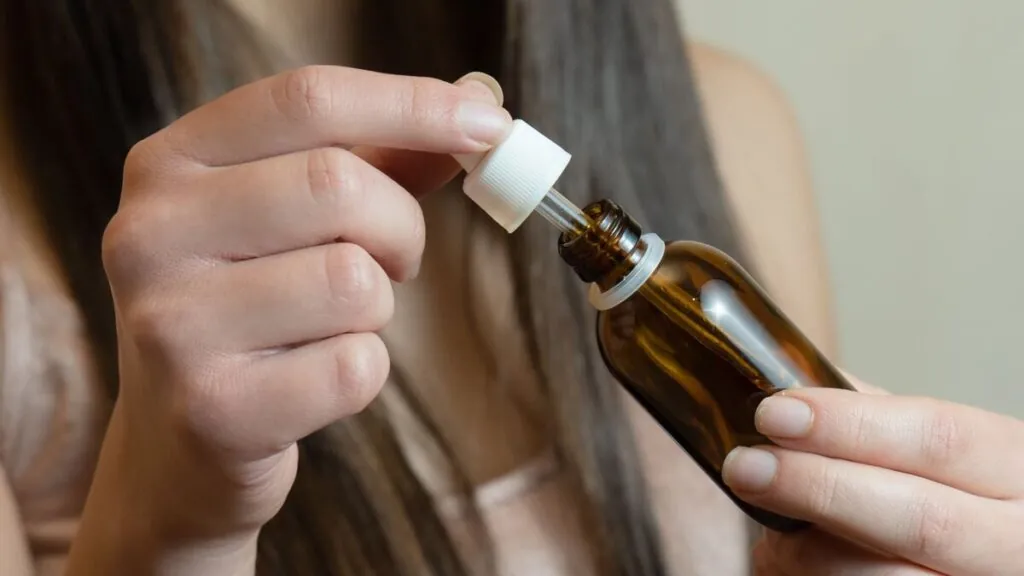
Hair growth serums cannot make hair grow fast, and for most of them the evidence that they help thinning hair at all is thin. A few ingredients have small, promising trials, but none of it matches the track record of a medicine such as MinoxidilA topical drug used for pattern hair loss. It needs ongoing use to keep results, so check with a dermatologist before starting.See glossary, and any fair test takes months rather than weeks.
That does not make every serum useless. It means you should know what a serum can realistically do, which ingredient claims have something behind them, and when thinning needs a doctor instead of another bottle.
The quick answer
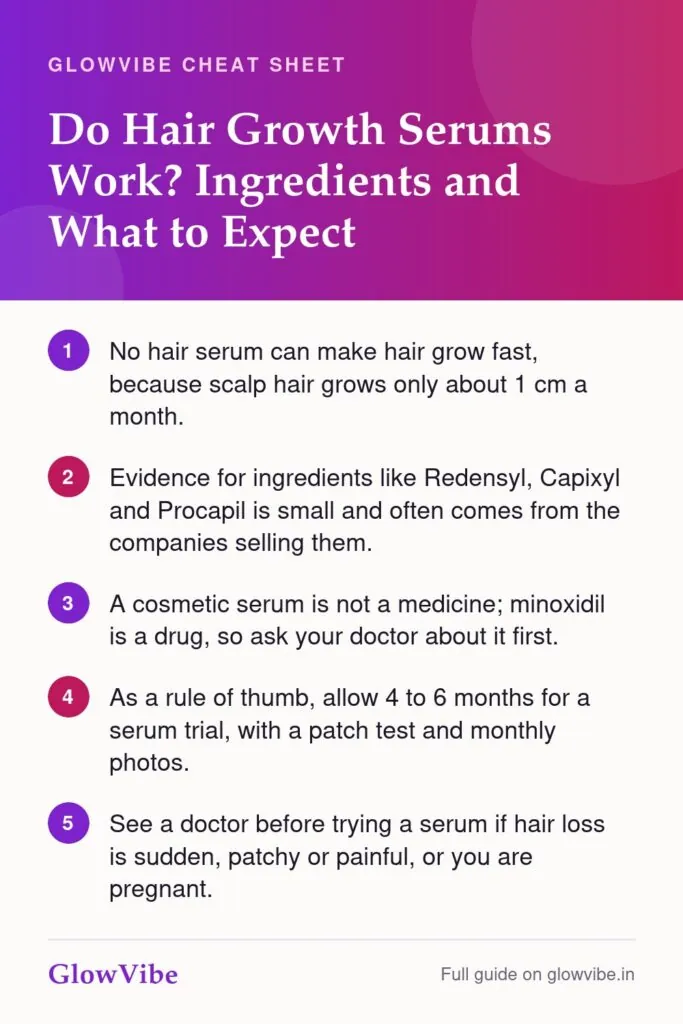
- “Instant” and “fast” growth are not real. Scalp hair grows about 1 cm a month, and no serum has been shown to change that in any dramatic way.
- The evidence is early. Ingredients like Redensyl, Capixyl and Procapil rest mostly on small studies, often run on mixed formulas or reported by the ingredient maker.
- A cosmetic is not a medicine. Minoxidil is a drug with known limits and side effects. Most serums are sold as cosmetics, which is a different category altogether.
- Allow 4 to 6 months. That is a rule of thumb rather than a medical standard, but anything shorter tells you very little.
- Some hair loss needs a doctor first. Sudden, patchy or painful loss should not wait for a serum trial.
Why no serum can deliver fast growth
A hair strand grows from the follicle under your scalp, at roughly 1 cm a month. The strand you can see is no longer living tissue, so anything you apply along it can change how it feels and looks, but not how quickly the next centimetre appears. The detailed guide on how much hair grows in a day walks through the numbers and the full cycle.
Each follicle also runs on a long timetable. DermNet describes a growth phase of about 4 years followed by a resting phase of about 4 months, with about 85% of follicles growing at any one time. So the realistic best case for a scalp serum is not speed. It is keeping more follicles in the growth phase, or thickening hairs that have become fine, and both of those changes would show slowly.
This also explains the “instant” results in advertisements. A serum that coats strands can make hair look fuller and feel smoother after one use, and that effect is real, but it is styling and it washes out. If thickness in the mirror is your main goal, cuts and styling for fuller-looking hair will do more for you this week than any scalp product.
Cosmetic serum or medicine: what is the difference?
India’s drug regulator, CDSCO, quotes the legal definition of a cosmetic as something applied for cleansing, beautifying, promoting attractiveness or altering appearance. That wording does not mention treating a condition. So calling a bottle a cosmetic tells you nothing about whether it can regrow hair, even though the Cosmetics Rules separately say a cosmetic may not make false or misleading claims.
Minoxidil sits on the other side of that line. It is a medicine used to stimulate hair growth and slow balding, and it comes with clear limits, which are worth reading as a benchmark for what honest claims sound like.
| Typical cosmetic growth serum | Topical minoxidil | |
|---|---|---|
| What it is | Cosmetic, often a blend of plant extracts and PeptidesShort chains of amino acids used in serums and creams to support firmer, smoother-looking skin. Generally gentle and easy to layer.See glossary | A medicine |
| Evidence | Mostly small studies, often of mixed formulas | Long-established use for pattern hair loss, though it does not work for everyone |
| Time to any effect | Not well established; most studies ran about 3 to 6 months | At least 4 months and possibly up to a year, per MedlinePlus |
| If you stop | Little is known | Most new hair is lost within a few months |
| Known limits | Rarely stated on the pack | Most effective under 40 with recent loss; no effect on receding hairlines |
| Who decides | You, after a Patch testTrying a small amount of a new product behind the ear or on the inner arm for a few days to check for a reaction before using it widely.See glossary | Ask your doctor first |
MedlinePlus also lists scalp itching, dryness, flaking and irritation as common effects, and says to call a doctor straight away for chest pain, a rapid heartbeat, trouble breathing, or swelling. This article gives no advice on minoxidil strength or dosing, because that is a conversation for your doctor. It also matters for serums: if the label of a “growth serum” lists minoxidil, treat it as a medicine and speak to a doctor before you use it.
For where serums fit among the wider options, see this guide to hair loss treatments in India ranked by evidence.
Which serum ingredients have any evidence?
The most useful single source here is a published paper in the International Journal of Trichology, “Topical Alternatives for Hair Loss: Beyond the Conventional”. It went through 24 articles and technical files on the ingredients advertised most heavily, and its findings are summarised below. Technical files are documents from the company selling the ingredient, not independent research.

| Ingredient | Main evidence described | The catch |
|---|---|---|
| Redensyl | Placebo-controlled pilot in 26 men over 3 months | Figures come from the maker’s technical file; other trials used mixed formulas |
| Capixyl | Placebo comparison in 30 men over 4 months | Very small; also cited from a technical file |
| Procapil | Placebo-controlled pilot in 35 men over 4 months | Pilot only; technical file again |
| Baicapil | Placebo comparison in 61 volunteers over 6 months | The paper lists no published studies, only a technical file |
| Anagain (pea sprout) | Study of 20 volunteers over 3 months | Small, and cited from the maker’s technical file |
| Caffeine | Controlled trial in 40 people over 24 weeks | It tested a daily shampoo, not a leave-on serum |
| Saw palmetto | Controlled trial in 60 men and women over 50 weeks | A small group, one arm added an oral supplement, and results may not carry over to other formulas |
| Rosemary oilAn essential oil popular in scalp routines. Always dilute it in a carrier oil like coconut or jojoba before applying.See glossaryRead the guide | 100 people over 6 months, compared with 2% minoxidil; no significant difference in hair count | One trial, no placebo group, and it used an oil |
| Pumpkin seed oil | Serum study in 42 people over 8 weeks | Short, no comparison group described, and it used a special delivery form |
Read that table as “worth more research”, not “proven”. The paper’s author points to limited sample sizes, poor comparison groups, qualitative rather than measured regrowth, and sponsorship by companies. The paper also notes that most products mix the active with other vitamins, minerals or additives, so it is hard to tell which ingredient did what. Its conclusion is that these products may find a place as add-on or maintenance options, or for people who cannot tolerate standard treatment.
If rosemary is what drew you in, the rosemary and onion oil comparison covers that question in depth, and this overview of oils for hair growth covers the rest of that format.
The trial behind the “beats minoxidil” claims
You may see claims that the Redensyl, Capixyl and Procapil combination “beat minoxidil”. The study usually behind them is a 2019 trial by Karaca and Akpolat in the Journal of Cosmetology & Trichology, which the review above also reports. It compared the combination with 5% minoxidil in 106 men with pattern hair loss over 24 weeks. The researchers rated 64.7% of the combination group as having moderate or significant recovery, against 25.5% on minoxidil.
That sounds decisive, but look closer. It is one study, in men only, with no placebo group. The paper does not describe any blinding, the researcher score depends on someone’s judgement, and the formula was developed specifically for this work, so the result may not apply to a bottle on a shop shelf. It is a reason to run a bigger, independent trial. It is not a reason to drop a medicine your doctor has prescribed.
How to judge a serum before you buy it
- Find the active on the ingredient list. A front-of-pack “with Redensyl” means little if you cannot see it on the label.
- Ask what the claim refers to. “Clinically tested” may describe one ingredient at a set strength in a different formula, not the bottle in your hand.
- Look at how the result was measured. Hair counts over several months mean more than a survey saying people “felt” less hair fall.
- Check who ran the study. Company-run work is not automatically wrong, but it needs independent confirmation.
- Be wary of short timelines. Results promised in days or a couple of weeks do not fit how hair grows.
What a fair trial looks like
If you still want to try a serum, and your hair loss is mild with no warning signs, give it a proper test. The timeline below is a practical rule of thumb built on how slowly hair grows and how long the studies above ran. It is not a medical standard.

| When | What to do | What to expect |
|---|---|---|
| Before you start | Patch test on the inner arm or behind the ear for 24 to 48 hours. Take photos of your parting and crown in daylight. | A baseline you can trust more than memory |
| Weeks 1 to 4 | Use it as the label says, on a clean scalp. Keep the rest of your routine the same. | No growth change. Softer hair is conditioning, not regrowth. |
| Months 2 to 3 | Take monthly photos in the same spot and light. | New hairs, if any, would be only a few centimetres long at most |
| Months 4 to 6 | Compare the photos side by side. | This is the earliest point for a fair verdict |
| After 6 months | If nothing has changed, stop and see a dermatologist. | No need to keep paying for no clear benefit |
A few practical points help in Indian conditions. In humid months, a sticky serum on a sweaty scalp can feel unpleasant, so a light, water-based texture and regular washing make it easier to stay consistent. Apply it after washing rather than on top of oil, since a layer of oil and old product may keep the serum from reaching your scalp evenly.
Stop straight away if you get burning, redness, swelling or an itchy rash, and see a doctor if it does not settle.
When to skip the serum and see a doctor
A serum cannot treat the cause of many types of hair loss, and waiting six months can cost you time. See a doctor or dermatologist first if you notice any of these:
- Round or patchy bald spots, or spots in your beard or eyebrows
- Fast loss, or loss starting in your teens or twenties
- Pain, itching, redness, or a scaly or infected scalp
- Thinning along with acne, facial hair or irregular periods
- Heavy shedding along with tiredness or weight changes, since thyroid disease and anaemia are both possible causes
If you are pregnant, planning a pregnancy or breastfeeding, ask your doctor before using any growth serum, and especially anything with minoxidil. The same goes for children and for anyone with heart, kidney, liver or scalp disease.
Sudden, even shedding also has a typical pattern. DermNet says increased hair fall tends to appear 2 to 4 months after a trigger, and tapers over 6 to 9 months in most cases. Illness, childbirth, surgery and crash diets are all recognised triggers, so a serum started during that recovery can get credit for hair that was coming back anyway. Compare this with home remedies and medical treatment for hair fall if you are unsure which route fits.
Common mistakes
- Judging after a few weeks. Too little hair has grown for you to see anything either way.
- Testing three products at once. Starting a serum, a new oil and a supplement together means you cannot tell what helped or what irritated your scalp.
- Applying it only to the lengths. If the aim is the follicle, the scalp is where the product goes. Lengths need conditioner.
- Using more for faster results. Extra product mainly adds residue and irritation risk.
Frequently Asked Questions
Some may help a little with mild thinning, but the evidence is small and often tied to the companies selling the ingredients. None should be expected to make hair grow fast. Treat a serum as an optional extra rather than a treatment.
As a rule of thumb, plan on 4 to 6 months before you judge it. Most of the studies on these ingredients ran for about 3 to 6 months, and hair grows only about 1 cm a month.
One trial reported better scores for a Redensyl, Capixyl and Procapil mix than for 5% minoxidil, but it was a single study in men with no placebo group. That is not enough to call it better. Discuss any change with your doctor, and do not stop a prescribed treatment on your own.
Do not rely on one for this. Round or patchy bald spots need a doctor’s assessment, as the cause may need specific treatment.
Ask your doctor before you use one, as many of these blends have little safety data, and minoxidil in particular needs a doctor’s input. Shedding after childbirth is also common and often goes away over 6 months to 2 years, so check with your doctor before treating it.
The bottom line
Hair growth serums will not give you fast growth, and the evidence for even the best-known ingredients is small and often company-linked. If your thinning is mild, a 4 to 6 month trial with monthly photos is reasonable. If it is sudden, patchy, painful or worrying you, see a doctor first, because that is where the treatments with a real track record are.
Quick poll
How much do you usually spend on one beauty product?
Sources
- Topical Alternatives for Hair Loss: Beyond the Conventional, International Journal of Trichology (via NIH PubMed Central)
- Minoxidil Topical, MedlinePlus, US National Library of Medicine
- Hair loss, MedlinePlus, US National Library of Medicine
- Telogen effluvium, DermNet
- Cosmetics, Central Drugs Standard Control Organisation, India