How to Choose Peanut Butter: Reading the Label in India
A step-by-step way to compare peanut butter labels in India: ingredients, added sugars, oils, protein per serving, sodium and sensible portions.

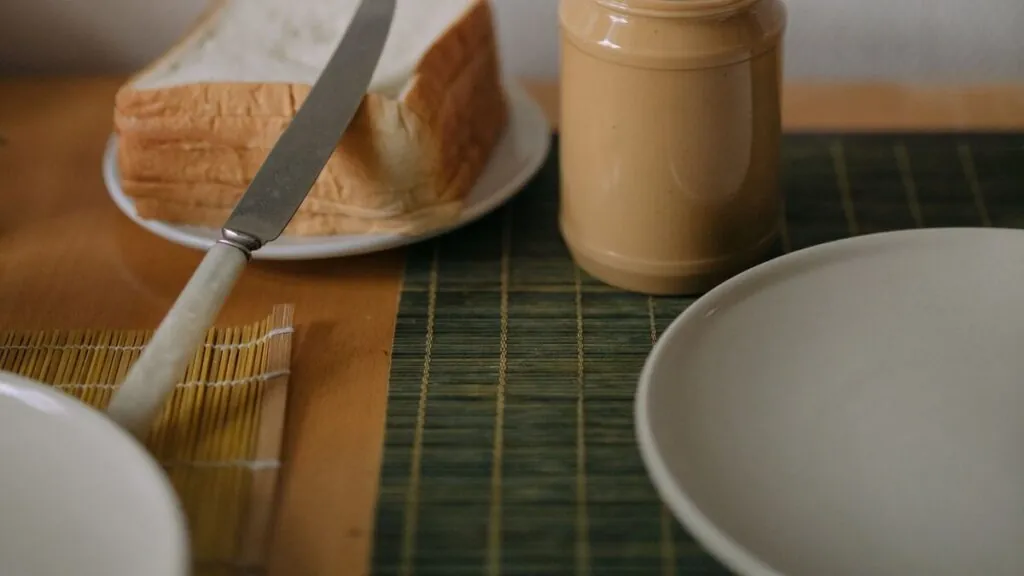
To choose a healthy peanut butter, read the ingredient list first and pick a jar that is mostly peanuts, ideally with nothing more than a little salt. Then check the nutrition table for added sugars, trans fat and sodium, and measure your portion, because even the cleanest jar is high in calories.
This guide covers how to choose peanut butter from the label on an Indian jar, whichever brand is on your shelf. It names no products on purpose, since formulas change and the label in your hand is what counts.
The quick answer
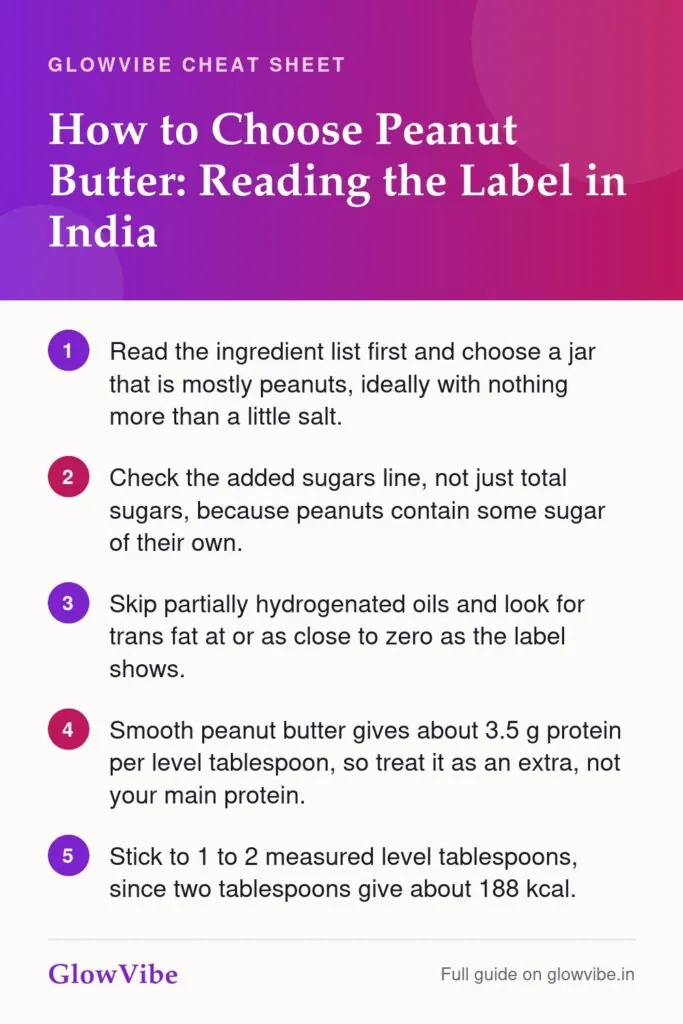
- Ingredients: peanuts first, and the shorter the list the better. Peanuts plus salt is a good result.
- Added sugars: 0 g per 100 g is ideal. If there is some, compare jars and take the lower one.
- Fats: skip partially hydrogenated oils. Look for 0 g trans fat in the table.
- Protein: expect about 3.5 g per level tablespoon from a typical smooth peanut butter. It is a useful extra, not your main protein.
- Portion: 1 to 2 level tablespoons, measured rather than scooped.
Step 1: Read the ingredient list before the front of the jar
Words like “natural”, “fitness” and “high protein” on the front tell you little. A Cleveland Clinic dietitian warns that a jar called natural can still contain palm oil or sugar, and suggests looking for peanuts or, at most, peanuts and salt.

Under FSSAI’s labelling rules, ingredients are listed in descending order by weight or volume. So the first item is the largest, and anything sitting in second place deserves a close look. If sugar or oil comes straight after peanuts, you are buying more than ground nuts. India’s food standard for peanut butter allows sugar, salt, liquid glucose, jaggery, honey and edible oils and fats, so these can all legally appear. FSSAI amends its rules from time to time, so treat the jar’s label as the final word.
Some jars also print a peanut percentage. For a benchmark, the US standard for anything sold as peanut butter asks for at least 90 percent peanuts, according to the FDA. That is an American rule and doesn’t bind jars sold in India, but it is a handy yardstick when you compare two labels.
Step 2: Find the added sugars line
Look at added sugars, not just total sugars. FSSAI’s rules ask for both to appear in the nutrition table. Total sugars will rarely be zero, because peanuts contain some sugar of their own: USDA data shows 4.72 g per 100 g in raw peanuts.
Why it matters: ICMR-NIN’s “My Plate for the Day” guidance limits sugar to 25 to 30 g a day. As a worked example, a jar with 15 g added sugar per 100 g gives you about 4.8 g in a 32 g serving, which is close to a fifth of that limit before your chai or dessert. Honey, jaggery and chocolate variants count here too, however wholesome they sound.
Step 3: Check the oils and fats
Peanut butter is naturally about half fat, so a high total fat number isn’t a fault. USDA data for smooth peanut butter shows 49.5 g fat per 100 g, and raw peanuts have 49.2 g. What you are checking is which fats were added.
FSSAI’s rules ask makers using edible vegetable fat to name its type, such as interesterified, fractionated, hydrogenated or partially hydrogenated. Here is how to read those words:
- Partially hydrogenated oil: skip it. It is a source of trans fat, and WHO says industrially produced trans fats should be avoided altogether.
- Hydrogenated oil: Harvard’s public health school suggests choosing peanut butter without hydrogenated oils, so prefer a jar without it when you can.
- Palm oil or other vegetable fats: usually there to stop the oil separating and to keep the texture smooth. A jar without them is the simpler choice, though you will have to stir it.
Then read the saturated fat and trans fat lines. The rules allow these to be declared as “not more than”, so a figure may be an upper limit. For comparison, USDA lists 9.52 g saturated fat per 100 g for smooth peanut butter, and you want trans fat at or as close to zero as the label shows.
Step 4: Judge the protein by serving, not by the front label
Labels show protein per 100 g, which makes the number look large. You won’t eat 100 g. In USDA’s data, smooth peanut butter has 21.9 g protein per 100 g, which works out to about 3.5 g in one level tablespoon and 7 g in two.
For scale, ICMR-NIN puts the protein allowance for healthy adults at 0.83 g per kg of body weight a day, or 1 g per kg for those on a cereal-based diet with lower quality protein. For someone weighing 60 kg, that is about 50 to 60 g a day. Two tablespoons provide a useful part of that, but not most of it.
The bigger point is how many calories come along with that protein. These USDA figures show why peanut butter is better thought of as a fat-rich food that has some protein:
| Food (USDA data) | Protein per 100 g | Energy per 100 g | Protein per 100 kcal |
|---|---|---|---|
| Smooth peanut butter | 21.9 g | 588 kcal | About 3.7 g |
| Whole egg, raw | 12.6 g | 143 kcal | About 8.8 g |
| Lentils, boiled | 9.02 g | 116 kcal | About 7.8 g |
If you need more protein, build meals around foods from this list of veg and non-veg protein sources in India, and treat peanut butter as a tasty addition.
What about “high protein” jars? Raw peanuts and smooth peanut butter sit at roughly 22 to 26 g per 100 g in USDA’s data. That gives you a rough guide rather than a legal test: a label well above that range suggests extra protein was added, so look for it on the ingredient list, such as whey or soy. That can suit you if you want more protein per spoon, but check the added sugars too, and note that whey means milk and soy is a separate allergen.
Step 5: Compare the sodium
Salted peanut butter isn’t automatically a problem in small amounts. USDA’s figure for smooth salted peanut butter is 476 mg sodium per 100 g, or about 150 mg in two tablespoons, while WHO advises adults to stay under 2 g of sodium (5 g of salt) a day.
Indian meals with pickle, papad and namkeen can add up quickly, so an unsalted or lightly salted jar makes sense if you eat those often. If you have high blood pressure or kidney disease, ask your doctor or dietitian how much sodium suits you.
Step 6: Measure your portion
This step matters more than which clean jar you pick. A Cleveland Clinic article gives a serving as about 2 tablespoons and advises eating peanut butter in moderation. Here is what portions look like, calculated from USDA’s figures for smooth peanut butter, so treat them as estimates and check your own jar:
| Level portion | Approx. weight | Energy | Protein | Fat |
|---|---|---|---|---|
| 1 teaspoon | 5 g | 29 kcal | 1.1 g | 2.5 g |
| 1 tablespoon | 16 g | 94 kcal | 3.5 g | 7.9 g |
| 2 tablespoons | 32 g | 188 kcal | 7 g | 15.8 g |
Everyday steel kitchen spoons aren’t measuring spoons, and a heaped scoop can hold far more than a level one. Weigh your usual spoonful on a kitchen scale once, or use a measuring tablespoon for a week until you can judge it by eye.
Nuts and seeds also have a daily place in ICMR-NIN’s plate: 35 g on a 2,000 kcal diet. Two tablespoons of peanut butter nearly fill it, so count them in rather than eating them on top of your usual nuts. Your needs may differ with your size and activity.
Which type of jar should you buy?
| Type | What the list usually shows | May suit | Watch for |
|---|---|---|---|
| Plain or unsweetened | Peanuts, sometimes salt | Most people, as a default | Oil separation; needs stirring |
| Creamy, no-stir | Peanuts, sugar, vegetable fat or stabiliser, salt | Those who want easy spreading | Type of fat, added sugars |
| Crunchy | As above, with peanut pieces | Those who like texture | Same label checks; not for small children |
| Chocolate, honey or flavoured | Peanuts, sugars, cocoa or flavourings | An occasional treat | Added sugars |
| High protein | Peanuts plus whey or soy protein | Those short on protein | Sweeteners, added sugars, allergens |
How peanut butter fits a gym or everyday Indian diet
For training days, pair it with carbohydrates and a stronger protein source rather than relying on it alone. A thin layer on a banana or whole wheat toast works before a workout, while a large spoonful right before training may sit heavily because of the fat. Our guide to pre and post-workout meals covers timing and full meal ideas.
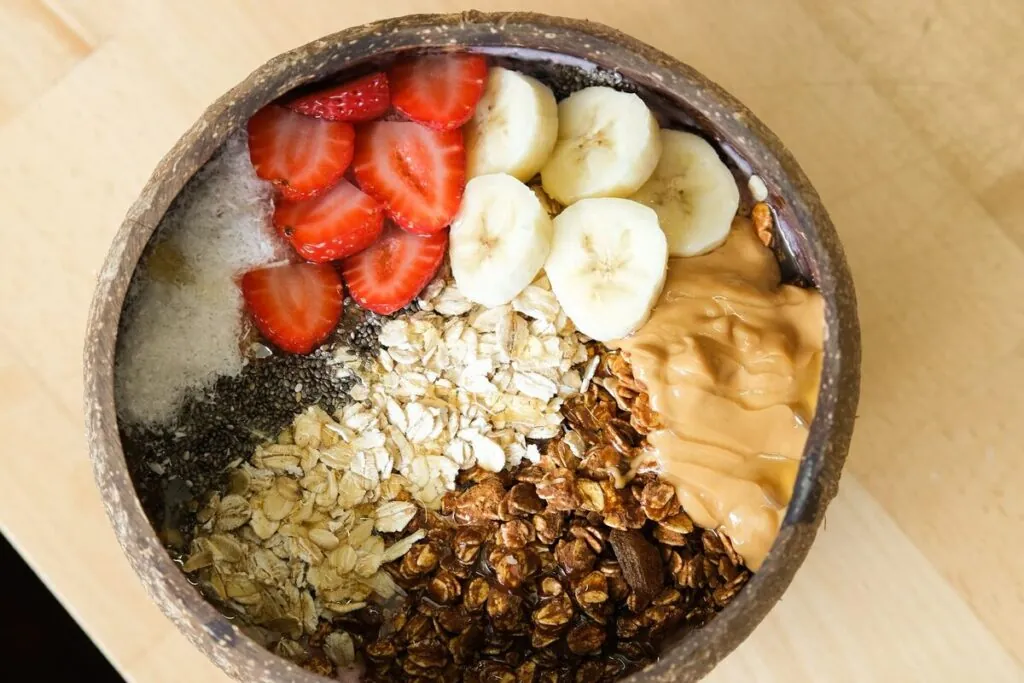
Everyday ideas that keep the portion easy to control:
- One tablespoon stirred into warm oats or dalia with fruit.
- A thin layer on a roti with sliced banana, as a snack.
- One tablespoon blended into a milk or curd smoothie, which also adds protein.
Count peanuts you already eat. If your day includes poha with peanuts, groundnut chutney or chikki, you may not need a jar’s worth on top. Plain roasted peanuts are a fair alternative, and our guide to dry fruits and daily amounts helps you balance your wider nut intake.
If you are trying to gain muscle, its calorie density can help you eat enough, and our Indian muscle gain diet plan shows where such extras can go. If you are trying to lose weight, no peanut butter will cause weight loss, and larger portions can make a calorie target harder to meet. Measured amounts can still fit, alongside the foods in this protein guide for weight loss.
Allergy, children and storage
Peanut allergy: if you have one, avoid peanut butter and read every label. FSSAI’s rules require peanuts to be declared as an allergen (the word may simply be “Nut”), and a “may contain” note flags cross-contamination, which matters on other nut butters too. The rules word that note as something that “may be declared”, so a jar without it isn’t a guarantee. The NHS lists a tight throat, trouble swallowing, swollen lips or tongue, struggling to breathe and fainting as serious signs. Get emergency help immediately if these appear, and use an adrenaline auto-injector straight away if one has been prescribed.
Babies and young children: the NHS says not to give whole nuts to children under 5 because of choking risk. It says peanut butter can be introduced at weaning, around 6 months, but only spread on a food such as toast, because given alone it is a choking risk. So no thick spoonfuls. If your family has a history of food allergies, eczema, asthma or hay fever, speak to your paediatrician first.
Storage: oil rising to the top of a plain jar is normal. A Cleveland Clinic dietitian suggests stirring it when you get home, then storing the jar upside down in the fridge. Moulds that produce aflatoxin thrive in heat and humidity, and high aflatoxin levels are linked to health risks, so buy sealed jars within date and throw away anything mouldy or rancid-smelling. Don’t scoop it out to save it.
Common mistakes
- Comparing per-serve numbers across brands. Serving sizes can differ, so compare per 100 g, then work out your own portion.
- Eating from the jar. It is the fastest way to lose track of your portion.
- Pouring away the separated oil. Stir it back in, or what remains turns dry and hard to spread.
Frequently Asked Questions
Generally, one with peanuts as the main ingredient, no added sugars and no partially hydrogenated oil, with a little or no salt. No single jar is right for everyone. Compare the current labels of what is on sale near you, since formulas change.
One to two level tablespoons is a sensible amount for most adults, and it counts towards your nuts and seeds for the day. Two tablespoons give about 188 kcal. If you have diabetes, kidney disease or a heart condition, ask your doctor or dietitian what fits your plan.
It can help as an easy source of extra calories and some protein, but it won’t build muscle by itself. Strength training and enough total protein across the day matter far more. Eggs, dal, curd, paneer, chicken or fish give you more protein for the calories.
It can be, because you control exactly what goes in. Roast fresh peanuts, discard any shrivelled or discoloured ones, and grind them in a mixer for several minutes, pausing so the motor can cool. With no stabilisers, make small batches, keep them in the fridge and finish them quickly.
Many people can, but pregnancy is a good reason to check with your doctor about your own diet, especially if you or your family have allergies. The same label checks apply to the jar you choose.
The bottom line
Ignore the front of the jar. Pick peanuts first, no partially hydrogenated oil, as little added sugar as you can find and modest sodium, then stick to 1 to 2 level tablespoons. It is a tasty, filling extra with some protein, not a protein staple. See a doctor or dietitian if you have an allergy concern or a medical condition that affects your diet.
Sources
- Promotion of “My Plate for the Day” and physical activity (policy brief), ICMR-National Institute of Nutrition
- Healthy diet, World Health Organization
- Foods to avoid giving babies and young children, NHS
- Food allergy, NHS
- Food Safety and Standards (Labelling and Display) Regulations, 2021 compendium, FSSAI