Small Home Gym Equipment: What to Buy for a Small Flat
Which small, non-machine kit gives the most training in a small flat, what order to buy it in, and a short routine for each piece.

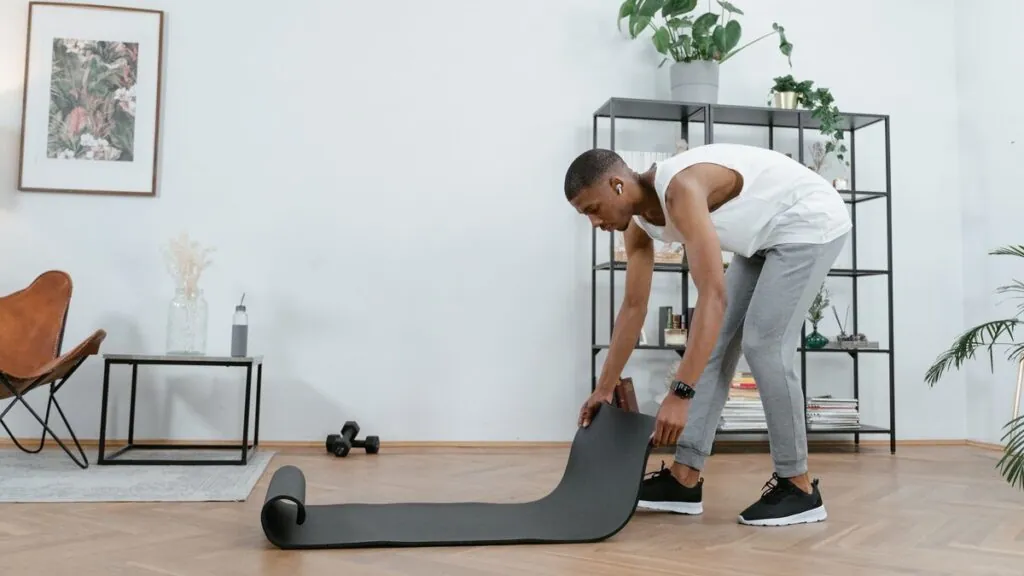
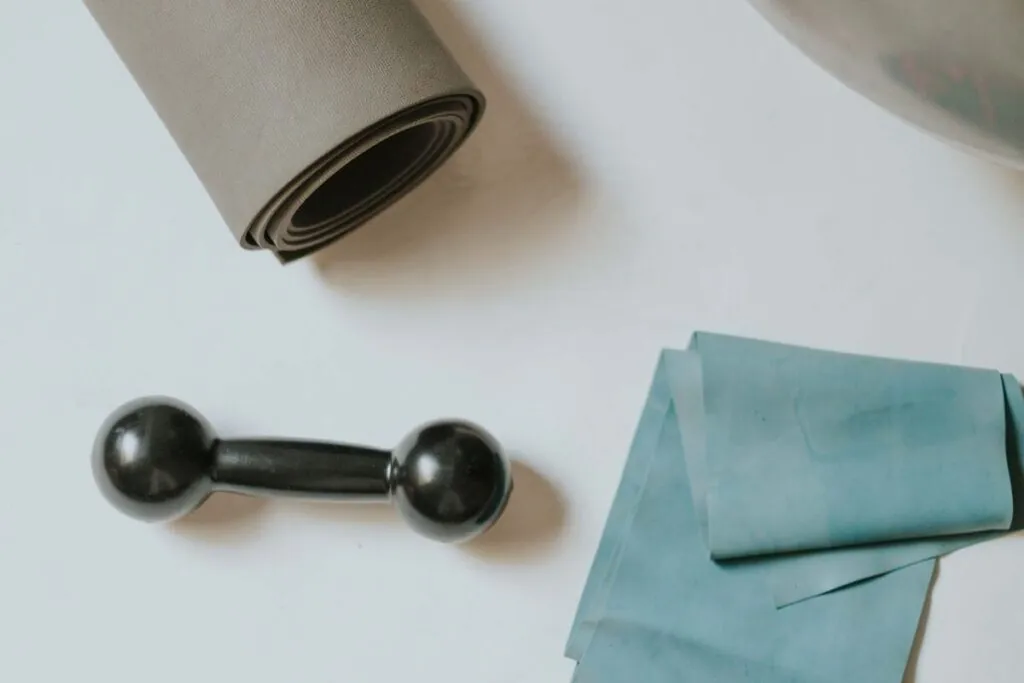
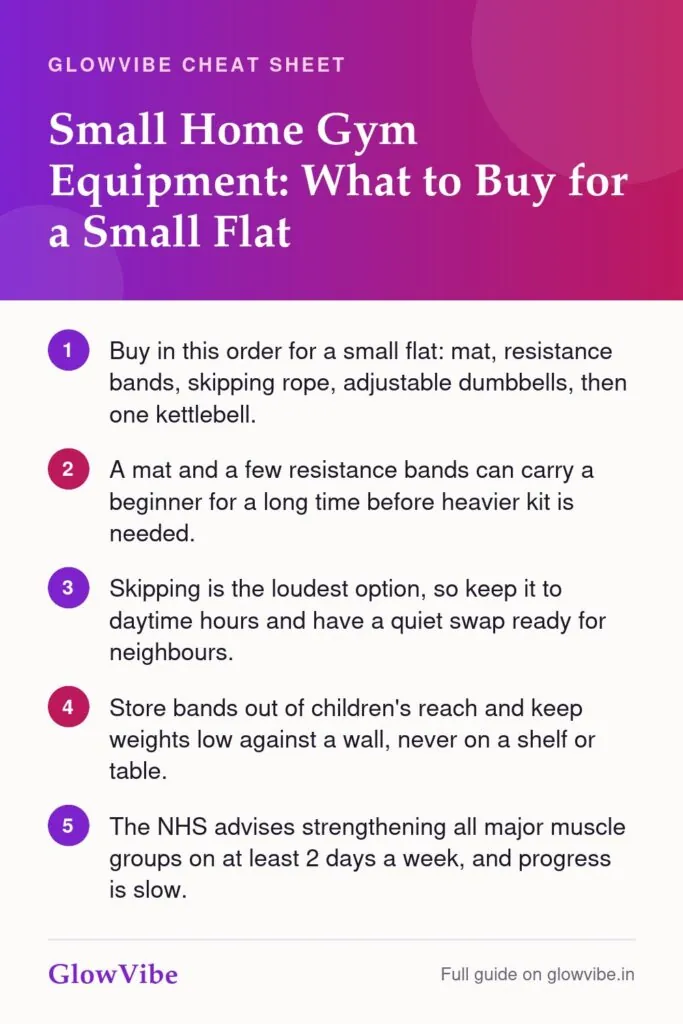
The most useful home gym equipment for a small space is a mat, resistance bands, a skipping rope, a pair of adjustable dumbbells and, later, one kettlebell. Buy them in that order, and most of it can live under a bed or in a wardrobe corner between workouts.
This guide compares types of equipment, not brands, so you can decide what kind of kit suits your flat.
The quick answer
Small flats reward kit that packs away and does many jobs. A treadmill does one job and stays in the room all day. A pair of dumbbells trains your legs, back, chest, shoulders and arms, then slides out of sight. If you do want a large machine, the guide to choosing cardio equipment for home covers that decision.
| Buy order | Item | Mainly trains | Storage | Noise risk |
|---|---|---|---|---|
| 1 | Exercise mat | Core, mobility, bodyweight strength | Rolled, in a corner | Very low |
| 2 | Resistance bands | Whole body, especially back and hips | A small drawer or pouch | Very low |
| 3 | Skipping rope | Heart and lungs, calves, coordination | A hook or a bag | High |
| 4 | Adjustable dumbbells | Whole-body strength | Under a bed or against a wall | Medium if set down carelessly |
| 5 | One kettlebell | Hips, grip, whole-body power | On the floor, against a wall | Medium if set down carelessly |
You don’t need all five. The mat and bands alone can carry a beginner for a long time. Add the next item only when you have been training regularly and the current kit has started to feel too easy.
The small-flat buying checklist, in order
The rounds and repetitions below are suggestions for a healthy adult starting out, not a tested programme, so adjust them to suit you. Warm up first with a few minutes of marching on the spot and easy squats, and stop any move that causes sharp pain. Choose a resistance that leaves you able to do two or three more clean repetitions at the end of each set.
1. Exercise mat: the base for everything
Most Indian flats have tile, marble or vitrified floors, which are hard on knees and slippery under sweaty hands. A mat fixes both problems. Look for a surface that grips when damp, and enough thickness to cushion your knees without feeling wobbly when you balance.
Suggested routine (about 10 minutes): do 2 or 3 rounds, resting a minute between rounds.
- Glute bridges: 12 repetitions
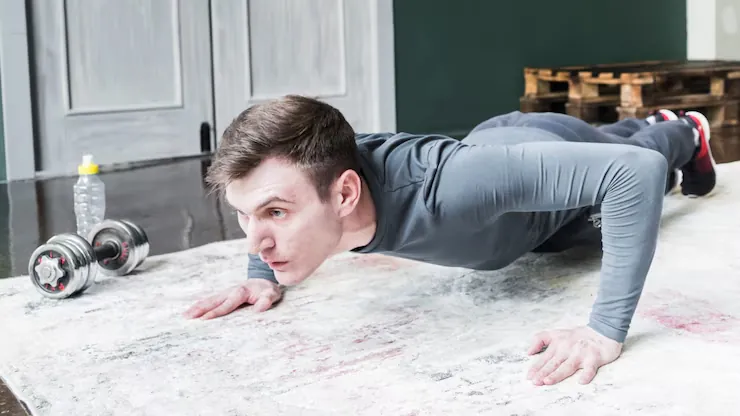
- Knee or incline push-ups: 8 repetitions
- Bird dogs: 8 on each side
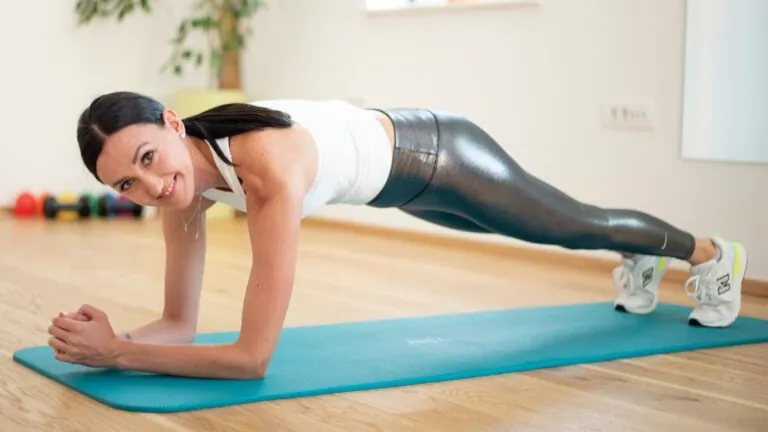
- Forearm plank: 20 to 30 seconds
When this feels comfortable, the core routine with form cues gives you more mat moves to rotate in. If your push-ups or planks feel off, check them against these common bodyweight form mistakes.
2. Resistance bands: the most training per square foot
Bands take up almost no room and make pulling exercises possible, which are the hardest to do at home with bodyweight alone. The NHS lists working with resistance bands among its examples of muscle-strengthening activity, so they count as real strength work and not just a warm-up.
Buy two or three resistance levels, because your legs will outgrow a light band quickly while your shoulders may not. Small loop bands suit hip work. Long bands or tubes with handles suit rows and presses. Bands may contain natural latex, so if you or anyone at home has a latex allergy, choose fabric or latex-free ones.
Suggested routine (about 15 minutes): do 2 or 3 rounds.
- Squats with a loop band above the knees: 12 repetitions
- Seated row with the band around your feet: 12 repetitions
- Chest press with the band behind your upper back: 10 repetitions
- Side steps with a loop band: 10 each way
- Band pull-aparts: 15 repetitions
3. Skipping rope: cardio without a machine
A rope is the smallest piece of cardio kit you can own, and it packs away into a bag. The catch is impact and noise, so it ranks third only if your floor and neighbours allow it. If you live above someone and can’t skip at a reasonable hour, leave it out, or take it and a firm mat to the terrace or a nearby ground-floor space.
To size it, stand on the middle of the rope and bring the handles up; they should reach around your armpits. Before your first session, swing it slowly where you plan to skip and check the clearance from the ceiling fan, light fittings and furniture. Wear proper sports shoes, and don’t jump directly on tile or concrete. Harvard Health advises a surface with some give, such as a thick, firm mat rather than a thin yoga mat.
Suggested routine (about 10 minutes): skip for 20 to 30 seconds, then march on the spot for 60 seconds. Repeat 6 times. Keep the jumps just a few inches off the floor and land softly with bent knees, not only on your heels or the balls of your feet. Two or three days a week is plenty, because Cleveland Clinic warns that jumping every day may cause foot, ankle or knee problems. If your calves stay sore for days, drop to fewer rounds.
4. Adjustable dumbbells: the big step up
One adjustable pair replaces a whole row of fixed dumbbells, which is exactly what a small flat needs. Its real advantage over bands is that the load is easy to measure. You can see that you lifted more than last month, and that makes steady progress simpler to plan.
There are two common designs. Dial or selector types change weight quickly, but they are bulky in the hand and have more parts to fail. Plate-and-collar types are simpler, though changing plates takes longer and the collars need tightening before every set. Either way, check that the lock feels solid and the range starts light enough for your weakest lift.
Suggested routine (about 20 minutes): do 3 rounds, resting 60 to 90 seconds between rounds.
- Goblet squat: 10 repetitions
- One-arm row, with a hand on a sturdy chair: 10 on each side
- Floor press, lying on your mat: 10 repetitions
- Romanian deadlift: 10 repetitions
- Seated overhead press: 8 repetitions
Sit for the overhead press and make sure the fan is switched off and well out of reach.
5. One kettlebell: useful, but not first
A kettlebell sits on a very small patch of floor and suits hip hinges, carries and goblet squats. It comes last because the weight is fixed, so one bell covers fewer exercises than adjustable dumbbells, and the swing is a skill that takes practice. Choose a weight you can deadlift for 10 clean repetitions with some effort.
Suggested routine (about 12 minutes): do 3 rounds.
- Kettlebell deadlift: 10 repetitions
- Goblet squat: 8 repetitions
- Suitcase carry, held in one hand: 20 steps on each side
Only add swings once your deadlift feels natural, with your hips moving back and your back staying long. Swing in a clear area, away from glass, furniture and anyone walking past. Dry your palms first.
Your floor, your neighbours and your space
Measure your space by what your body needs, not by the kit. You want room to lie on a mat with your arms stretched overhead and out to the sides, with nothing sharp in reach.
- Protect the tiles. A dropped weight can crack tile or chip marble. Lift only what you can lower with control, and set weights down on a thick rubber mat or folded exercise mat.
- Keep the sound down. Skipping and jumps are the loudest things you will do, and thuds carry through a floor more than music does. Save them for daytime hours and check your society’s rules if there are any.
- Have a quiet swap ready. For early mornings and late nights, replace rope work with marching on the spot, step-ups on the lowest stair or slow bodyweight squats.
- Plan for the weather. Humidity and sweat can rust bare iron, so wipe weights dry after use and keep them off damp floors during the monsoon. Keep bands out of direct sun and away from a hot balcony, because a band left in strong sun may break.
Safety at home, especially with children
Small flats put your kit within easy reach of small hands, so storage is a safety decision as well as a tidiness one.
- Storing bands: keep them in a closed cupboard or high up, out of reach of small children and pets, as NHS physiotherapy leaflets advise. A loop or long band can also be a strangling risk for a young child, so never leave one tied to a door or railing.
- Dumbbells and kettlebells: keep them low, flat on the floor and pushed against a wall or inside a closed cupboard. Never store them on a shelf, table or bed where they can be pulled down, and don’t leave loose plates stacked where fingers can get pinched. Check locks and collars before every set.
- During a workout: keep children and pets out of your swing and lifting zone, and pause if they wander in.
- Using bands: before each use, check for small tears, nicks or punctures, and throw the band away if you find any. Take off rings, mind long nails, and check your soles for stones if you stand on the band. Keep it away from eye level so it can’t snap back at your face, and don’t overstretch it. One NHS leaflet’s limit is three times the resting length.
- Door anchors: follow the instructions that come with your anchor. One manufacturer’s sheet places it on the hinge edge of a door that is then closed, latched and locked, and Cleveland Clinic suggests a good tug before you start. Keep your face out of the band’s line of pull, because a US safety recall of one door anchor reported eye injuries, including permanent vision loss, after part of it came loose. With no solid, lockable door, loop the band around your feet instead.
How to fit this kit into your week
The NHS advises adults to do strengthening activities that work all the major muscle groups on at least 2 days a week, alongside at least 150 minutes of moderate activity or 75 minutes of vigorous activity. Two or three of the routines above, on non-consecutive days, cover the strength part well.
On days when you want a longer session, try this 30-minute full-body plan for home, and swap in bands or dumbbells where the moves allow.
To progress, add repetitions first, then move to a stronger band or a slightly heavier weight. Strength and shape change slowly, and the pace differs from person to person, so judge your progress over months and not days.
Common mistakes
- Buying everything at once. Unused kit takes up the room you were trying to save. Build the habit with a mat and bands first.
- Choosing gadgets over basics. Ab rollers with springs, sweat belts and vibrating gadgets take up space and do little that a mat, a band or a dumbbell can’t do better. A belt will not remove fat from one area.
- Training barefoot on wet tile. Wipe the floor and use the mat for floor work. For rope work, wear sports shoes on a thick, firm mat.
Frequently Asked Questions
Start with a grippy mat and a set of two or three resistance bands. Together they cover pushing, pulling, legs and core, and they pack away easily. Use them regularly for a while before you spend on anything heavier.
Bands can build strength, especially for beginners, as long as the work stays challenging and you keep making it harder over time. Their limit is that the load is harder to measure, and stronger legs can outgrow them. That is usually when adjustable dumbbells start to make sense.
For most people, adjustable dumbbells are the better first choice because one pair gives you many weights and many exercises. A kettlebell is smaller and very handy for hip work and carries, but its weight is fixed.
You can reduce the noise with low jumps, soft landings, cushioned shoes and a thick, firm mat under you, but you are unlikely to remove it completely. If it still bothers the people below, take the mat to the terrace or a ground-floor space, or switch to marching.
It often can be, but ask your doctor first if you are pregnant, have a heart condition or high blood pressure, have had recent surgery, or have ongoing back or joint pain. The same goes for skipping if you have joint problems or trouble with balance. A physiotherapist can show you which moves to adapt. For children and teenagers, ask a doctor or qualified coach before they use weights.
The bottom line
A small flat is enough space for real strength training if you pick kit that does many jobs and packs away. Begin with a mat and bands, add a rope if your neighbours allow it, then move to adjustable dumbbells and one kettlebell as you grow. Store everything safely, set weights down gently, and let regular sessions do the work over time.