How to Stay Consistent at the Gym When Motivation Drops
Motivation fades for almost everyone. Here is how to keep going with a realistic schedule, a short fallback workout and a gentle way back after any break.


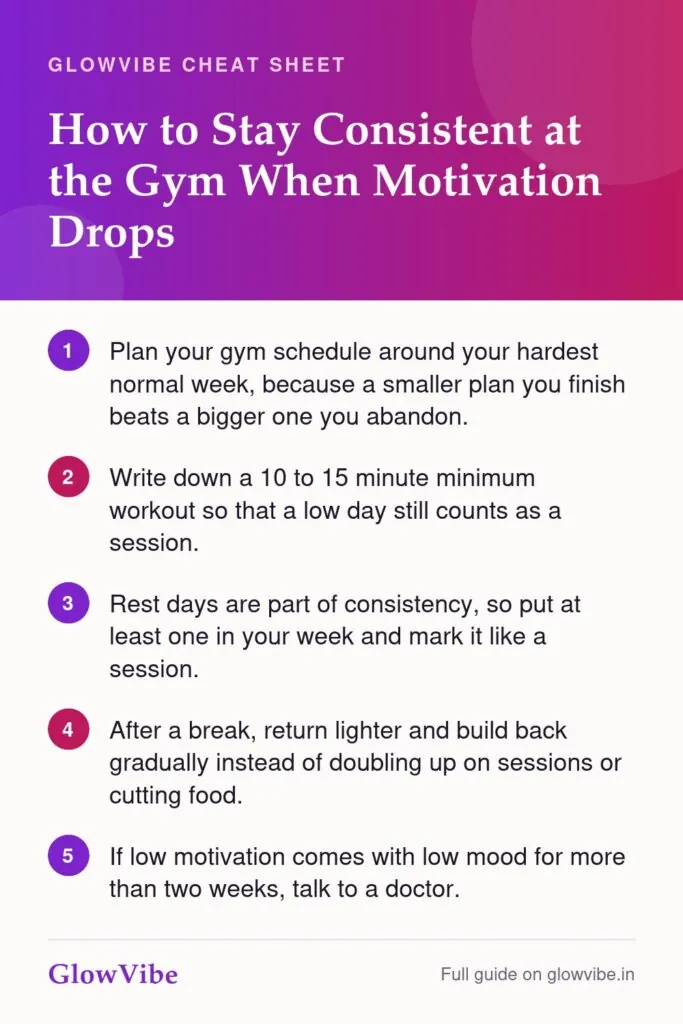
To stay consistent at the gym, stop relying on motivation and plan for the days it won’t turn up. Pick a schedule you can keep during a bad week, set a very short fallback workout, and restart gently after a break instead of trying to make up for it.
Consistency doesn’t mean never missing a session. It means that a missed session, or even a missed month, doesn’t end the routine. This guide covers how to keep going after the first keen weeks. If you still need a plan to stick to, start with how to build a fitness routine and come back.
The quick answer
- Plan for your worst normal week, not your best one. Three sessions you actually do beat six you keep skipping.
- Write down a minimum workout of 10 to 15 minutes for days when the full session won’t happen.
- Attach the gym to something fixed, such as waking up or finishing a shift, and pack your bag the night before.
- Count rest days as part of the plan, because they are what let you keep training.
- Come back lighter after a break and never try to double up on missed sessions.
Why motivation drops after the first few weeks
The first weeks run on novelty. Then that wears off, work gets busy, and the effort stays the same while progress starts to feel slower.
None of this is a character flaw. Motivation rises and falls for almost everyone, so a routine that needs it every day will eventually break. The aim is a setup that still works on a day when you feel flat.
How long a habit may take
A much-quoted study on this was published in the European Journal of Social Psychology in 2010. It asked 96 volunteers to repeat a chosen eating, drinking or activity behaviour daily in the same setting for 12 weeks. The researchers’ model fitted 39 of them well. The time for a behaviour to become close to its most automatic ranged from 18 to 254 days, and anything past the 84 days of the study was a projection.
The figure you will see quoted is 66 days, which is the median estimate and not a rule. Missing one chance to do the behaviour didn’t materially affect the process, and people who performed it more consistently fitted the model better. Two of the authors later wrote that simple actions, such as drinking water, peaked sooner than more elaborate ones, such as doing 50 sit-ups.
This was one small study of daily actions, not gym programmes, so 66 days is not a deadline. The useful message is modest: a routine can still feel like effort after a month or two.
Step 1: Choose a schedule that survives a bad week
Look at your last four weeks rather than your most enthusiastic plans. Count how many days you could really have reached the gym, including the weeks with deadlines, guests and bad sleep, and plan for that number. The table below is a rule of thumb rather than a study finding, so adjust it to your life.
| Your usual week | Gym days to plan (rule of thumb) | What to do on other days |
|---|---|---|
| Long commute, long hours or young children at home | 2 to 3 | A walk or a short home session if you have the energy |
| Regular office hours with some free evenings | 3 to 4 | Easy walking, plus at least one full rest day |
| Flexible hours and a year or more of steady training | 4 to 6 | Rest and light movement, with one lighter week whenever you feel run down |
For a general target, the NHS suggests 150 minutes of moderate activity or 75 minutes of vigorous activity a week, with strength exercises on at least 2 days. Brisk walks and home sessions count towards that too.
A 6-day gym split is a good option once four days feel easy, but it’s a hard place to begin, because one busy week can knock out half the plan. If you want a gentler structure with rest built in, this beginner weekly gym schedule for women shows how training and recovery days can sit together.
Step 2: Write down a minimum workout
A minimum workout is the smallest session that still counts. It removes the all-or-nothing thinking that turns “only 20 minutes today” into no gym at all. The WHO says any amount of physical activity is better than none, and a short session also keeps the routine of showing up alive.

Decide on three versions in advance and write them in your phone, so you never have to design a workout while tired.
| Version | Time | What it looks like |
|---|---|---|
| Full | 45 to 60 minutes | Your normal session as written |
| Short | 25 to 30 minutes | Warm up, then your main 3 exercises for 2 sets each |
| Minimum | 10 to 15 minutes | 5 minutes of walking, then 2 sets each of one leg, one push and one pull exercise |
Use one simple rule: on a low day, go and do the minimum. If you feel better once you’ve started, carry on. If you don’t, leave without guilt, because you’ve done what you planned.
If you can’t reach the gym at all, the same idea works at home. Keep this 30-minute full-body home workout saved, and cut it down if you have less time.
Step 3: Make going easier than skipping
Small bits of friction cause many skipped sessions: a missing towel, no clean T-shirt, not knowing what to do when you arrive.
- Use a fixed cue. Right after the school drop-off, or straight from the office before going home, works better than “sometime in the evening”.
- Pack the night before. Keep shoes, a towel, a bottle and a spare T-shirt in one bag by the door or in the car.
- Prepare if-then plans. If the meeting runs late, you do the short version. If it’s pouring, you do the home session. Decide these in advance.
- Track attendance first. Tick each session on a calendar. Weight and looks change slowly, while a tick is in your control.
- Go with someone if it helps. A friend expecting you at 7 am is harder to cancel on than an alarm.
- Eat before you feel drained. Evening sessions are often lost at 5 pm, when lunch is long gone. A banana or a small snack can help, and this guide to Indian pre and post-workout meals has more ideas.
Step 4: Count rest as part of consistency
A rest day isn’t a lapse. Muscles need time to recover between hard sessions, and training without a break can leave you tired or hurt, which is a common way for routines to end. Put at least one full rest day in your week and tick it on the calendar like any other session.
Take an extra easy day if your sleep has been poor for several nights, your usual weights feel unusually heavy, or you’re dreading every session. Mild muscle soreness a day or two after a workout is common, and gentle movement is usually fine. Sharp pain, joint pain or pain that doesn’t settle is different: stop that exercise and see a doctor or physiotherapist.
How to restart after a break
The risky part of any break is the return, when you pick up your old weights, feel wrecked for days and decide the gym isn’t for you. Come back a little below what you think you can do, and let the first week feel easy on purpose.
These are rules of thumb, not study findings or official guidance, so adjust them to how you feel.
| Length of break | First week back (rule of thumb) | Then |
|---|---|---|
| Up to a week | Pick up your usual plan where it fell, and don’t repeat what you missed | Carry on as normal |
| 2 to 4 weeks | About 10 to 20% lighter, with one set fewer per exercise | Build back over 1 to 2 weeks |
| 1 to 3 months | About half to two-thirds of your old weights, on 2 or 3 days | Add a little each week for around 3 to 4 weeks |
| Longer than 3 months | Treat it as a fresh start with a beginner plan | Add days only once you’ve kept the new number for a month |
Don’t punish yourself with extra sessions, longer cardio or cutting food to “make up” for the gap. Your only job in week one is to get back through the door. The free workout plans include gym, home, walking and busy-day options if your old plan no longer fits.
If your break was because of illness, injury, surgery or pregnancy, or you have a medical condition, ask your doctor when and how to return.
Handling travel, work shifts and festivals
Travel
Aim for movement, not progress. Two or three rounds of squats, push-ups against a bed or wall, lunges and a plank take about 10 minutes in a hotel room, and walking around a new city counts too. Plan your first gym session for the day after you get home, while the trip still feels like a pause.

Work shifts
If your hours rotate, a fixed clock time won’t work, so tie the session to your shift instead, such as two hours after waking up, or on the way home from a day shift. Check the roster at the start of each week and pencil in your sessions then.
Protect sleep first. After a run of night shifts, it’s sensible to do the short version or take a rest day. If you find a hard workout right before bed keeps you awake, move it earlier in your waking hours.
Festivals, weddings and exams
Diwali week, a family wedding or exam season isn’t the time to chase new personal records. Drop to the short or minimum version for those days, tell yourself the date you’ll return to normal, and enjoy the food without treating the next workout as a penalty for it.
If you fast during Navratri, Ramzan or another observance, keep the sessions light and plan them around when you can eat and drink. People with diabetes or another medical condition, and anyone pregnant, should ask a doctor about exercising while fasting.
Weather
Monsoon flooding, peak-summer heat and smoggy winter mornings can all derail the trip. Keep a home version ready, carry extra water in hot, humid weather, and skip outdoor walks or runs on high-pollution days.
When low motivation is more than a rut
Sometimes the gym isn’t the real problem. The NHS lists having no motivation or interest in things as a symptom of depression, and advises seeing a GP if symptoms last most of the day, every day, for more than 2 weeks. If your energy has dropped along with your mood, or you’ve lost interest in other things you used to enjoy too, please talk to a doctor.
Ongoing tiredness can also have physical causes that a doctor can check, so it’s worth raising even if your mood seems fine. Exercise may be one helpful part of feeling better, but it doesn’t replace proper care. If you ever have thoughts of harming yourself, seek urgent help straight away.
Common mistakes
- Starting at maximum. Six days and a strict diet from day one leaves nowhere to fall back to.
- Treating one miss as a broken streak. Try “never miss twice in a row, unless it’s a planned rest” instead.
- Changing plans every two weeks. Swap one or two exercises if you’re bored, but keep the structure long enough to see it working.
Frequently Asked Questions
Go as often as you can manage in a difficult week. As a rule of thumb, that is 2 to 4 days for many beginners. Keep that number for about a month before adding another. A smaller plan you finish does more for you than a bigger one you keep abandoning.
There’s no fixed number. One often-quoted study gave a median estimate of 66 days across simple daily behaviours, with a very wide spread between people. A gym routine may take longer, so don’t judge yourself if it still takes effort after a few weeks.
If you’re simply feeling flat, try the minimum workout and see how you feel after 10 minutes. If you’re ill, in pain or badly short of sleep, rest instead. Choosing to rest for a good reason is still part of being consistent.
Go back to your next planned session, without repeating or adding anything. If your weights feel heavier than usual, reduce them a little for that week.
Yes. It won’t replace your full sessions forever, but the WHO says any amount of activity is better than none.
The bottom line
Staying consistent at the gym is less about discipline than about preparation. Choose a schedule that fits your hardest normal week, keep a short version ready, rest on purpose, and come back gently after every break. Missed sessions will happen. What counts is that the next one is easy to start.