Weightlifting Program for Athletes: Phases + Sample Plan (2026)
A phase-by-phase weightlifting program for athletes, with the key lifts, a sample weekly plan, in-season tips and Indian nutrition and recovery advice.

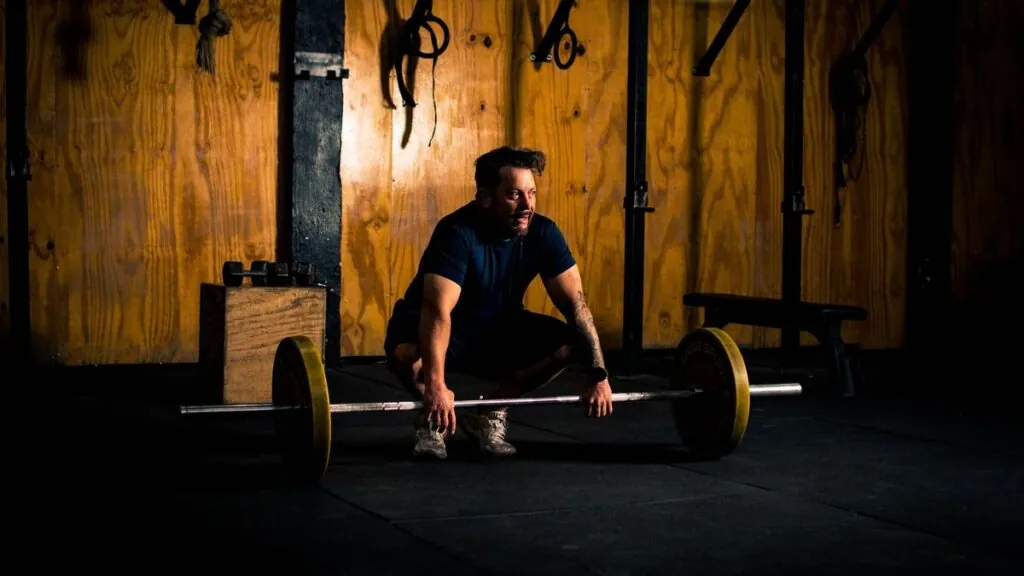
A good weightlifting program for athletes builds strength and power that carry over to the field, while keeping you fresh enough to practise your sport. In practice that means two to four focused gym sessions a week, built around a handful of big lifts, organised in phases that peak before your competition season.
This guide gives you the principles, a phase-by-phase plan, sample weekly sessions for off-season and in-season, and the recovery and nutrition habits that make it work. It suits cricketers, footballers, kabaddi players, sprinters, badminton players and anyone else who lifts to play better, not just to look bigger.
The plan at a glance
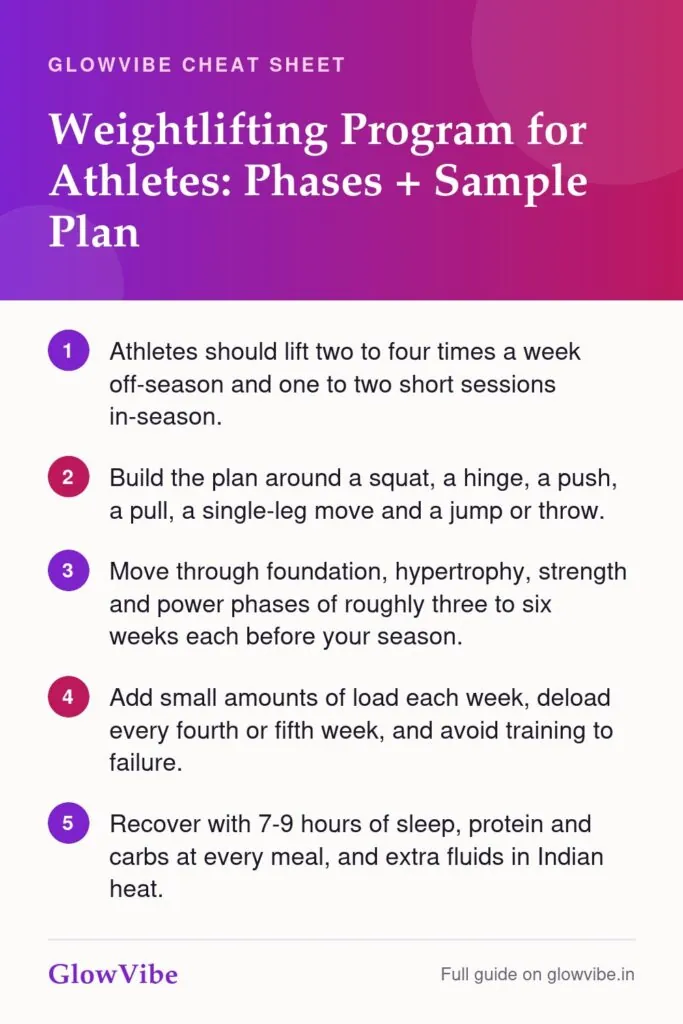
- Frequency: 3–4 sessions a week in the off-season, 1–2 short sessions a week in-season.
- Core lifts: a squat, a hinge (deadlift or Romanian deadlift), a push, a pull, a single-leg move and a jump or throw.
- Phases: foundation, then hypertrophy, then strength, then power, each lasting roughly 3–6 weeks.
- Progression: add a little load or a rep each week, then ease off every fourth or fifth week.
- Recovery: 7–9 hours of sleep, enough protein and carbs, and lifting placed so it does not wreck your practice.
Why athletes should lift differently from bodybuilders
A bodybuilder trains to change how muscles look. An athlete trains to change how the body performs: how fast you accelerate, how hard you hit or throw, how well you change direction and how much load your joints can tolerate across a long season. Muscle size helps, but only as a means to that end.
That changes the rules. You favour compound, multi-joint lifts over isolation work, you care about bar speed and quality of reps rather than chasing a pump, and you never train to the point where you cannot run properly the next day. The gym serves the sport, not the other way round.
The main benefits of strength training for athletes are well established: more force production, better sprint and jump performance, stronger tendons and connective tissue, and fewer of the soft-tissue niggles that come from muscles being too weak for the demands of the game.
Before you start: set goals and check readiness
Start by asking what your sport actually demands. A fast bowler needs a robust trunk, strong legs and resilient shoulders. A footballer needs acceleration, hamstring strength and repeat-sprint ability. A wrestler or kabaddi player needs whole-body strength and grip. Write down two or three performance goals, such as “faster first 10 metres” or “stronger in contact”, and build the plan around them.
Next, be honest about your training age. Someone new to the barbell should spend more time in the foundation phase, learning to squat, hinge and brace well before loading heavily. Note any past injuries, pain during certain movements or mobility limits, such as stiff ankles or hips.
If you have a current injury, persistent pain, a heart condition or any medical concern, get cleared by a doctor or sports physiotherapist first. Young athletes can lift safely with proper coaching, but they should be supervised and progress conservatively, with technique taking priority over the number on the bar.
The four phases of an athlete’s strength program
Most well-designed athletic programs move from general to specific as the season approaches. This is often called periodisation. The table below shows a simple version you can adapt to your own calendar.
| Phase | Typical length | Main goal | Sets x reps (main lifts) | Effort |
|---|---|---|---|---|
| 1. Foundation | 3–4 weeks | Technique, mobility, fixing imbalances | 2–3 x 10–12 | Moderate; 3–4 reps left in the tank |
| 2. Hypertrophy | 4–6 weeks | Build muscle and work capacity | 3–4 x 8–12 | Moderately hard; 2–3 reps in reserve |
| 3. Strength | 4–6 weeks | Increase maximal force | 3–5 x 3–6 | Hard but crisp; 1–2 reps in reserve |
| 4. Power | 3–4 weeks | Turn strength into speed | 3–5 x 2–5, fast | Light to moderate loads, maximum intent |
| In-season | Whole season | Maintain strength and power | 2–3 x 3–5 | Short sessions, low fatigue |
Phase 1: Foundation
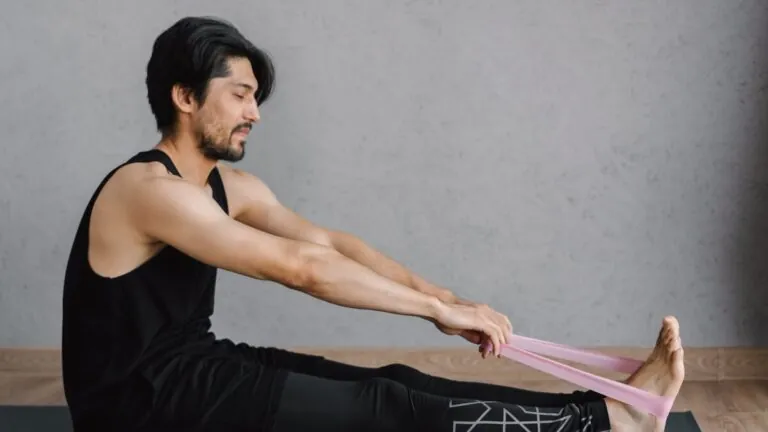
This phase is about moving well. Use goblet squats, Romanian deadlifts with light weight, push-ups, rows, split squats, planks and carries. Add mobility work for the ankles, hips and upper back, and train both sides of the body evenly so one leg or shoulder does not dominate.
Phase 2: Hypertrophy
Now you build muscle and the ability to handle more training. Volume goes up with moderate reps on the main lifts plus accessory work for the hamstrings, glutes, upper back and core. This phase usually sits early in the off-season, when there is time to recover from sore muscles.
Phase 3: Strength
Loads get heavier and reps drop. Rest two to three minutes between heavy sets so each one is high quality. Accessory volume comes down slightly so the main lifts get your best effort. Stop sets when your form starts to break, not when you physically cannot move the bar.
Phase 4: Power
In the weeks before competition, you convert strength into speed. Pair a heavy lift with an explosive move, such as squats followed by box jumps, or bench press followed by medicine ball chest passes. Keep reps low, rest fully and move every rep as fast as you can with good control.
Essential exercises for athletes
You do not need dozens of exercises. Pick one or two from each movement pattern and get genuinely good at them. Variations exist so you can match a lift to your experience, mobility and sport.
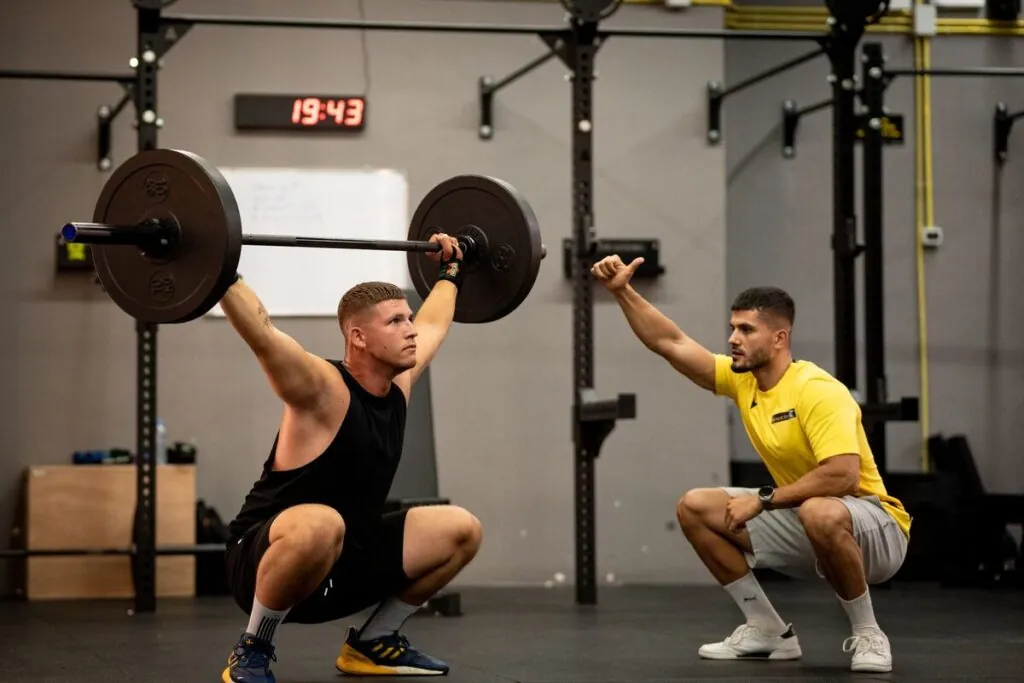
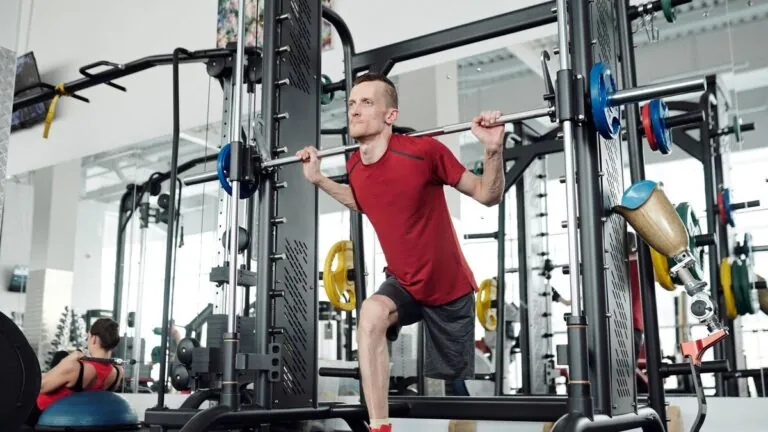
- Squat: back squat, front squat, goblet squat or safety-bar squat for leg strength and acceleration.
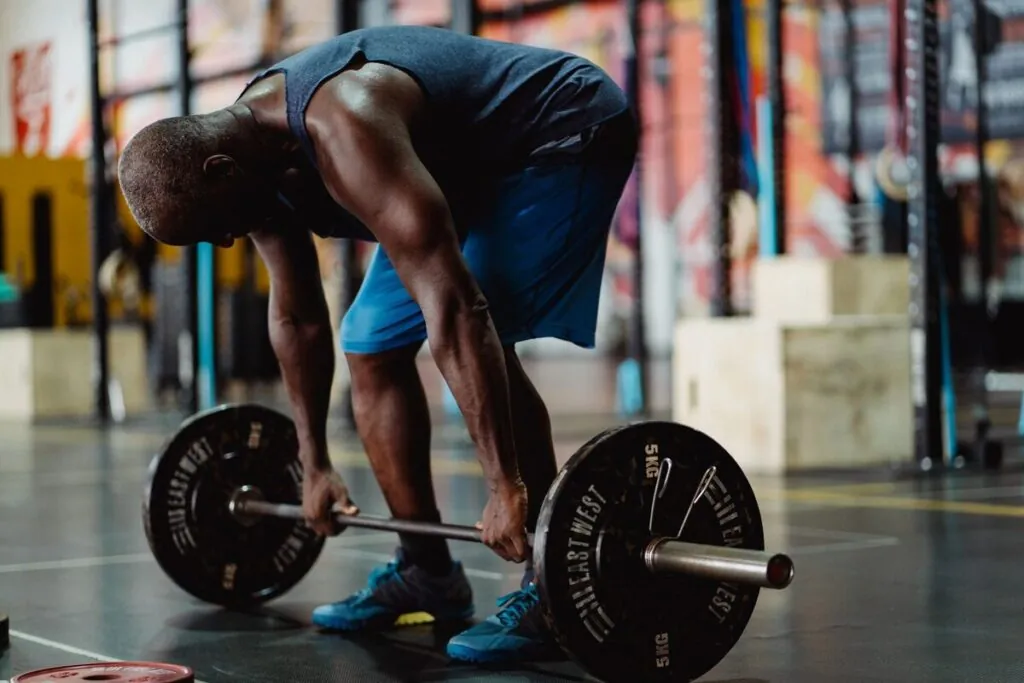
- Hinge: trap-bar deadlift, conventional deadlift or Romanian deadlift for the posterior chain and sprint speed.
- Single-leg: Bulgarian split squats, step-ups, reverse lunges and single-leg Romanian deadlifts, since most sport happens on one leg.
- Push: bench press, landmine press, push-ups or dumbbell overhead press.
- Pull: pull-ups, chin-ups, barbell or dumbbell rows to balance all the pressing and protect the shoulders.
- Power: box jumps, broad jumps, medicine ball throws, kettlebell swings and, with coaching, hang cleans or high pulls.
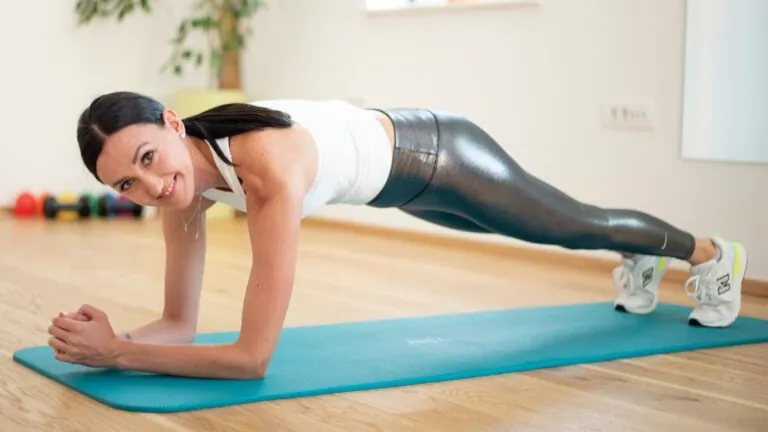
- Trunk and carries: planks, side planks, Pallof presses, dead bugs and farmer’s carries.
- Injury-resilience extras: Nordic hamstring curls, Copenhagen planks for the groin, calf raises and rotator cuff work.
If you want to dig into specific areas, our guides to back exercises at the gym and VMO strengthening exercises for knee support cover technique in more detail. Sport-specific drills, like change-of-direction work, belong on the field with your coach, but functional training can bridge the gap between gym and game.
Sample weekly weightlifting program for athletes
Here is a three-day off-season template. Warm up for 10 minutes first with light cardio, mobility drills and a few ramp-up sets. Adjust sets and reps to whichever phase you are in, using the table above.
Day 1: Lower body strength
- Box jumps: 3 x 3
- Back squat or front squat: 4 x 5
- Romanian deadlift: 3 x 6–8
- Bulgarian split squat: 3 x 8 each leg
- Copenhagen plank: 3 x 20–30 seconds each side
Day 2: Upper body strength
- Medicine ball chest pass: 3 x 5
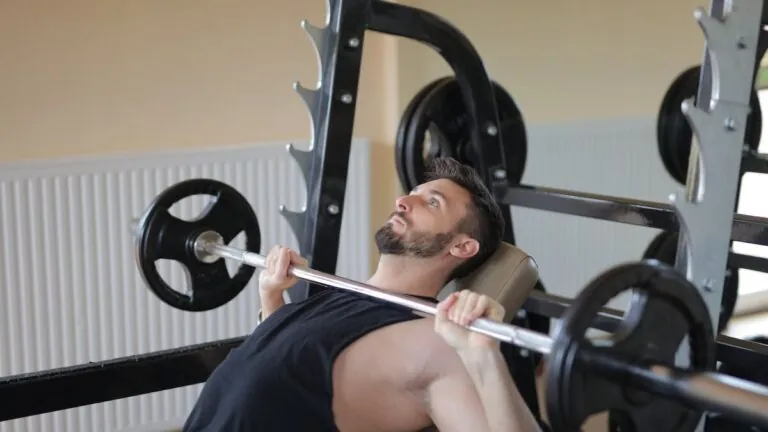
- Bench press or landmine press: 4 x 5
- Weighted or assisted pull-ups: 4 x 5–8
- Single-arm dumbbell row: 3 x 8–10 each side
- Pallof press: 3 x 10 each side
Day 3: Total-body power
- Broad jumps: 4 x 3
- Trap-bar deadlift: 4 x 3–5, moved fast
- Kettlebell swings: 3 x 10
- Reverse lunges: 3 x 6 each leg
- Nordic hamstring curl: 3 x 4–6
- Farmer’s carry: 3 x 30 metres
If you prefer four days a week, an upper/lower split repeated twice works well, or you can adapt a push pull legs routine by adding jumps and single-leg work. In-season, cut down to one or two 30–40 minute sessions: a jump, two main lifts at moderately heavy weight for low reps, and one or two injury-resilience exercises. Lift at least 48 hours before a match where possible.
How to progress and track your training
Keep a simple log of the weight, sets and reps for each main lift. Each week, try to add a small amount of load, such as 2.5 kg on a squat, or one extra rep per set. When you can no longer progress with good form, it is time to move to the next phase or change the variation.
Every fourth or fifth week, take a lighter “deload” week with about a third to half less volume. Also track performance markers that matter for your sport, such as a standing broad jump, a 10 or 20 metre sprint time, or a vertical jump. If those improve while your lifts go up, the program is doing its job.
Watch for signs that you need to back off: performance dropping for more than a week, persistent heavy legs, poor sleep, low mood, frequent colds or joint pain that lingers. Reduce volume first, and check in with your coach or physio if things do not improve.
Recovery and nutrition for athletes in India
Strength is built during recovery, not during the session. Aim for 7–9 hours of sleep, keep at least one full rest day a week, and use light activity such as walking, easy cycling or mobility work on off days. Schedule hard gym sessions and hard practice sessions on the same day where possible, so your easy days stay genuinely easy.
For food, build every meal around a protein source and a carb source. Indian options include eggs, chicken, fish, paneer, curd, dal, rajma, chana, soya chunks and milk, paired with rice, roti, poha, oats or potatoes. Our guide to protein-rich Indian foods lists veg and non-veg options that are just as useful for athletes who want to fuel and recover.
- Before training (1–3 hours): a balanced meal with carbs and some protein, like curd rice, a paneer roti roll or banana with peanut butter on toast.
- After training: protein plus carbs within a couple of hours, such as eggs with roti, dal-chawal or a glass of milk with fruit.
- Hydration: in Indian heat and humidity you sweat heavily, so drink water through the day and consider adding salt or an electrolyte drink, nimbu pani or coconut water on long or very hot sessions.
Supplements are optional. A protein powder can be a convenient top-up if you struggle to eat enough, and our explainer on natural whey protein covers how to choose one. Competitive athletes should only use batch-tested products, check anti-doping rules, and speak to a sports dietitian or doctor before adding anything new.
Common mistakes athletes make in the gym
- Copying a bodybuilding split: five days of chest, arms and shoulders leaves you sore and does little for speed.
- Training to failure all the time: grinding reps build fatigue that spills into practice and matches.
- Skipping single-leg and posterior-chain work: weak hamstrings and glutes are a common source of strains.
- Dropping lifting entirely in-season: strength gained in the off-season fades over a long season without maintenance.
- Ego lifting: adding weight before technique is solid, especially on deadlifts and Olympic lifts.
- Under-eating: hard training on too little food, sleep and water stalls progress fast.
Frequently Asked Questions
Most athletes do well with three to four sessions a week in the off-season and one to two in-season. The right number depends on how much practice and match play you already have. Quality sessions you recover from beat extra sessions that leave you flat.
No, not when it is programmed for sport. Stronger legs and hips usually improve acceleration and jumping, and gaining large amounts of muscle takes deliberate eating and high-volume training. Pairing heavy lifts with jumps and throws keeps you fast.
Change the emphasis every 3–6 weeks, moving through the phases toward your season. You do not need new exercises every week; keep the core lifts and adjust sets, reps and loads. Swap a variation when progress stalls or a movement causes discomfort.
Eat a meal with carbs and some protein one to three hours before training. Afterwards, have protein and carbs within a couple of hours to support recovery, such as dal-chawal, eggs with roti or milk and fruit. Drink enough water, especially in hot weather.
Watch for performance that keeps dropping, ongoing fatigue, poor sleep, irritability, frequent illness and aches that do not settle. If you notice several of these, cut your training volume and prioritise rest. See a doctor or sports physio if symptoms last more than a week or two.
Yes, with qualified supervision and a focus on technique. Teenagers should start with bodyweight and light loads, progress gradually and avoid maximal lifts until they have solid form. A coach who understands youth training is strongly recommended.
Not necessarily. A well-planned diet covers most needs, and supplements only fill gaps. If you compete, use batch-tested products, check anti-doping rules and consult a sports dietitian before starting anything.
Final thoughts
The best weightlifting program for athletes is simple, consistent and built around your season. Master a few big lifts, move through foundation, hypertrophy, strength and power phases, and keep lifting in-season to hold on to what you built.
Back it up with good sleep, Indian meals rich in protein and carbs, and plenty of fluids in the heat. Track a few performance numbers, listen to your body and lean on a coach or physio when something does not feel right. Do that for a full year and you will feel the difference on the field.