7 Natural Hair Dyes You Can Use at Home: Honest Guide (2026)
Henna, indigo, coffee, beetroot, sage, chamomile and lemon compared: what each natural hair dye really does on Indian hair, how to apply it and how to stay safe.

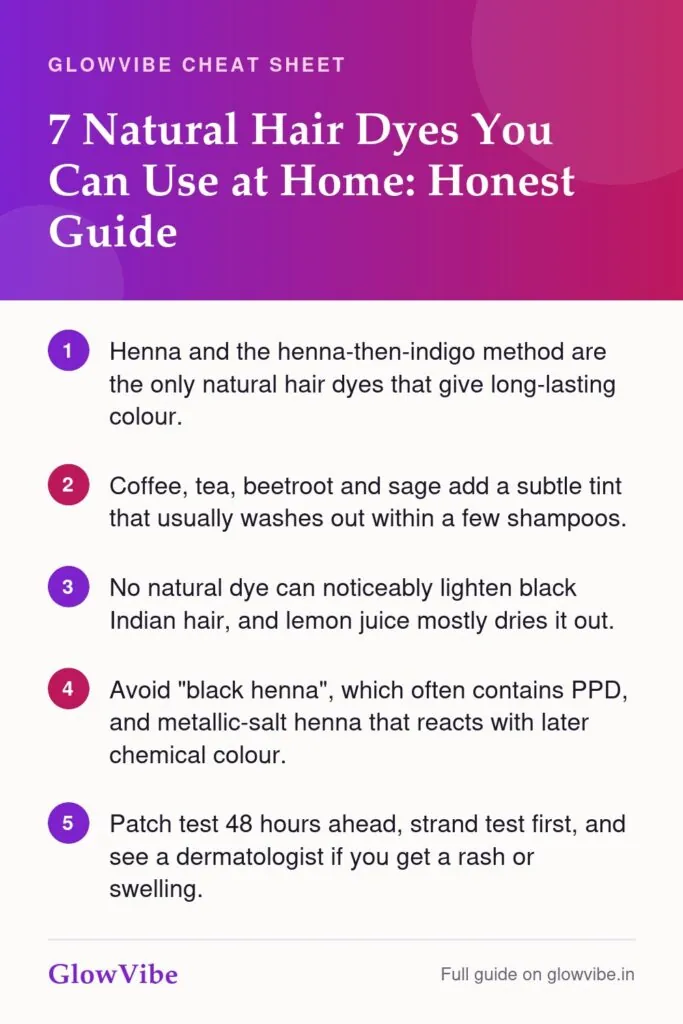
The natural hair dyes that genuinely work at home are Henna (mehendi)A plant dye that stains hair reddish-brown and coats strands for a glossy feel. Pure henna is different from "black henna", which can contain harsh dyes.See glossary for red-brown tones and henna followed by indigo for brown to black, while coffee, black tea, beetroot, sage and chamomile give softer, temporary tints. Be realistic before you start: plant dyes can’t lighten dark Indian hair the way bleach does, and apart from henna and indigo their colour washes out within a few shampoos.
Pick the right ingredient for your base colour, though, and the results can look rich and natural. Below are seven options, how to apply them, and the safety checks (including “black henna” and metallic-salt henna) that most DIY posts skip.
Natural hair dyes at a glance
- Best for grey coverage: henna followed by indigo (the two-step method)
- Best for a red or copper tint: pure henna
- Best quick brown tint on dark hair: strong coffee or black tea rinse
- Best for a burgundy flush: beetroot juice (temporary)
- Best for gradually darkening greys: sage rinse
- Best for golden shine on light hair: chamomile tea
- Use with caution: lemon juice (barely visible on dark hair and drying)
Comparison table
| Natural dye | Colour result | Works best on | How long it lasts | Grey coverage |
|---|---|---|---|---|
| Henna | Orange-red to deep copper | All hair; most visible on greys and brown hair | Semi-permanent; fades slowly and grows out | Good, but greys turn orange-red |
| Henna + indigo | Brown to soft black | Dark hair with greys | Long-lasting; indigo fades faster than henna | Very good |
| Coffee / black tea | Subtle brown, adds depth | Brown and dark hair | A few washes | Light blending only |
| Beetroot (and carrot) | Pink-red or burgundy tint | Light brown or lightened hair | 1–3 washes | Faint tint on greys |
| Sage | Gradual darkening | Dark hair with scattered greys | Builds with repeated use; washes out | Mild, cumulative |
| Chamomile | Golden glint | Blonde or light brown hair | Builds slowly | No |
| Lemon juice | Very slight lightening | Light hair only | Grows out | No |
1. Henna (mehendi)
Pure henna, from the leaves of Lawsonia inermis, is the most effective natural hair dye you can use at home. Its colour molecule, lawsone, binds to the KeratinThe protein that hair is made of. "Keratin treatments" are salon smoothing services, and some contain formaldehyde-releasing chemicals.See glossary in your hair, so the shade doesn’t rinse out. On dark hair you’ll see a reddish glow in sunlight; on greys you’ll get a bright orange-copper that deepens over two or three days.
Who it suits: anyone happy with red, copper or auburn tones, and anyone who wants long-lasting colour without synthetic dye.
How to use:
- Mix pure henna powder with warm water (or cooled black tea) into a thick, yoghurt-like paste.
- Cover and rest it for 4–8 hours so the dye releases. In hot Indian summers it’s often ready sooner, so check for a slight brownish surface layer.
- Apply to clean, dry, oil-free hair in sections, roots first. Cover with a shower cap.
- Leave on for 2–4 hours, then rinse with plain water. Wait 24–48 hours before shampooing.
Many people add a spoon of AmlaIndian gooseberry, used in Ayurvedic hair oils, powders and packs. It is valued for conditioning hair and adding shine.See glossaryRead the guide powder to soften the red, but expect only a small shift. Henna can feel drying, so condition well or oil your lengths the day after.
Pros:
- Long-lasting, builds with each application
- Coats the hair strand, so it can look thicker and glossier
- Widely available across India
Cons:
- Messy and time-consuming
- Can’t lighten hair, and you can’t easily remove it
- Can make later chemical colouring or keratin treatments unpredictable
2. Henna followed by indigo (for brown or black)
Indigo powder, from the Indigofera tinctoria plant, adds blue-black tones. On its own over greys it can look blue or greenish, which is why it’s applied on top of henna. Henna lays the red-brown base and indigo cools it towards brown or black.
Who it suits: dark-haired Indians who want to cover greys without chemical dye, and anyone who dislikes henna’s orange.
How to use the two-step method:
- Day one: apply henna as above, rinse and let it sit overnight.
- Day two: mix indigo powder with lukewarm water (a pinch of salt is a common addition) and apply it straight away, since indigo releases its dye quickly and loses strength if left standing.
- Leave on 1–2 hours, rinse with water and skip shampoo for a day or two.
For a softer brown, you can mix henna and indigo in one paste; more indigo means darker. The colour may look slightly greenish for a day before it settles.
Pros:
- The closest natural option to a black or dark brown dye
- Good grey coverage when done in two steps
Cons:
- Indigo fades faster than henna, so roots and greys may turn reddish between touch-ups
- Results vary from person to person, so do a strand test first
3. Coffee or black tea rinse
Coffee and strong black tea contain tannins and pigments that add subtle brown depth to dark hair and soften a few greys. Think of it as a tint, not a dye.

How to use: brew a strong, concentrated cup of coffee or tea (no milk or sugar) and let it cool. Pour it over clean, damp hair, or mix it into a little conditioner, and leave for 30–60 minutes under a shower cap. Rinse with cool water. Repeat over a few sessions to build colour.
Pros: cheap, gentle, uses what’s in your kitchen. Cons: the effect is mild and washes out within a few shampoos; it won’t cover lots of grey.
4. Beetroot and carrot juice
Beetroot juice gives a pink-red or burgundy flush, while carrot juice gives a warmer orange tint. On naturally black Indian hair you may only notice it in sunlight; on lighter or previously lightened hair it shows more.
How to use: mix fresh juice with a spoon of Coconut oilA common Indian hair oil that can soak into the hair shaft, which may reduce protein loss during washing. It can feel heavy on fine hair.See glossary, apply to damp hair, cover and leave for an hour or so. Rinse with cool water and skip the shampoo that day.
Pros: fun, temporary, low commitment. Cons: fades within one to three washes, stains towels and skin, and is barely visible on very dark hair.
5. Sage rinse
Sage tea is a traditional rinse for gradually darkening hair and making scattered greys less obvious. It works slowly and needs repeated use.
How to use: simmer a handful of dried sage leaves in water for about 20–30 minutes, cool and strain. Pour over clean hair, leave for 30 minutes, then rinse. Repeat once or twice a week.
Pros: gentle and easy to fit into your wash routine. Cons: subtle results, and dried sage can be hard to find locally.
6. Chamomile tea
Chamomile can bring out golden glints, but only on blonde or light brown hair. On black or dark brown hair, which most Indian readers have, you’re unlikely to see a difference.
How to use: brew a few chamomile tea bags in hot water, cool, and pour over clean hair. Leave for 30–60 minutes and rinse.
7. Lemon juice (use with caution)
Lemon juice plus sunlight is often recommended for natural highlights, but on dark Indian hair the change is usually very slight or slightly brassy. The acid and sun exposure can also leave hair dry and rough. If you try it, keep it to a diluted mix (equal parts lemon juice and water), limit sun time, and condition well afterwards. Honestly, most dark-haired readers can skip this one.
Safety first: black henna, metallic salts and patch tests
Avoid “black henna” (PPD)
Pure henna never dyes hair black on its own. Products sold as “black henna” or “instant black mehendi” often contain PPD (para-phenylenediamine), a synthetic dye that can cause severe allergic reactions, including blistering, swelling and lasting skin sensitivity. Read the ingredient list, and be wary of any “henna” that promises black or brown colour in under an hour.
Watch for compound or metallic-salt henna
Some cheaper “herbal” hair colours contain metallic salts. These can react badly with chemical colour, bleach or perms applied later, causing unpredictable colour, breakage or heat. Buy body-art-quality or clearly labelled pure henna, and tell your salon if you’ve used henna before any chemical service.
A simple home check: take a few strands of hair coloured with the product, place them in a small amount of hydrogen peroxide (the developer used with hair colour), and watch for 30 minutes. If the liquid fizzes, heats up or the hair changes texture, metallic salts are likely present.
Always patch test and strand test
- Patch testTrying a small amount of a new product behind the ear or on the inner arm for a few days to check for a reaction before using it widely.See glossary: dab a little prepared mix behind your ear or on your inner elbow and leave it for 48 hours. Any itching, redness or swelling means don’t use it.
- Strand test: colour a small hidden section first to check the shade, especially if your hair is chemically coloured, permed or keratin-treated.
If you develop a rash, swelling, oozing or burning after any dye, rinse it off immediately and see a dermatologist. Seek urgent medical care for facial swelling or difficulty breathing.
How to choose the right natural hair dye
- Black or dark brown hair, few greys: coffee, tea or sage rinses add depth; henna adds a red glow.
- Dark hair with lots of greys: the henna-then-indigo method gives the most even coverage. If you need a predictable shade, a chemical colour may suit you better; see our guides to the best hair colour for women and the best hair colour for men.
- Light brown or lightened hair: beetroot, carrot and chamomile show up best.
- Dry or frizzy hair: henna can feel drying in dry winter air, so add an oil or hair mask routine. Our list of DIY hair packs has nourishing options.
- Hard water areas: mineral build-up can make colour look dull and patchy. Wash with a clarifying shampoo a few days before dyeing, and consider a final rinse with filtered water.
- Humid summers: henna paste dries out and releases dye faster in heat, so mix smaller batches and keep hair covered while it sets.
How to apply natural hair dye at home: step by step
- Wash hair a day or two before with a mild shampoo and skip conditioner and oil so the dye can grip the strand.
- Do your patch test 48 hours ahead and a strand test on a hidden section.
- Rub petroleum jelly or oil along your hairline and ears, wear gloves and an old T-shirt.
- Section your hair into four parts and apply from roots to ends, working the mix in well, especially over greys.
- Cover with a shower cap and leave for the recommended time.
- Rinse with cool water until it runs clear. For henna and indigo, wait a day or two before shampooing.
- Follow up with oil or a deep conditioner in the next wash. For more everyday tips, see our natural hair care tips at home.
How to make natural hair colour last longer
- Wash two or three times a week, not daily, and use a Sulfate-freeShampoo made without strong sulfate cleansers like SLS. Gentler on dry, curly or colour-treated hair, though it may lather less.See glossaryRead the guide shampoo.
- Rinse with cool water rather than hot.
- Touch up roots with henna or indigo every 4–6 weeks.
Common mistakes to avoid
- Buying “black” or “instant” henna without checking for PPD.
- Expecting henna to lighten hair or produce a cool brown on its own.
- Applying henna over oily hair, which leads to patchy colour.
- Using indigo powder that was mixed hours earlier; it loses strength quickly.
- Skipping the strand test on chemically treated hair.
- Going straight to a salon bleach or chemical colour after henna without telling your colourist.
Store-bought options if DIY isn’t for you
If mixing powders sounds like too much work, look for ready products that list their ingredients clearly. Pure henna powders such as Godrej Nupur Henna are easy to find in India, and Surya Brasil Henna Cream is a henna-based ready-to-use option. Brands like Naturtint and Herbatint are ammonia-free permanent colours, but they are not purely plant-based and still contain synthetic dye ingredients, so a patch test is just as important.
Frequently Asked Questions
Henna is semi-permanent: it fades a little over weeks but largely stays until the hair grows out. Indigo fades faster, so most people touch up every 4–6 weeks. Coffee, tea, beetroot and sage rinses usually wash out within a few shampoos.
Henna covers greys well but turns them orange-copper. For brown or black coverage, apply henna first and indigo the next day. Coffee, tea and sage only soften the look of a few greys.
Pure henna is never black, so “black henna” usually contains PPD or other synthetic dyes. PPD can trigger serious allergic reactions, so avoid such products unless the ingredients are clearly listed and you have passed a patch test. If you react, see a dermatologist.
Pure henna can go over chemically coloured hair, but the result may differ from what you expect, so strand test first. The bigger risk is the other way round: chemical colour, bleach or perms over henna, especially metallic-salt henna, can give odd results or damage. Always tell your colourist about past henna use.
They work, but results are subtle. Henna adds a red sheen in sunlight, and coffee or tea add depth, but nothing natural will lighten black hair noticeably. Beetroot and chamomile barely show on very dark hair.
Pure henna doesn’t damage the hair structure, though many people find it drying. Oiling or conditioning after application helps. If you notice increased hair fall or scalp irritation, stop and consult a dermatologist or trichologist; our guide to hair loss treatment in India explains your options.
Quick poll
How often do you wash your hair?
The bottom line
Natural hair dyes give beautiful, gentle colour when your expectations match the ingredient. Henna and henna-indigo last; kitchen rinses add a soft tint that fades fast. Choose pure, clearly labelled products, avoid black henna, and patch test every time.