Curly Hair Routine for Indian Weather: Wash Day to Day 3 (2026)
A step-by-step wash-day and daily curly hair routine for wavy, curly and coily Indian hair, adjusted for humidity, hard water and winter.


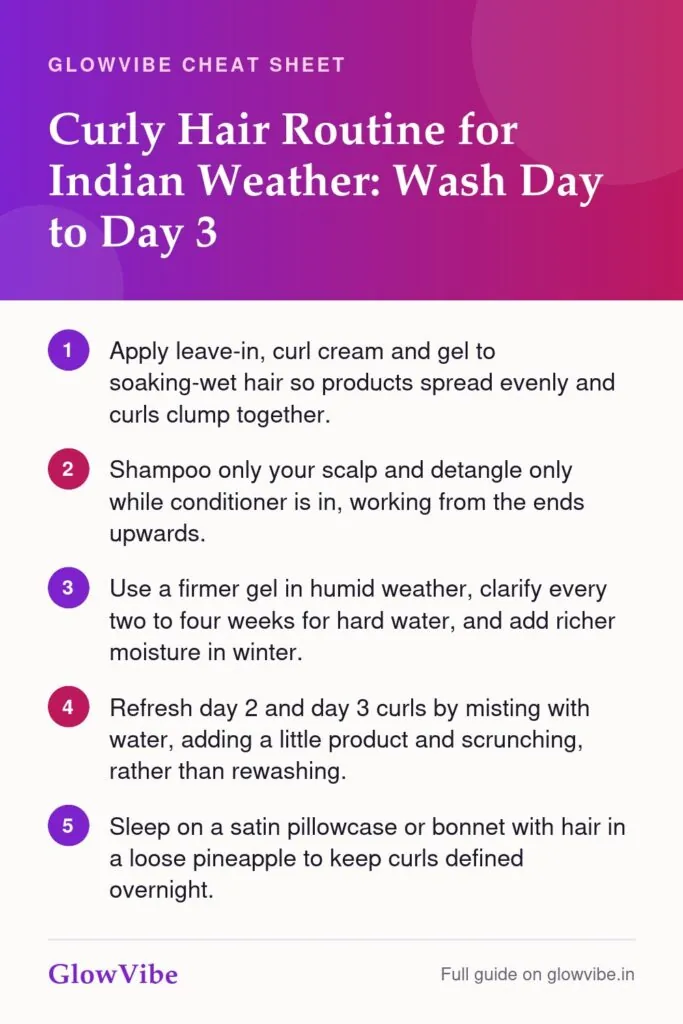
A good curly hair routine for Indian weather is simple: cleanse gently, condition generously, layer a Leave-in conditionerA light conditioner you do not rinse out. It helps with detangling, frizz and moisture, especially for curly or dry hair.See glossaryRead the guide and a curl cream or gel onto soaking-wet hair, then dry without touching. Do that two or three times a week, refresh in between, and protect your curls with satin at night, and humidity, hard water and winter dryness stop being such a fight.
This guide walks you through each step in order, with timings, so you know exactly what to do on wash day and on the days after. If you want specific product picks for every step, our roundup of the best curly hair products in India has the full list.
Your Curly Hair Routine at a Glance
- Know your hair: check your curl pattern (wavy, curly or coily) and roughly how quickly your hair absorbs water.
- Wash day (2–3 times a week): cleanse the scalp, condition and detangle, apply leave-in, add curl cream or gel, then plop or diffuse.
- Day 2–3: mist with water, add a little product where needed, scrunch and let it set.
- Every night: satin pillowcase, satin bonnet or a loose “pineapple” on top of your head.
- Every 2–4 weeks: a clarifying wash if you live with hard water or use a lot of product.
- By season: firmer gel in humid months, richer cream and a few drops of oil in winter.
Step 1: Find Your Curl Type and Porosity
Your curl type tells you how much weight your hair can carry. Hair porosityHow easily your hair absorbs and holds moisture. Low-porosity hair resists water; high-porosity hair absorbs it fast but loses it quickly.See glossaryRead the guide tells you how quickly it drinks up water and product. Together they decide how heavy or light every step of your routine should be.
Curl type in plain words
Look at a section of hair that has dried without product. Loose S-shaped bends that start below the ears are wavy (often called 2A–2C). Springy spirals or ringlets are curly (3A–3C), which is the pattern many Indian curlies have. Tight coils or zig-zags packed closely together are coily (4A–4C).
Most heads have more than one pattern. It is normal to have looser waves on top and tighter curls at the nape, so treat the type as a starting point, not a label you must match.
Porosity: a rough guide
Porosity is how open the outer layer of each strand is. Instead of the popular “glass of water” float test, which is not reliable, watch how your hair behaves in the shower and while drying.
| Porosity | How it behaves | What it usually needs |
|---|---|---|
| — | — | — |
| Low | Water beads on the surface, hair takes long to get fully wet and long to dry, products sit on top | Lighter lotions, mousse or gel, warm water to help product absorb, regular clarifying |
| Medium | Wets and dries at a normal pace, holds styles well | A balanced conditioner, light-to-medium cream and gel |
| High | Soaks up water instantly, dries very fast, frizzes easily, often from colour or heat damage | Richer conditioner, weekly mask, creamy leave-in, oil to seal the ends |
Step 2: The Wash-Day Order
Set aside 45–60 minutes for wash day, more for long or coily hair. The order matters more than the brand, because each layer is built for the one before it.

1. Optional pre-wash oil (30–60 minutes before)
If your lengths feel dry, smooth a little Coconut oilA common Indian hair oil that can soak into the hair shaft, which may reduce protein loss during washing. It can feel heavy on fine hair.See glossary, such as Parachute, through the mid-lengths and ends before you wash. This cushions the hair while you shampoo. Keep it off an oily or dandruff-prone scalp, and skip it altogether if you have fine waves that go limp easily.
2. Cleanse the scalp, not the lengths
Wet your hair thoroughly with lukewarm water. Massage a gentle shampoo into your scalp with your fingertips for about a minute, then let the lather run down the lengths as you rinse. Your scalp needs cleaning; your curls mostly need leaving alone.
3. Condition and detangle
Apply conditioner generously from ears to ends. This is the only time you should detangle: work from the ends upwards with your fingers or a wide-tooth comb while the hair is slippery. Leave it on for 3–5 minutes, then rinse with cool or room-temperature water. Many curlies leave a tiny bit in, which is fine for dry or coily hair.
4. Leave-in on soaking-wet hair
Do not towel-dry first. Water is what helps product spread and curls clump. Smooth a leave-in conditioner through your hair in sections using “praying hands”, pressing the product down each section between flat palms. Wavy hair needs only a pea-to-coin amount; thick coils may need much more.
5. Curl cream, gel or both
Now add your styler. A curl cream gives softness and definition; a gel gives hold and frizz control; layering cream first and gel on top gives both. In humid cities, the gel layer is what keeps your curls from turning into a puff by lunchtime. If you are unsure which cream suits your pattern, our guide to choosing hair creams for curly hair explains it by curl type and porosity.
Rake the product through with your fingers, then scrunch upwards towards the scalp. You should hear a slight “squish”, which means the hair is wet enough.
6. Plop or diffuse
Plopping: lay a cotton T-shirt or microfibre towel flat, flip your hair onto it, and wrap it on top of your head for 10–20 minutes. This removes extra water without roughing up the cuticle and encourages curls to form. Don’t plop for hours, as curls can flatten.
Diffusing: for faster drying, attach a diffuser to your dryer and use low heat and low speed. Cup sections of hair in the bowl, lift towards the scalp, hold for 30–60 seconds, then move on. Avoid moving the diffuser around constantly, which causes frizz. Our guide to hair styling tools for your hair type covers diffusers and other heat tools.
Or simply air-dry. Whatever you choose, keep your hands out of your hair until it is 100% dry.
7. Scrunch out the crunch
If you used gel, your curls will feel stiff once dry. That cast is good: it protected them while drying. Rub one or two drops of light oil between your palms and gently scrunch upwards until the hair feels soft.
Adjusting Your Routine for Indian Weather
Humidity (coastal cities and monsoon)
Moist air swells the hair shaft and lifts the cuticle, which shows up as frizz. Use a firmer gel, apply it on soaking-wet hair and let it dry fully before stepping outside. On sticky days, a light leave-in plus gel often works better than a heavy cream, which can attract more moisture.
Hard water (much of North India and many borewell homes)
Calcium and magnesium leave a film that makes curls dull, stiff and tangly, and stops conditioner working well. Use a clarifying shampoo every 2–4 weeks, follow it with a deep conditioner, and consider a shower filter. If your curls suddenly stop clumping even though nothing in your routine changed, build-up is usually the reason.
Winter (dry air in the north, chilly evenings everywhere)
Indoor heaters and dry winter air pull water out of hair. Add a weekly deep-conditioning mask for 10–20 minutes, switch to a creamier leave-in and seal your ends with a few drops of oil. Avoid very hot showers, however tempting, as they dry both scalp and hair. If winter also brings flakes or extra shedding, read our guide to winter hair fall and dandruff care.
Refreshing Curls on Day 2 and Day 3
Curls flatten and frizz as you sleep, but you rarely need to rewash. A five-minute refresh brings them back.

- Shake out the pineapple or remove your bonnet, then flip your head over and gently fluff the roots with your fingertips.
- Mist with water from a spray bottle until the hair is damp, not dripping. Focus on frizzy or flat sections, not the whole head.
- Add a little product: a dime-sized amount of leave-in diluted with water in your palms for softness, or a small amount of gel for hold.
- Scrunch and set: scrunch upwards, then air-dry or diffuse for a few minutes. Hands off until dry.
- Fix single curls: twist a stubborn piece around your finger with a dab of cream instead of re-wetting everything.
By day 3, many people prefer a loose braid, bun or clip-up style before washing again. If your scalp is itchy or oily before then, rinse your scalp with water, or wash early. Comfort matters more than stretching the routine.
Sleeping With Satin
Cotton pillowcases absorb moisture and create friction, which roughens curls overnight. Satin or silk lets hair glide instead.
- Satin or silk pillowcase: the easiest change. It works on its own for short curls and waves.
- Pineapple: gather your hair loosely on the very top of your head with a soft scrunchie, so you sleep on your neck, not your curls.
- Satin bonnet or scarf: best for long curls and coils. Pair it with a pineapple for the most day-2 definition.
- Never sleep on wet curls if you can help it; they set flat and frizzy and are more fragile when wet.
Common Frizz Mistakes
- Towel-rubbing: a rough terry towel lifts the cuticle. Blot or plop with cotton or microfibre instead.
- Styling on damp, not soaking-wet, hair: product goes on unevenly and curls don’t clump.
- Brushing dry curls: this breaks up curl clumps and creates a frizz cloud. Detangle only with conditioner in.
- Touching while drying: every touch before hair is fully dry breaks the cast and causes frizz.
- Skipping gel in humidity: a cream alone rarely holds through a muggy day.
- Too much product: limp, greasy or flaking curls usually mean overload. Start small and add.
- Never clarifying: with hard water and layered stylers, build-up slowly ruins definition.
- Rough hair ties: use soft scrunchies or spiral ties rather than tight elastic bands.
Before trying any new product, patch-test it on the skin behind your ear for 24–48 hours, especially before a wedding or event.
Choosing products for this routine? See the best shampoo for curly hair, the best conditioner for curly hair and curl cream vs gel vs mousse.
Frequently Asked Questions
Most wavy and curly hair does well with two to three washes a week, and coily hair often prefers one or two. Wash more often if you sweat a lot or have an oily scalp, and rinse with water or a conditioner wash between shampoos.
Yes. The basic ideas, which are gentle cleansing, lots of conditioner, styling on wet hair and avoiding rough towels and brushes, suit Indian curls well. You don’t need to follow strict ingredient rules; with hard water, an occasional clarifying wash is actually helpful.
No. Daily oiling usually weighs curls down and can make an oily scalp worse. Use oil as a pre-wash treatment or a few drops on dry ends after styling, and keep it light if you have waves or low-porosity hair.
The usual causes are styling on damp rather than soaking-wet hair, touching hair while it dries, skipping gel in humid weather or product build-up from hard water. Fix one thing at a time over three or four washes so you can see what actually helps.
Yes, if you keep it on low heat and low speed and use a Heat protectantA spray, cream or serum applied before blow-drying, straightening or curling to reduce heat damage to the hair.See glossary or a leave-in first. Air-drying is gentler, so alternate if your hair feels dry. If your hair stays dry and brittle despite care, cut back on heat altogether.
It does. Men with short curls can usually shorten it to shampoo, conditioner and one styler, such as a small amount of curl cream or gel, applied to wet hair. Our guide to curly hairstyles for boys has easy cuts that work with natural texture.
Quick poll
How often do you wash your hair?
The Bottom Line
The best curly hair routine is the one you can repeat: gentle cleansing, plenty of conditioner, product on soaking-wet hair, hands off while it dries, and satin at night. Adjust the weight for your curl type and porosity, and adjust the hold for the weather. If you notice sudden heavy shedding, bald patches or a sore, flaky scalp, see a dermatologist rather than changing products.
Give any change three to four wash days before judging it. Once your routine is settled, browse our list of the top curly hair products available in India to fine-tune each step.