Traditional Indian Hairstyles: 8 Regional Looks, Step by Step (2026)
Learn 8 traditional Indian hairstyles, from the Punjabi choti and South Indian jada to the Maharashtrian khopa and Bengali bridal bun, with simple how-to steps.

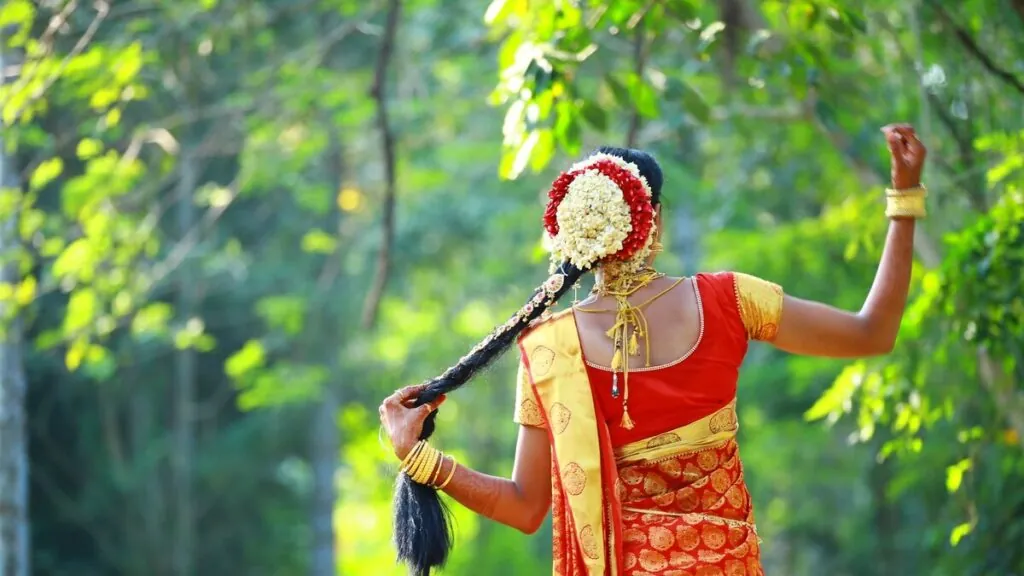
The most loved traditional Indian hairstyles are the long choti with a paranda, the South Indian jada, the jasmine kondai bun, the Maharashtrian khopa, the Bengali bridal bun and the Assamese Bihu khopa. Each one comes from a region, a festival or a wedding ritual, and almost all of them can be done at home with pins, a comb and a little practice.
This guide covers what each style looks like, which hair length it needs and how to do it step by step. If you want quick, modern looks to wear with a saree or lehenga, our guide to easy saree hairstyles for Diwali and weddings covers messy buns, waves and half-up styles. Here, we stick to the regional classics.
Traditional Indian hairstyles at a glance
- Choti with paranda (Punjab and North India)
- Jada or poola jada (Tamil Nadu, Andhra Pradesh, Telangana)
- Kondai bun (Tamil Nadu and Karnataka)
- Kerala braid with mulla poo (Kerala)
- Khopa or ambada (Maharashtra)
- Bengali bridal bun (West Bengal)
- Bihu khopa (Assam)
- Rajasthani centre-parted bun with borla (Rajasthan)
Comparison table: which traditional hairstyle suits you
| Hairstyle | Region | Hair length needed | Best occasion | Difficulty |
|---|---|---|---|---|
| Choti with paranda | Punjab, North India | Shoulder length and longer (paranda adds length) | Lohri, Baisakhi, Henna (mehendi)A plant dye that stains hair reddish-brown and coats strands for a glossy feel. Pure henna is different from "black henna", which can contain harsh dyes.See glossaryRead the guide, sangeet | Easy |
| Jada / poola jada | Tamil Nadu, Andhra, Telangana | Mid-back or an extension | Wedding, seemantham, Varalakshmi Vratham | Medium to hard |
| Kondai bun | Tamil Nadu, Karnataka | Shoulder length and longer | Wedding, temple visits, Pongal | Medium |
| Kerala braid with mulla poo | Kerala | Shoulder length and longer | Onam, Vishu, weddings | Easy |
| Khopa / ambada | Maharashtra | Shoulder length and longer | Gudi Padwa, Ganeshotsav, weddings | Easy to medium |
| Bengali bridal bun | West Bengal | Shoulder length (a bun donut helps) | Wedding, Durga Puja | Medium |
| Bihu khopa | Assam | Shoulder length and longer | Bohag Bihu | Easy |
| Rajasthani bun with borla | Rajasthan | Shoulder length and longer | Teej, Gangaur, weddings | Easy |
Before you start: prep and tools
Traditional styles hold best on hair washed a day earlier, not freshly washed. If you oil your hair, do it two nights before and wash it out; heavy oil on the day makes a bun look flat and stains silk.
Keep these within reach:
- A tail comb for clean partings and a wide-tooth comb for detangling.
- Bobby pins and U-pins in a shade close to your hair colour.
- Soft elastics, a bun donut or a hair extension (choti) if your hair is short or thin.
- A light hairspray or a little hair gel for flyaways, especially in humid weather.
- Fresh flowers (jasmine, mogra, roses, kopou phool) and your hair jewellery.
1. Choti with paranda (Punjabi braid)
The choti is the simplest traditional Indian hairstyle and still one of the prettiest. In Punjab it is finished with a paranda, a black thread extension with colourful silk tassels that swings as you move.
- Detangle and make a centre parting. Smooth the front with a drop of serum.
- Gather all your hair at the nape and split it into three equal sections.
- Braid two or three crosses, then lay the paranda’s three threads over your three sections.
- Braid hair and thread together right to the end, keeping tension even.
- Tie off with the paranda’s own loop or a small elastic so the tassels hang free.
Tip: braid loosely near the scalp. A choti that is pulled tight at the roots gives headaches and strains the hairline over a long day.
2. South Indian jada (poola jada)
The jada is the signature South Indian bridal braid. In a poola jada the whole braid is covered with a woven panel of jasmine, kanakambaram or roses. In other versions, gold or kemp jada billai ornaments run down its length, topped with a rakodi (round ornament) at the crown and ending in kuppulu tassels.
- Make a centre parting and smooth the front two sections back. Pin them flat behind the ears.
- If your hair is shorter than mid-back, clip a matching choti extension at the crown first.
- Braid a firm, even three-strand braid all the way down. A flat, wide braid gives the jewellery a better base.
- Place the rakodi or a flower ring at the crown and secure it with U-pins.
- Lay the flower jada or jada billai along the braid and stitch or pin it at intervals of a few inches. Finish with the tassels.
A full poola jada is heavy. Ask your florist for a light base, and anchor it to the braid in several places so the weight is shared.
3. Kondai bun with jasmine
Kondai means bun in Tamil, and the classic version is a round, polished bun set slightly higher than a nape bun, then wrapped in rows of jasmine. Brides add a nethi chutti and temple jewellery; for temple visits a string of malli is enough.
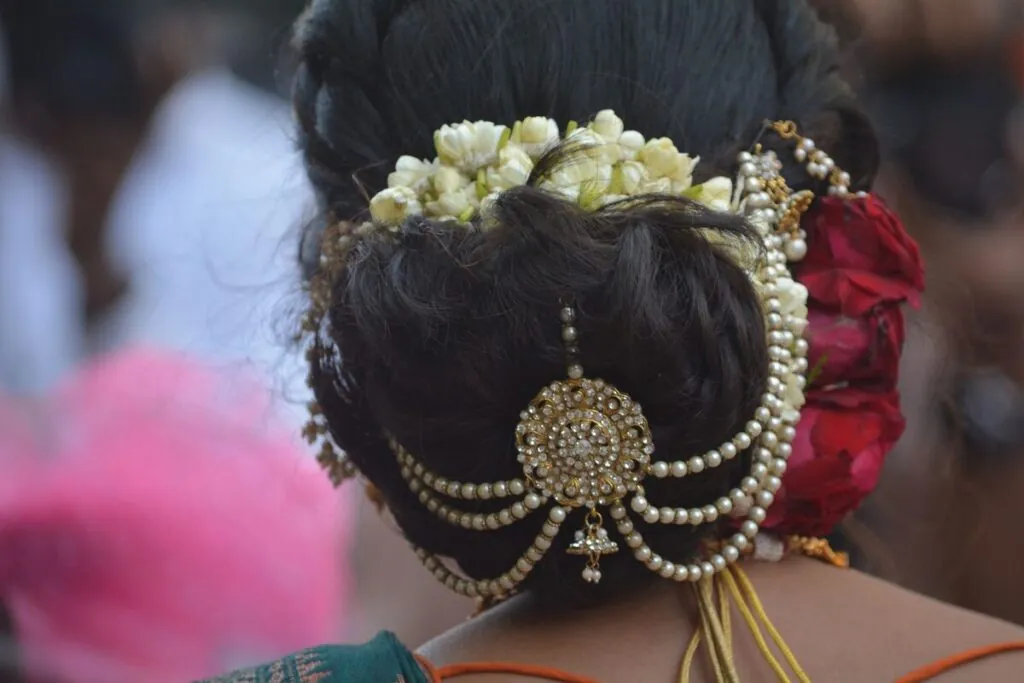
- Comb hair back from a centre parting and tie a smooth ponytail at the back of the head, between the crown and the nape.
- Slip a bun donut over the ponytail if you want a fuller shape.
- Spread the hair over the donut, wrap the ends around the base and pin with U-pins pushed in towards the centre.
- Wind two or three jasmine strings around the bun, pinning each end underneath.
4. Kerala braid with mulla poo
Kerala’s look is softer and less structured. For Onam and Vishu, many women wear their hair in a loose braid or half-up with a long strand of mulla poo (jasmine), paired with the cream-and-gold kasavu saree.
- Take two small sections from the front, twist them back and pin them together at the back of the head.
- Leave the rest open, or braid it loosely from just below the pinned section.
- Pin one end of the jasmine string where the twists meet and let it fall along the braid or down the open hair.
5. Maharashtrian khopa (ambada)
The khopa, also called ambada, is a neat, rounded bun at the nape that pairs with the nauvari saree and nath. It is finished with a veni (a semicircle of mogra or aboli flowers) around the bun and often an ornamental khopa pin or a small flower cluster on top.
- Comb hair straight back or from a centre parting. Keep the front sleek with a little gel.
- Tie a low ponytail at the nape and braid it into a three-strand braid.
- Coil the braid around the base of the ponytail into a flat, round bun. Pin all around the edge.
- Wrap the veni around the outer edge of the bun and pin it at both ends.
- Push the khopa pin or jewelled ornament into the centre at an angle.
6. Bengali bridal bun
The Bengali bride wears a large, low bun that sits at the nape, with the sindoor parting and the shola or tinsel mukut framing the face. The bun is usually decorated with white flowers such as rajanigandha or jasmine and gold pins.
- Make a deep centre parting; this is where the sindoor and tikli sit.
- Gently backcomb the crown for a little height, then smooth the top layer over it.
- Tie a low ponytail and build a wide bun over a large donut. The bun should be broad rather than tall.
- Wrap white flower strings around it in rings, then add gold pins or a decorative kanta.
7. Assamese Bihu khopa with kopou phool
For Bohag Bihu in April, Assamese women wear a simple bun or khopa tucked with kopou phool, the foxtail orchid that blooms in that season. Paired with the mekhela chador, it is light enough for dancing.
- Comb hair back and twist it into a mid-height or low bun. Pin it securely, as you will be moving a lot.
- Tuck one or two kopou phool sprays into the side of the bun so they hang towards the shoulder.
8. Rajasthani centre-parted bun with borla
In Rajasthan, the hair is often less visible than the jewellery. A sleek centre parting holds the borla, a bell-shaped ornament that sits on the forehead, while the hair is braided and coiled into a low bun under the odhni. It is a good choice for Teej and Gangaur because it stays neat under a heavy dupatta.
- Make a sharp centre parting. Fix the borla’s string or chain to a small section at the crown with a pin.
- Smooth both sides back over the ears and braid all the hair at the nape.
- Coil the braid into a low, flat bun so the odhni drapes smoothly over it.
How to pin a gajra or veni so it stays
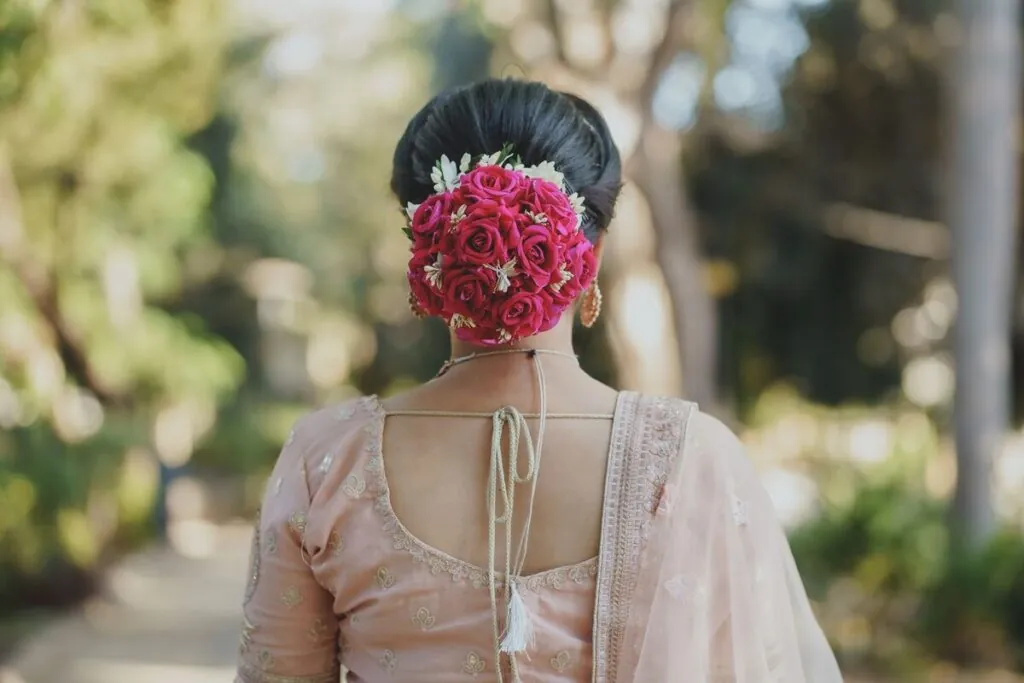
Flowers are what make a hairstyle feel traditional, and the gajra is used in almost every region. The trick is to anchor it to the hair underneath, not to the surface of the bun.
- Buy flowers the same morning and keep them wrapped in a damp cloth in the fridge until you dress.
- Pin one end of the gajra under the bun, pushing the pin into the base of the ponytail.
- Wrap or drape it, then pin the other end the same way. Add a crossed pair of bobby pins in the middle for long strings.
- For roses or single blooms, trim the stem short, wrap it with a pin and slide it into the bun at an angle.
How to choose a traditional hairstyle
By hair length and type
- Long, thick hair: anything works. A jada or choti shows off length best.
- Shoulder-length hair: khopa, kondai and Bengali buns over a donut, or a jada with a clip-in extension.
- Thin or fine hair: gently backcomb the crown and use a donut or extension. Braids look fuller if you pull the loops slightly wider after braiding.
- Curly or wavy hair: curls grip pins well, so buns hold easily. Use a curl cream instead of straightening; our guide to hair creams for curly hair explains how to apply one.
By weather and occasion
In humid weather, such as a Chennai or Kolkata wedding, choose a bun or braid over open hair, since frizz shows less in a tight shape. Under a heavy dupatta or odhni, go for a low, flat bun. For functions with dancing, a braid needs fewer touch-ups.
Match your hair to your face and outfit too. If you are planning the whole look, our wedding guest makeup guide pairs well with these styles.
Caring for your hair before and after
Traditional bridal styles can mean heavy jewellery, many pins and a tight pull for eight hours or more. Once in a while this is fine, but repeated tight styles can cause traction hair loss along the hairline. Loosen the braid near the scalp, spread the weight with extra pins, and take everything out as soon as the function ends.
Detangle from the ends up and wash out hairspray the next day. A gentle oil massage a day later helps with the dryness that backcombing leaves; see our natural hair care tips at home for a simple routine. If you notice thinning patches at the temples or a sore, bumpy scalp that does not settle, see a dermatologist or trichologist.
Common mistakes to avoid
- Styling freshly washed hair: it is too slippery. Wash a day before.
- Pinning flowers on top of the bun only: they slide off. Anchor pins into the base of the ponytail.
- Hanging a heavy jada from one point: it pulls on the crown. Secure it every few inches.
- Using a mismatched extension: match colour and texture, and blend it into the braid from the top.
- Skipping a trial: practise once a week before the event, especially for bridal styles with jewellery.
Frequently Asked Questions
The best known are the choti or long braid, the South Indian jada, the jasmine kondai bun, the Maharashtrian khopa, the Bengali bridal bun and the Assamese Bihu khopa. Most of them are braids or buns finished with fresh flowers and regional hair jewellery.
A jada is a long South Indian braid decorated for weddings and ceremonies. A poola jada is covered with woven flowers, while other versions use gold or kemp jada billai ornaments along the braid with tassels at the end. Extensions are commonly used to add length.
Yes. Shoulder-length hair can be built into a khopa, kondai or Bengali bun with a bun donut, and a clip-in choti extension lets you wear a full jada or paranda braid. Very short hair can still carry a gajra pinned along a twisted half-up style.
Buy the flowers in the morning, keep them in a damp cloth in the fridge and put them on last. Avoid spraying hairspray directly on the flowers, and carry a spare string in a damp tissue if the function runs late.
Wearing them occasionally is fine, but frequent tight braids and heavy jewellery can cause traction hair loss at the hairline. Keep tension light near the scalp, spread weight with extra pins and give your hair a rest afterwards. See a dermatologist if you notice thinning patches.
Quick poll
How often do you wash your hair?
Pick your region, practise once, and wear it with pride
Traditional Indian hairstyles are easier than they look. The regional character comes mostly from the flowers and jewellery you add. Choose the style that fits your hair length and the occasion, do one trial run, and pin everything to the base, not the surface.
Getting ready for the festive season? Pair your hairstyle with our Diwali makeup looks for Indian skin for a finished look from head to toe.